Profile
Moe Berg
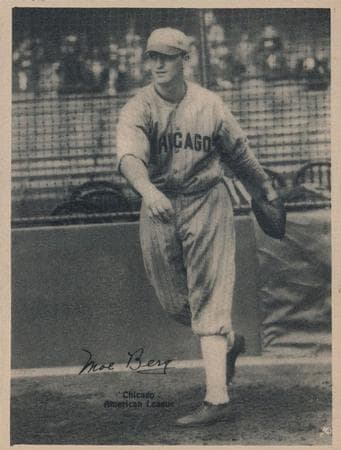
Moe Berg baseball card portrait, 1929.
Photo credit: Kashin Publications via Wikimedia Commons (Public domain)
Morris "Moe" Berg played fifteen major league seasons, hit .243, played for five teams, spoke at least a dozen languages, earned a law degree from Columbia while playing professional baseball, and spent World War II as a spy for the Office of Strategic Services, tasked with determining how close Nazi Germany was to building an atomic bomb. His baseball career was unremarkable by every conventional measure. His life was one of the most unusual in the history of American sport.
The Educated Catcher
Berg was born in Harlem to Russian Jewish immigrants and grew up in Newark, New Jersey. He graduated magna cum laude from Princeton in 1923 with a degree in modern languages, then signed with the Brooklyn Robins (later the Dodgers). He bounced to the Chicago White Sox, the Cleveland Indians, the Washington Senators, and finally the Boston Red Sox, never becoming a regular starter but lasting in the majors for fifteen years because of his defensive skill and his ability to handle pitching staffs.
He studied at the Sorbonne during the offseason and earned his law degree from Columbia in 1930, attending classes during the baseball season and completing exams between road trips. He read ten newspapers a day in multiple languages. Teammates described him as brilliant and unknowable. Casey Stengel reportedly said Berg was "the strangest man ever to play baseball," though the attribution is disputed.
Japan, 1934
In November 1934, Berg traveled to Japan as part of an American all-star barnstorming tour that included Babe Ruth, Lou Gehrig, and Jimmie Foxx. While the stars played exhibition games, Berg slipped away from the group, climbed to the roof of St. Luke's International Hospital in Tokyo, one of the tallest buildings in the city, and filmed panoramic footage of the Tokyo harbor, military installations, and industrial facilities with a Bell & Howell movie camera hidden in his kimono.
The footage was reportedly reviewed by the U.S. military during preparation for the Doolittle Raid in April 1942, the first American air strike on the Japanese home islands. Whether Berg knew at the time that his film would be used for military purposes remains unclear, but the trip marked his first known intelligence work.
The OSS and Werner Heisenberg
Berg retired from baseball after the 1939 season and joined the Office of Strategic Services in 1943. His assignment was extraordinary. He was sent to Europe to gather intelligence on the German nuclear weapons program and, specifically, to assess the progress of physicist Werner Heisenberg. Berg attended a lecture by Heisenberg in Zurich, Switzerland, in December 1944, carrying a pistol with orders to assassinate Heisenberg if his presentation indicated Germany was close to building a bomb. Berg concluded that Germany's nuclear program was not advanced enough to pose a threat and didn't fire.
Berg was awarded the Medal of Freedom in 1945. He declined it without explanation. The medal was accepted posthumously by his sister after his death.
The Enigma After the War
Berg never held a steady job after the war. He lived with his sister, carried a briefcase whose contents he never revealed, and drifted through the following decades as a sort of intellectual vagrant, showing up at baseball games, attending lectures, and living off the generosity of friends. He refused to write a memoir despite numerous offers.
He died on May 29, 1972, in Belleville, New Jersey. His last words, according to his nurse, were "How did the Mets do today?" He was a .243 hitter who spoke Sanskrit, spied on the Third Reich, and carried a loaded pistol to a physics lecture. Baseball has never produced anyone quite like him, and it is difficult to imagine how it could.