Era Overview
The Dead-Ball Era
1900–1919
Before Babe Ruth changed everything, baseball was a game of strategy, speed, and pitching dominance. The Dead-Ball Era produced some of the sport's most fascinating characters and its most enduring controversies.
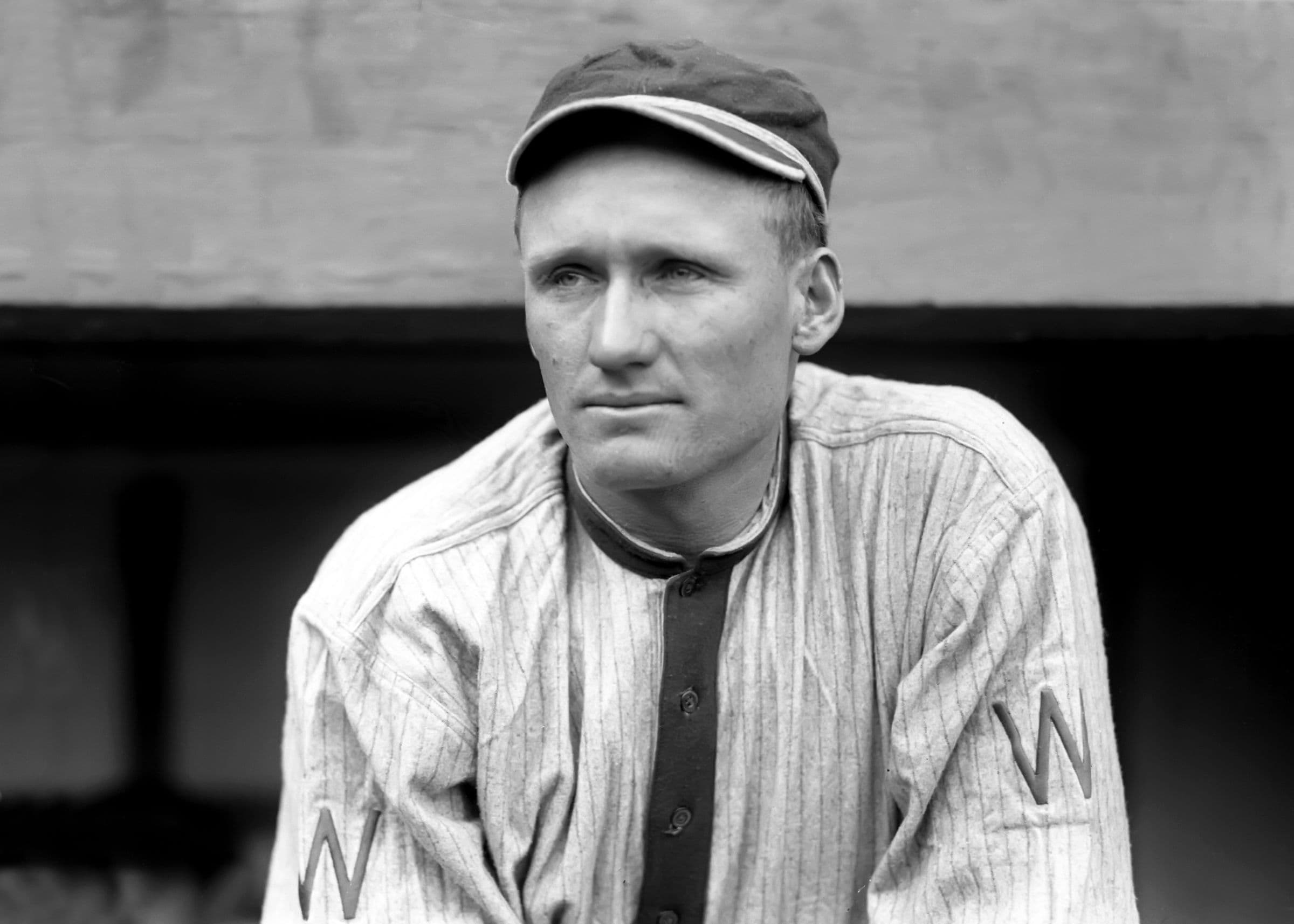
Walter Johnson, 1914. Dead-Ball command from one of the era's dominant pitchers.
Photo credit: Charles M. Conlon via Wikimedia Commons
The name tells you what defined it. The ball was dead. Or close to it. From roughly 1900 to 1919, major league baseball operated under conditions that made home runs rare, pitching dominant, and low-scoring games the norm. The reasons were physical and structural. Baseballs were used until they fell apart, growing softer and darker with each inning. Pitchers doctored balls with spit, mud, tobacco juice, and whatever else they could get away with. Ballparks were enormous by modern standards. The result was a game built on bunts, stolen bases, hit-and-run plays, and pitchers who could throw complete games without breaking a sweat.
The Ball
The baseball itself was the era's defining variable. Teams used a single ball for as long as possible, and by the late innings it was often brown, misshapen, and soft. The 1910 introduction of a cork-centered ball briefly boosted offense, but pitchers adapted. It wasn't until 1920, after Ray Chapman's death from a pitched ball he likely couldn't see, that the rules changed to require fresh, white baseballs throughout the game.
The Pitchers
This was a pitcher's paradise. The spitball was legal until 1920. So were the shine ball, the emery ball, and various other doctored deliveries. Cy Young finished his career in 1911 with 511 wins, a number that exists outside the reach of modern pitchers. Walter Johnson threw his fastball for 21 seasons and struck out 3,509 batters in an era when strikeouts were considered embarrassing for the hitter. Christy Mathewson won 373 games and threw three shutouts in the 1905 World Series.
The Players
Ty Cobb dominated the era's offensive landscape. His .366 career batting average remains the highest in history. Cobb played baseball like a contact sport, sharpening his spikes and sliding into bases with the clear intention of injuring defenders. He was brilliant, relentless, and widely despised. Honus Wagner, his National League counterpart, was nearly as talented and considerably more likable. Tris Speaker, Nap Lajoie, and Eddie Collins rounded out an era of hitters who manufactured runs rather than driving them over fences.
The black Sox
The Dead-Ball Era ended with its greatest scandal. In the 1919 World Series, eight members of the Chicago White Sox conspired with gamblers to throw the series against the Cincinnati Reds. The scheme unraveled, the players were banned for life, and the episode nearly destroyed professional baseball's credibility. It took Babe Ruth and his home runs to bring the fans back.
The Legacy
The Dead-Ball Era established baseball as America's national pastime. The game that emerged from this period, with its strategic complexity, its regional rivalries, and its mythology, created the foundation everything else was built on. The stadiums were new. The leagues had just stabilized after years of competition and consolidation. The World Series, first played in 1903, became an annual national event. Baseball entered the Dead-Ball Era as a popular sport. It left as a cultural institution.
Related Articles
Babe Ruth Changed Everything
Before Babe Ruth, baseball was a game of singles, bunts, and stolen bases. After Ruth, it was a game of home runs. He changed the economics of the sport, the strategy of the game, and the relationship between baseball and the public.
Continue Reading
The Day Babe Ruth Punched an Umpire and His Replacement Threw a No-Hitter
On June 23, 1917, Babe Ruth got ejected after one batter and hit the home plate umpire. Ernie Shore took over and retired everyone else.
Continue Reading
The Batting Helmet and the Decades Baseball Refused to Protect Its Hitters
From Roger Bresnahan's inflatable head protector to mandatory earflaps, MLB took more than seven decades to fully require basic head protection for hitters.
Continue Reading
Bill Dahlen and the 42-Game Summer
In 1894, Bill Dahlen hit in 42 straight games, then started a 28-game streak the next day. A century later, his name is still a test of how baseball remembers its own history.
Continue Reading
The Black Sox Scandal: Eight Men Out
Eight Chicago White Sox players conspired with gamblers to lose the 1919 World Series. The scandal nearly destroyed professional baseball and produced lifetime bans that stood for more than a century.
Continue Reading
Comiskey Park and Eighty Years on 35th Street
Built on a city dump for $750,000 and christened the Baseball Palace of the World, Comiskey Park stood at 35th and Shields for eighty seasons, hosting the first All-Star Game, the Black Sox scandal, and Disco Demolition Night before the wrecking ball arrived in 1991.
Continue Reading
Floodwater, Floodlights, and the Hill in Left Field at Crosley
Crosley Field hosted the first night game in major league history, survived a flood that put 21 feet of water over home plate, and featured a left field terrace that no visiting outfielder ever fully trusted.
Continue Reading
When Pitchers Ruled the Diamond
During the Dead-Ball Era, pitchers worked under conditions that will never be replicated. Dirty baseballs, legal trick pitches, and the expectation of finishing what you started produced statistics that look like misprints today.
Continue Reading
The Dead Ball and the Live Ball
Baseball's 1920s offensive revolution came from overlapping equipment and rules changes: cleaner balls, doctored-pitch bans, and a livelier construction that rewarded power swings.
Continue Reading
The Death of the Complete Game
Complete games once defined ace pitching. Over the last century, bullpens, role specialization, and third-time-through data pushed the complete game from expectation to rarity.
Continue Reading
Ebbets Field and the Soul of Brooklyn Baseball
Built on a garbage dump called Pigtown and demolished before its fiftieth birthday, Ebbets Field packed more history per square foot than any ballpark in America.
Continue Reading
Eight Men Out and the Black Sox Scandal on Screen
In 1977, John Sayles wrote a screenplay about the 1919 Black Sox. He waited eleven years to make it. The result was the only baseball film that treats the fix as a labor dispute.
Continue Reading
The Federal League and the Supreme Court Decision That Made Baseball a Legal Monopoly
In 1914, a group of wealthy businessmen declared the Federal League a third major league. The war lasted two seasons. Its legal aftermath lasted a century.
Continue Reading
Steel, Ivy, and Sixty-One Years at Forbes Field
Forbes Field stood in Pittsburgh's Oakland neighborhood for sixty-one years, hosted the only walk-off home run in a Game 7, and left behind a section of outfield wall that still marks its original location on the University of Pittsburgh campus.
Continue Reading
When Bare Hands Were the Only Glove in Baseball
Players once caught barehanded as a matter of pride. Gloves arrived slowly, drew ridicule, and eventually transformed defense through Bill Doak's web-pocket innovation.
Continue Reading
Griffith Stadium, Washington
Griffith Stadium hosted the Senators' only World Series championship in 1924 and the Homestead Grays' greatest home runs during the segregation era. It stood at the corner of Georgia Avenue and W Street from 1911 to 1965.
Continue Reading
Helene Britton Owned the Cardinals
Helene Britton became the first woman to own a major-league club in 1911, ran the Cardinals through financial and league pressure, and sold in 1918.
Continue Reading
The History of Baseball Cards, from Tobacco Inserts to Modern Hobby Culture
Baseball cards began as photographic keepsakes in the 1860s, became marketing tools for tobacco companies, survived a monopoly in the gum era, and evolved into a collectibles market shaped by professional grading.
Continue Reading
The Invisible Rectangle That Runs the Game
The strike zone has shifted for more than a century, but the core argument never changes: who controls the boundary between pitcher and hitter, the rulebook or the umpire?
Continue Reading
Kenesaw Mountain Landis and the Invention of the Commissioner
The owners needed a strongman. They found a federal judge who demanded absolute authority, banned the Black Sox for life, and maintained baseball's color line for 24 years.
Continue Reading
Lost Ballparks and the Artifact Market
When Ebbets Field came down in 1960, pieces of the Dodgers' home scattered across the country. Seats, signs, bricks, and structural pieces from demolished ballparks now form a niche collectibles market where provenance is the central pricing driver.
Continue Reading
The Polo Grounds and the Ghosts of Coogan's Hollow
For more than half a century, the Polo Grounds sat in the shadow of Coogan's Bluff, its horseshoe shape producing some of the strangest and most famous plays in baseball history.
Continue Reading
Ring Lardner and the Writer Who Made Baseball Literature Possible
Before there was Roger Kahn or Roger Angell, there was Ring Lardner. He proved that baseball could sustain serious fiction and that the language of the clubhouse was worth capturing.
Continue Reading
The Strangest Man Who Ever Pitched
Rube Waddell chased fire trucks during games, wrestled alligators in the offseason, and had a contract clause banning him from eating animal crackers in bed. He also struck out more batters than anyone alive.
Continue Reading
The Concrete Cathedral at 21st and Lehigh
Baseball's first steel-and-concrete stadium opened on April 12, 1909, in a North Philadelphia neighborhood where chickens still pecked in empty lots, and stood for sixty-seven years through seven World Series, two tenants, a spite fence, a riot, and a fire.
Continue Reading
Smoky Joe Wood's 1912 and the Second Career
Smoky Joe Wood won 34 games in 1912, looked like the era's next pitching giant, and then rebuilt his career as a position player after arm trouble changed everything.
Continue Reading
A Century of Baseball at Sportsman's Park
For ninety years, the northwest corner of Grand Boulevard and Dodier Street hosted professional baseball in St. Louis, and no other intersection in America held two major league tenants for as long or produced a World Series played entirely in one park.
Continue Reading
The T206 Honus Wagner and the High-End Card Market
The T206 Wagner sits at the center of card-collecting mythology because authentic examples are scarce, historically loaded, and constantly scrutinized.
Continue Reading
How "Take Me Out to the Ball Game" Became Baseball's Shared Song
Written in 1908 as a Tin Pan Alley hit, Take Me Out to the Ball Game evolved into baseball's communal anthem through decades of reuse and reinvention.
Continue Reading
104 Years of Baseball at Michigan and Trumbull
From a wooden grandstand built on a former hay market in 1896 to Robert Fick's rooftop grand slam in 1999, the corner of Michigan and Trumbull hosted professional baseball longer than any other site in America.
Continue Reading
Why Foul Balls Became Strikes (and How It Saved the Game)
Before 1901, hitters could foul off pitches forever with no penalty. Counting foul balls as strikes changed at-bats, sped games, and reset the balance between pitcher and batter.
Continue Reading
Why the Pitcher Stands 60 Feet, 6 Inches Away
Baseball tried multiple pitching distances before settling on 60 feet, 6 inches in 1893, a rules change that restored offense and has endured for more than a century.
Continue Reading
Profiles from This Era
Addie Joss
Pitcher · 1880–1911
Hall of Fame 1978
Continue Reading
Alex Pompez
Executive · 1890–1974
Hall of Fame 2006
Continue Reading
Andy Cooper
Pitcher · 1897–1941
Hall of Fame 2006
Continue Reading
Babe Ruth
Pitcher / Outfielder · 1895–1948
Hall of Fame 1936
Continue Reading
Ban Johnson
Executive · 1864–1931
Hall of Fame 1937
Continue Reading
Barney Dreyfuss
Executive · 1865–1932
Hall of Fame 2008
Continue Reading
Ben Taylor
First Base · 1888–1953
Hall of Fame 2006
Continue Reading
Bill Dahlen
Shortstop · 1870–1950
Continue Reading
Bill Klem
Umpire · 1874–1951
Hall of Fame 1953
Continue Reading
Bill McKechnie
Manager · 1886–1965
Hall of Fame 1962
Continue Reading
Billy Evans
Umpire · 1884–1956
Hall of Fame 1973
Continue Reading
Biz Mackey
Catcher · 1897–1965
Hall of Fame 2006
Continue Reading