Profile
Babe Ruth
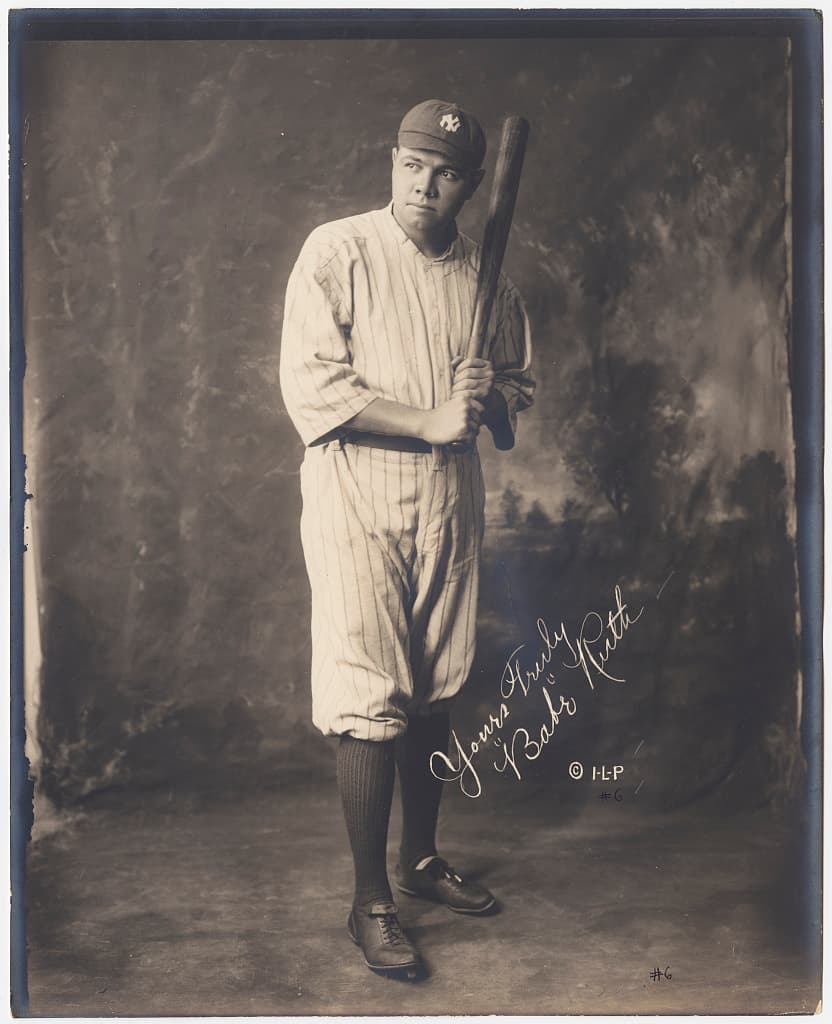
Babe Ruth, full-length portrait, circa 1920.
Photo credit: Unknown via Library of Congress
George Herman Ruth Jr. changed the game more than any player who has lived. He entered the major leagues as a left-handed pitcher good enough to anchor a World Series rotation, became the greatest power hitter baseball had seen or would see for a generation, and transformed the sport from a strategic contest of bunts and stolen bases into a spectacle built around the home run. He hit 714 of them, batted .342 with a .474 on-base percentage, and played on seven World Series champions. The Hall of Fame inducted him in its inaugural class in 1936, one of the first five players chosen.
Baltimore
Ruth was born on February 6, 1895, at 216 Emory Street in Baltimore, the home of his maternal grandfather. His parents, George Sr. and Kate, ran a saloon elsewhere in the city and had little time for their children, and of their eight children only George and his sister Mamie survived to adulthood. By seven, Ruth was roaming the waterfront, skipping school, chewing tobacco, and drinking whiskey from his father's bar. His parents signed him over to St. Mary's Industrial School for Boys, a Catholic reformatory and orphanage run by the Xaverian Brothers, and he spent most of the next twelve years there.
Brother Matthias Boutlier, the school's disciplinary prefect, became the closest thing Ruth ever had to a father. Matthias was a towering figure who hit fungoes to the boys one-handed with an ease that mesmerized Ruth. He taught Ruth to bat left-handed, to pitch, and to play the game with a joy that survived everything the institution imposed on the boys in its care. Ruth credited Matthias with everything that followed.
The Pitcher
Jack Dunn, the owner and manager of the Baltimore Orioles of the International League, signed Ruth in February 1914, and because Ruth was still a minor and a ward of St. Mary's, Dunn had to become his legal guardian to complete the paperwork. The other Orioles players started calling the 19-year-old "Jack's newest babe," and the name stuck. Dunn sold Ruth to the Boston Red Sox that July, and Ruth reached the major leagues at 19.
Ruth's pitching career with the Red Sox was short and brilliant. He went 89-46 with a 2.19 ERA over six seasons and set a World Series record of 29 and two-thirds consecutive scoreless innings that stood for 43 years. In 1918, manager Ed Barrow began using Ruth in the outfield on days he was not pitching, and in 1919 Ruth hit 29 home runs, breaking the major league record and signaling that something unprecedented was happening. Barrow's decision to move Ruth off the mound and into the everyday lineup was the most consequential lineup decision in the history of the sport.
The Sale
Red Sox owner Harry Frazee sold Ruth to the New York Yankees in late December 1919, with the deal publicly announced on January 5, 1920. The price was $100,000, paid in installments, plus a $300,000 loan from Yankees owner Jacob Ruppert secured by a mortgage on Fenway Park. Ruppert held that mortgage for the next thirteen years. The popular story that Frazee sold Ruth to finance the Broadway musical "No, No, Nanette" is a myth, as the show did not open until 1925 and Frazee's financial difficulties were broader and more complicated than any single production. The Yankees won their first pennant in 1921. The Red Sox did not win another World Series until 2004.
The Hitter
In 1920, his first season in New York, Ruth hit 54 home runs. No other team in the American League hit that many. In 1921, he hit 59. In 1927, playing alongside Lou Gehrig in the lineup the sportswriters called Murderers' Row, he hit 60, a record that stood for 34 years until Roger Maris broke it in a longer season.
Yankee Stadium opened on April 18, 1923, built to hold the crowds Ruth drew, and it was immediately called "The House That Ruth Built." More than 74,000 people attended the inaugural game, and Ruth christened the park with a three-run home run in the third inning against the Red Sox. The Yankees won their first World Series that fall.
The 1932 World Series against the Cubs produced the "Called Shot," Ruth's alleged pointing to center field before hitting a home run off Charlie Root in Game 3 at Wrigley Field. Whether he was pointing at the pitcher, the bench, or the bleachers has never been settled. Root went to his grave insisting Ruth had not called the shot and that he would have put the next pitch in Ruth's ear if he had. Ruth himself gave different accounts depending on the audience and the year.
Ruth played on seven World Series championship teams, four with the Yankees and three with the Red Sox. His career line of .342/.474/.690 with 714 home runs, 2,214 RBI, and 2,062 walks made him, by virtually any measure, the greatest hitter in the history of the game. His on-base percentage of .474 has been surpassed only by Ted Williams.
The End
After the 1934 season, the Yankees released Ruth, and he signed with the Boston Braves as a player and assistant manager, believing owner Emil Fuchs had promised him a future as the team's manager. The promise, if it existed, never materialized. On May 25, 1935, at Forbes Field in Pittsburgh, Ruth hit three home runs in his final great performance, the last one clearing the roof of the right-field grandstand. He retired the following week with a .181 batting average for the season and a body that could no longer play the game.
Ruth wanted to manage, and no owner gave him the chance. Yankees owner Jacob Ruppert reportedly told him he could not manage himself, let alone a team. Ruth believed the real reason was that the men who ran baseball did not trust a man from a reformatory to represent their organizations.
Ruth was diagnosed with nasopharyngeal carcinoma in 1946 and spent his final years in and out of hospitals. He died on August 16, 1948, at 53. His body lay in state in the rotunda of Yankee Stadium for two days, and more than 77,000 people filed past the casket. Hank Aaron passed 714 in 1974, and Barry Bonds passed Aaron in 2007, but Ruth's place in the history of the sport was never about a number that could be surpassed.
Sources
Related Articles
The Sandlot and the Summer That Wasn't
Baseball in Pop Culture · June 1, 2026
Continue Reading
The Pitcher Who Wore Babe Ruth's Hat
Strange But True · May 18, 2026
Continue Reading
The Autograph Market and How to Tell Real From Fake
Memorabilia & Collectibles · May 17, 2026
Continue Reading
Babe Ruth Changed Everything
Eras · May 17, 2026
Continue Reading
The Most Valuable Signed Baseballs in History
Memorabilia & Collectibles · May 17, 2026
Continue Reading
The Pride of the Yankees and the Birth of the Sports Biopic
Baseball in Pop Culture · May 17, 2026
Continue Reading