Profile
Hank Aaron
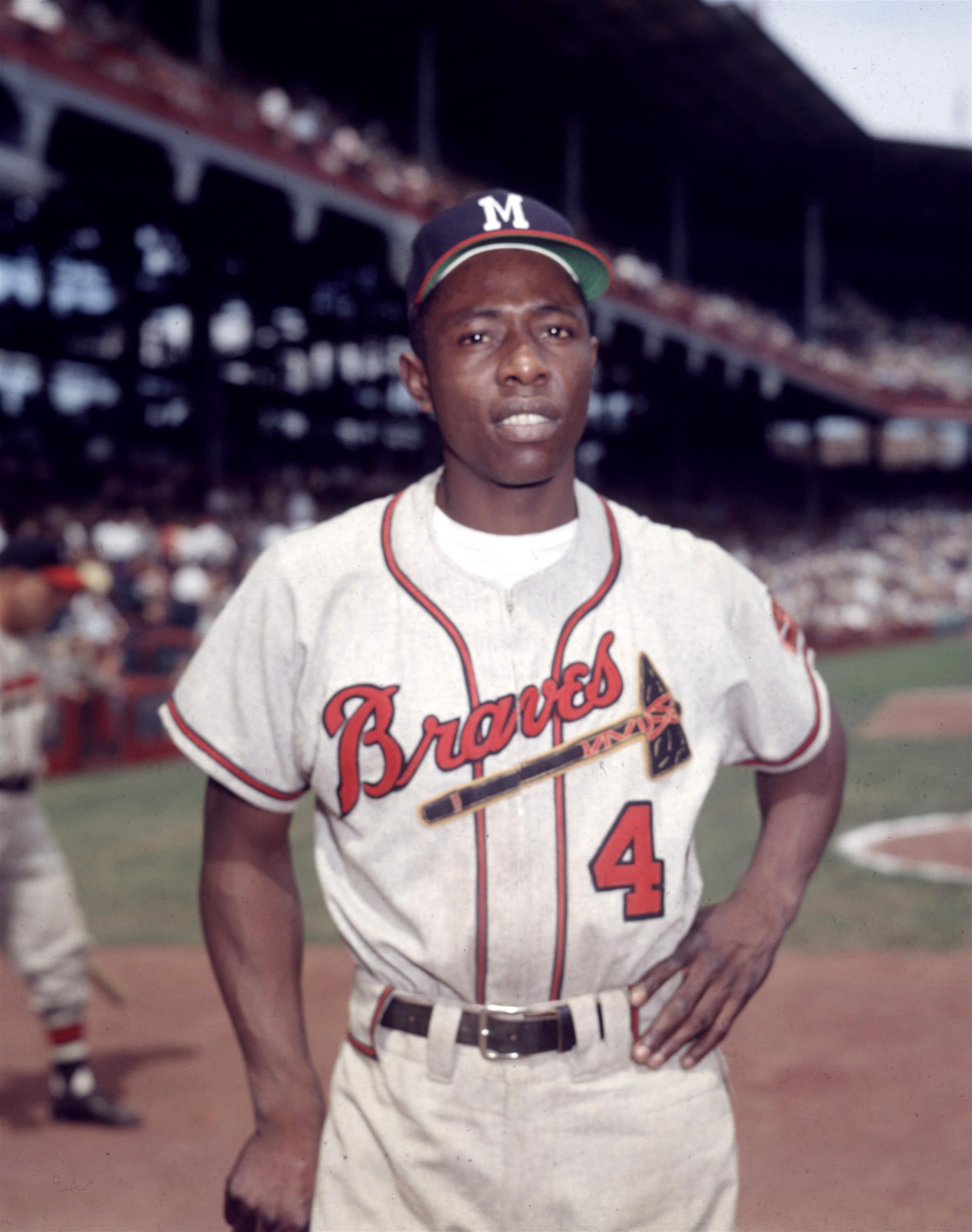
Hank Aaron in 1954, his rookie season with the Milwaukee Braves.
Photo credit: Unknown author via Wikimedia Commons (Public domain)
Henry Louis Aaron hit 755 home runs over 23 major league seasons, and the way he accumulated them remains one of baseball's great acts of sustained precision. He never hit 50 in a single year. His season high was 47, reached in 1971 at age 37. He posted between 24 and 47 home runs every season for two decades, compiling the record through consistency so relentless it looked routine. Aaron's swing was compact and quick, powered by wrists so fast that pitchers described the ball leaving the bat before they registered the swing. "I never worried about the fastball," he once said. "They couldn't throw it past me. None of them." He stood six feet tall and weighed 180 pounds, almost scrawny by baseball standards, and scouts who saw him for the first time kept wondering where the power came from. They wondered for 23 years.
Mobile
Aaron grew up in the Down the Bay section of Mobile, Alabama, the third of eight children. His father, Herbert, worked as a riveter in the shipyards. His younger brother Tommie would also reach the major leagues; the two combined for 768 home runs, the most by any siblings in baseball history. The family moved to Toulminville when Aaron was young. Money was scarce during and after the Depression, and he spent his childhood picking potatoes, tending a garden, and working on an ice-delivery truck. He practiced hitting by swinging a broomstick at bottle caps in the yard, gripping the bat cross-handed with his left hand on top of his right. Nobody corrected him because he never seemed to miss.
He attended Central High School and later transferred to Josephine Allen Institute. At 14 he joined the Prichard Athletics, a local team. A scout named Ed Scott signed him with the Mobile Black Bears for $3 a game, with his mother's condition that he play only home games. In 1951, the Indianapolis Clowns of the Negro American League signed him for $200 a month. He was 17.
Aaron played 26 games for the Clowns in 1952, still batting cross-handed, and hit .366 with five home runs and nine stolen bases while helping the team win the Negro League World Series. After the championship, two telegrams arrived. The New York Giants and the Boston Braves both wanted to buy his contract. Aaron chose the Braves because they offered $50 more per month. The Giants already had Willie Mays. The Braves got Hank Aaron. Both organizations came out fine.
The Minor Leagues
The Braves sent Aaron to the Eau Claire Bears in Wisconsin's Northern League. He was still batting cross-handed and hit .336 with nine home runs in 87 games, earning Rookie of the Year honors.
In 1953, the Braves assigned him to their Jacksonville affiliate in the South Atlantic League. Aaron, Felix Mantilla, and Horace Garner became three of the first black players in the Sally League's history. Jim Crow meant separate hotels, separate restaurants, and hostility from the stands. A line from the period captured the arrangement. "Henry Aaron led the league in everything except hotel accommodations." He led the league in batting average (.362), runs (115), hits (208), doubles (36), and total bases (338), and won the MVP award. His manager, Ben Geraghty, finally corrected the cross-handed grip that had carried Aaron from bottle caps in Toulminville to the top of the Sally League. Johnny Goryl, his Eau Claire teammate the year before, described what happened next. "That's when his power started surfacing," Goryl said, "and the rest was all history." A cross-handed swing works the wrists against their natural rotation on every cut, and Aaron credited those backward years with building the wrist speed that powered 755 home runs. Ed Scott, the scout who signed him with the Black Bears, offered a different version late in life. "I'm telling you, I never saw it," he said of the grip, "but that became part of the legend." Whether the story grew in the telling or not, the wrist speed was real.
Milwaukee
Bobby Thomson broke his ankle in spring training on March 13, 1954, and Aaron took his roster spot. He made his major league debut on April 13 in left field for the Milwaukee Braves, age 20. He hit .280 with 13 home runs as a rookie. By 1955, he was an All-Star. By 1956, he'd won his first batting title at .328.
The 1957 season produced the finest single year of Aaron's career. He hit .322 with 44 home runs and 132 RBI, won the MVP award, and on September 23 hit a walk-off two-run homer in the bottom of the 11th off Billy Muffett to clinch the pennant in front of 40,926 fans at County Stadium. His teammates carried him off the field. Aaron later said it was the greatest moment of his life, even after everything that followed.
The Braves met the Yankees in the World Series, and Aaron dismantled them. He batted .393 with 11 hits, three home runs, and seven RBI across seven games. Lew Burdette won three complete games, two of them shutouts, and Milwaukee beat the Yankees four games to three for the franchise's only championship. The Braves returned to the Series in 1958 but lost the rematch in seven games. In one of those Octobers, Yogi Berra told Aaron to turn his bat around so he could read the trademark. Aaron said, "Didn't come up here to read. Came up here to hit."
Atlanta
The Braves moved from Milwaukee to Atlanta after the 1965 season. Aaron followed and found himself in the city where the civil rights movement had its center of gravity. He met Martin Luther King Jr. at Atlanta-Fulton County Stadium shortly after the team arrived. King was assassinated two years later, and their conversations were few, but the encounter sharpened a commitment Aaron had carried since the Sally League. He befriended Andrew Young, one of King's closest confidants, a relationship that lasted for decades. As early as 1961, while the Braves still played in Milwaukee, Aaron had pressured general manager John McHale to remove segregated signs at the team's spring training facility in Bradenton, Florida. Atlanta gave that instinct a larger stage.
On July 14, 1968, Aaron hit his 500th home run off Mike McCormick of the Giants at Atlanta-Fulton County Stadium, a three-run shot over the left-center field fence. He was 34 years old and the eighth player in history to reach the milestone.
The 1969 season produced 44 home runs, a .300 batting average, and the first NL West division title in franchise history. In the NLCS against the Miracle Mets, Aaron homered in all three games, finishing 5-for-14 with three home runs and seven RBI, but the Braves were swept. It was the closest he came to October after 1958.
On May 17, 1970, at Crosley Field in Cincinnati, Aaron singled off rookie Wayne Simpson in the first inning for his 3,000th hit. He became the first player in history to combine 3,000 hits with 500 home runs. Later in the same game, he hit his 570th career home run.
The 1971 season was his finest as a power hitter. He hit 47 home runs with a .327 batting average and a .669 slugging percentage at age 37. The home run and slugging totals were career highs. On April 27, he drove a first-pitch fastball from Gaylord Perry over the left-field screen for his 600th home run, becoming the third player in history to reach that number after Ruth and Mays.
On July 21, 1973, Aaron hit his 700th home run off Ken Brett of the Phillies, the second player after Ruth to reach the mark. He ended the 1973 season with 713, one short of the all-time record.
Atlanta's fans never matched the devotion Aaron had known in Milwaukee. The Braves drew 1.5 million in their first year in the city, fell to 752,973 by 1972, and managed only 800,655 during the home run chase in 1973. Milwaukee had drawn over 2.2 million the year the Braves won the pennant. Aaron noticed. When asked whether the indifference bothered him, he answered, "What difference does it make?"
The Complete Player
Aaron's two-decade run of consistency produced numbers that still look implausible. He was a 25-time All-Star across 21 consecutive seasons. He won two batting titles, three Gold Gloves, and four RBI crowns. He led the National League in home runs four times. In 1959, he hit .355 with 39 home runs and led both leagues in hits (223), slugging (.636), and total bases (400). In 1963, he hit 44 home runs and stole 31 bases while narrowly missing the Triple Crown, losing the batting title to Tommy Davis by seven points.
In 1972, when Atlanta hosted the All-Star Game for the first time, Aaron hit a two-run home run off Gaylord Perry in the sixth inning, playing for his home crowd on the national stage.
He retired with all-time records for RBI (2,297) and total bases (6,856), numbers nobody has approached since. His career OPS+ of 155 keeps company with Babe Ruth, Ted Williams, and Willie Mays. He hit 30 or more home runs in 15 seasons and 40 or more in eight. Remove all 755 home runs from his record and he'd still have 3,016 hits.
The Pursuit
Aaron ended the 1973 season with 713 home runs, one short of Babe Ruth's career record. The pursuit should have been a celebration. Instead, it became an ordeal.
The U.S. Postal Service confirmed that Aaron received 930,000 letters in 1973, more than any non-politician in the country. Roughly a third was hate mail. Letters threatened his life and called him racial slurs. Some contained hand-drawn KKK hoods. One included a diagram of a rifle trajectory aimed from the bleachers. Others described in specific terms how the writers planned to kill him. The FBI investigated the most credible threats, and the Bureau's file on Aaron remains partially declassified in its public vault.
The Atlanta Police Department assigned detective Calvin Wardlaw as Aaron's plainclothes bodyguard for the 1973 and 1974 seasons. At Fisk University in Nashville, five FBI agents showed up at his daughter Gaile's dormitory after a kidnapping plot surfaced. "My kids had to live like they were in prison because of kidnap threats," Aaron said.
Aaron's personal secretary, Carla Koplin, sorted the mail into stacks. The Braves had written her into Aaron's contract as a full-time hire, a first for a baseball player. She was white and Jewish, and she received her own threats. "They knew I was white, Jewish, and working for a black man," she later said. She reported the most dangerous letters directly to the FBI and stayed with Aaron for a decade, following him to Milwaukee when he was traded to the Brewers.
Aaron kept the hate letters in boxes in his attic for decades and later donated some to the Hall of Fame. In 2014, he explained the ones he kept. "I kept the hate mail to remind myself that we are not that far removed from when I was chasing the record. If you think that, you are fooling yourself."
He feared he might not live to see the 1974 season, and he said so publicly. The threats were that specific. "All that hatred left a deep scar on me," he wrote in his autobiography. "I was just a man doing something that God had given me the power to do, and I was living like an outcast in my own country."
715
Aaron tied Ruth on Opening Day, April 4, 1974, in Cincinnati, hitting a three-run homer off Jack Billingham in his first at-bat of the season. The Braves wanted to bench him for the remaining road games so the record could fall at home. Commissioner Bowie Kuhn ordered them to play him. Aaron went hitless for the rest of the series.
On the night of April 8, 53,775 fans filled Atlanta-Fulton County Stadium for the Braves' home opener against the Los Angeles Dodgers. Aaron walked on five pitches in the second inning. In the fourth, with Darrell Evans on base, Al Downing threw a 1-0 fastball that didn't get far enough inside. Aaron drove it over the left-center field fence at 9:07 PM.
Relief pitcher Tom House caught the ball in the bullpen with a one-handed grab against the auxiliary scoreboard. He'd ended up in left-center because the senior relievers claimed spots closer to left field, where Aaron usually pulled the ball, leaving the junior pitchers farther out. House sprinted to home plate and arrived just as Aaron's mother, Estella, wrapped her arms around her son. She held on. She believed nobody would shoot while she was holding him.
Two 17-year-olds named Britt Gaston and Cliff Courtenay had jumped the fence and jogged alongside Aaron between second and third base. Wardlaw, in the stands, kept his hand on his .38-caliber pistol until he realized they meant to celebrate.
Vin Scully, calling the game on the Dodgers' broadcast, let the crowd carry the moment for 27 seconds before speaking. "What a marvelous moment for baseball," he said. "A black man is getting a standing ovation in the Deep South for breaking a record of an all-time baseball idol."
Kuhn was not in attendance. He was in Cleveland, addressing the Indians' booster club. Aaron never fully forgave the absence.
"I just thank God it's all over," Aaron said afterward.
Final Seasons
The Braves traded Aaron to the Milwaukee Brewers on November 2, 1974, for outfielder Dave May. He returned to the city where he'd become a star and spent two seasons as a designated hitter. He hit his 755th and final home run on July 20, 1976, off Dick Drago at County Stadium. He retired after the 1976 season as the last former Negro Leagues player on a major league roster.
He finished with 3,771 hits, 755 home runs, 2,297 RBI, and a .305 career batting average.
After the Game
The NAACP awarded Aaron the Spingarn Medal in 1975, its highest honor for achievement. He was elected to the Hall of Fame in 1982 with 97.8% of the vote, alongside Frank Robinson.
He returned to Atlanta as the Braves' vice president and director of player development in 1977, overseeing the farm system that developed Tom Glavine and a generation of prospects who would carry the franchise through the 1990s. In December 1989, the Braves promoted him to senior vice president and assistant to the president, a title he held until his death. He also served as a corporate vice president of community relations for Turner Broadcasting and sat on its board of directors.
Aaron built a second career in business. He started with Arby's franchises in Milwaukee in 1986, then expanded to Atlanta with Popeyes, Church's Chicken, and Krispy Kreme locations under the name 755 Restaurant Corporation. At its peak, the company operated 27 Popeyes restaurants and two Krispy Kreme stores in the Atlanta area. In December 1999, he became the first black BMW dealer in the United States, investing $5.5 million in a franchise in Union City, Georgia. The Hank Aaron Automotive Group grew to include Honda, Hyundai, and Toyota dealerships across Georgia, reaching $136.7 million in annual sales before he sold the business in 2007.
In 1994, he and his wife Billye founded the Chasing the Dream Foundation, which set out to award 755 scholarships to young people with exceptional ability and modest means. The foundation surpassed that goal.
He advocated for minority hiring in baseball's front offices for the rest of his life, and his language was not diplomatic. "On the field, blacks have been able to be super giants," he said. "But once our playing days are over, this is the end of it and we go back to the back of the bus again." After Al Campanis's disastrous 1987 appearance on Nightline revealed how baseball's leadership thought about race, Aaron was among the most vocal executives demanding change. He never stopped pushing.
He received the Presidential Citizens Medal from Bill Clinton in 2001 and the Presidential Medal of Freedom from George W. Bush in 2002. MLB created the Hank Aaron Award in 1999, the first time the league named an award after a living player.
Barry Bonds passed 755 on August 7, 2007. Aaron, who had declined to attend, appeared on the scoreboard in a recorded video. "It is a great accomplishment," he said, "that required skill, longevity, and determination."
On January 5, 2021, Aaron received his first dose of the Moderna COVID-19 vaccine at Morehouse School of Medicine, publicly encouraging black Americans to get vaccinated. "I don't have any qualms about it at all," he said. "It's just a small thing that can help zillions of people in this country." Seventeen days later, on January 22, he died in his sleep at his home in Atlanta. He was 86.
When the Braves won the World Series that fall, the championship ring carried 755 diamonds and 44 emerald-cut stones.