Profile
Ted Williams
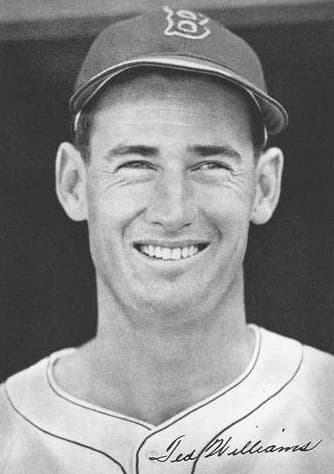
Ted Williams portrait, 1947.
Photo credit: Unknown author via Wikimedia Commons (Public domain)
Theodore Samuel Williams wanted one thing from life. "All I want out of life is that when I walk down the street folks will say, 'There goes the greatest hitter who ever lived,'" he said as a young man, and he spent 19 seasons with the Boston Red Sox proving the ambition was not idle. Williams batted .344 with a .482 on-base percentage, the highest in major league history. He hit .406 in 1941, the last player to reach that mark. He won two Triple Crowns, two MVP awards, and six batting titles, lost nearly five full seasons to military service in two wars, and hit a home run in his final at bat at Fenway Park in 1960, then walked off without tipping his cap. John Updike, who watched the last game, wrote the greatest baseball essay ever published about it and ended with six words that defined Williams as completely as his swing. "Gods do not answer letters." The BBWAA elected Williams to the Hall of Fame in 1966 on 93.4 percent of the ballot.
San Diego
Williams was born on August 30, 1918, in San Diego, California. His father Samuel, of Welsh, English, and Irish descent, who served in the Philippine-American War, worked as a photographer. His mother May Venzor, of Mexican and Basque ancestry, was a Salvation Army evangelist who preached on street corners and embarrassed her sons. Williams's uncle Saul taught him to swing a bat at eight, and the year-round California climate let him play every day. Williams attended Herbert Hoover High School and signed with the San Diego Padres of the Pacific Coast League while still a student. Red Sox GM Eddie Collins spotted him and secured an option on his contract.
Williams tore through the minor leagues, winning the American Association Triple Crown at Minneapolis in 1938 with a .366 average and 43 home runs. Rogers Hornsby taught him the lesson that governed his career. "Get a good pitch to hit."
.406
Williams debuted in 1939 and hit .327 with 31 home runs and a rookie record 145 RBI. In 1941 he entered the final day of the season hitting .39955, which would have rounded to .400. Manager Joe Cronin offered to sit him. "If I'm going to be a .400 hitter," Williams said, "I want more than my toenails on the line." Williams went 6-for-8 in a doubleheader against the Philadelphia Athletics and finished at .406. Nobody has reached .400 since. Williams lost the MVP that year to Joe DiMaggio, who hit safely in 56 consecutive games.
Williams won the Triple Crown in 1942 with a .356 average, 36 home runs, and 137 RBI but lost the MVP to Joe Gordon. Williams won the Triple Crown again in 1947 with a .343 average, 32 home runs, and 114 RBI and lost the MVP to DiMaggio by one vote. Williams remains the only player to win two Triple Crowns and not win the MVP in either year. Williams won the award in 1946 and 1949.
Two Wars
Williams joined the Navy in May 1942 and trained as a Marine aviator at Amherst College, where he earned a 3.85 GPA, and at Pensacola. Williams served as a flight instructor and was stationed in Hawaii but never saw combat during the Second World War. He missed three full seasons (1943, 1944, 1945) and returned in 1946 to win the MVP and lead the Red Sox to their first pennant since 1918.
The Marines recalled Williams during the Korean War in May 1952, when he was 33. Williams flew 39 combat missions in an F9F Panther jet as wingman to Major John Glenn, who later said, "Much as I appreciate baseball, Ted to me will always be a Marine fighter pilot." In February 1953, Williams's aircraft was hit by anti-aircraft fire over North Korea. His engine trailed smoke, his radio was dead, and his hydraulics were destroyed. Williams chose not to eject and belly-landed the burning plane on the runway before climbing out as the aircraft burst into flames. Williams flew another combat mission the next day. He earned three Air Medals and was discharged in late July 1953 after a pneumonia and inner ear infection grounded him. Williams hit .407 in 110 at bats after returning to the Red Sox.
Military service across both wars cost Williams roughly five full seasons. Researchers estimated he would have exceeded 600 home runs without the interruption.
Fenway
Williams feuded with Boston sportswriters throughout his career, calling them "knights of the keyboard," spitting toward the press box, and refusing to tip his cap to fans after booing early in his career. He never argued with an umpire and was never ejected from a game. One umpire said, "If Mr. Williams didn't swing at it, it wasn't a strike."
Williams hit 521 home runs, walked 2,021 times, and led the American League in on-base percentage 12 times. In 1957, at 38 turning 39, he batted .388 and would have hit .400 with five more hits. In 1954 he broke his collarbone in spring training, fell 14 at bats short of qualifying for the batting title, and would have won it with .345. That season prompted the rules change from official at bats to plate appearances for batting title qualification.
On September 28, 1960, Williams hit a home run off Jack Fisher of the Baltimore Orioles in his final at bat at Fenway Park before just over 10,000 fans. Updike, who was 28, attended the game and produced the essay "Hub Fans Bid Kid Adieu" for The New Yorker. Williams ran the bases "hurriedly and unsmiling with his head down, as if the praise were a storm of rain to get out of," Updike wrote. Williams refused to come out of the dugout despite minutes of applause. He never tipped his cap.
The Jimmy Fund
Williams was the leading spokesman for Boston's Jimmy Fund, a children's cancer research charity, from the late 1940s until his death. He made countless unreported bedside visits to children with cancer and paid medical bills anonymously. His brother Danny died of leukemia. Williams helped raise hundreds of millions of dollars for the Dana-Farber Cancer Institute over five decades.
At his Hall of Fame induction in 1966, Williams wrote his speech by hand the night before and included a passage that no one prompted him to add. "I hope that some day the names of Satchel Paige and Josh Gibson in some way could be added as a symbol of the great Negro players that are not here only because they were not given the chance." Sportswriter Shirley Povich later wrote, "Ted Williams launched the whole movement for the inclusion of Negro League players into the Hall of Fame at Cooperstown." Paige was inducted in 1971. Gibson was inducted in 1972.
Williams managed the Washington Senators from 1969 through 1971, winning Manager of the Year in his first season with an 86-76 record, the expansion club's only winning year. Williams loved fishing as much as hitting and was inducted into the International Game Fish Association Hall of Fame, the only person in both that hall and Cooperstown. Williams died on July 5, 2002, in Inverness, Florida, at 83. His son John-Henry arranged for his body to be sent to a cryonics facility in Arizona against Williams's stated wish to be cremated and have his ashes scattered in the Florida Keys. The decision produced a public dispute between Williams's children that was never resolved.