Era Overview
The Live-Ball Era
1920–1941
Babe Ruth turned baseball into a power game, attendance exploded, and the sport survived the Great Depression by becoming louder, faster, and harder to ignore.
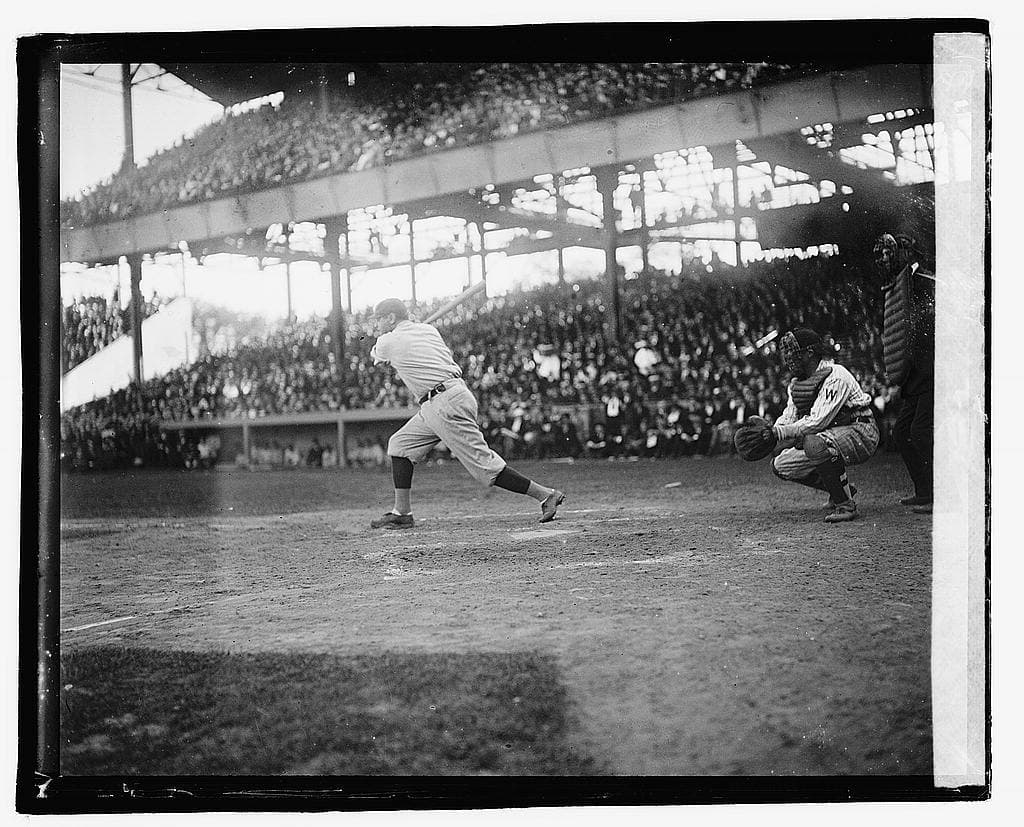
Babe Ruth, c. 1920s. Batting before a packed grandstand.
Photo credit: Library of Congress Prints and Photographs Division via Library of Congress
The Dead-Ball Era ended the moment Babe Ruth started swinging for the fences. In 1920, his first season with the New York Yankees, Ruth hit 54 home runs. The rest of the American League combined for 369. One player had shifted the entire geometry of the sport, and owners noticed immediately that fans would pay to watch baseballs leave the park.
The Ball Wakes Up
Several changes conspired to make offense explode. After Ray Chapman's death in August 1920 from a pitch he likely never saw, umpires began replacing dirty, discolored baseballs with fresh ones throughout the game. The spitball was banned that same year, though 17 pitchers received grandfather clauses to keep throwing it. The new ball was wound tighter with Australian yarn and had raised seams that gave hitters a better look and a livelier bounce off the bat. Batting averages, run totals, and home run counts all surged. The 1930 season remains the most offense-saturated in history, with the National League posting a collective .303 batting average.
Ruth and the Yankees Dynasty
Ruth was the era's gravitational center. He hit 714 career home runs, drove in 2,214 runs, and posted an OPS above 1.000 in thirteen separate seasons. His salary demands, his appetites, and his personality reshaped what a baseball star could be. The Yankees built their first dynasty around him, winning pennants in 1921, 1922, 1923, 1926, 1927, 1928, and 1932. The 1927 team, with Ruth hitting 60 home runs and Lou Gehrig driving in 175 runs behind him, is still the benchmark against which all great teams are measured.
Gehrig himself was a quieter force. He played 2,130 consecutive games, a record that stood for 56 years, and his career ended in 1939 when he was diagnosed with amyotrophic lateral sclerosis. His farewell speech at Yankee Stadium on July 4, 1939, calling himself "the luckiest man on the face of the Earth," became one of the most replayed moments in American sports history.
The Negro Leagues Flourish
While the major leagues operated under an unwritten but rigidly enforced color line, black baseball built its own world. The Negro National League, founded by Rube Foster in 1920, and the Eastern Colored League, established in 1923, created a parallel structure with its own stars, traditions, and packed stadiums. Satchel Paige threw with a precision and variety that made him arguably the best pitcher alive in any league. Josh Gibson hit home runs with a frequency that invited constant comparison to Ruth. Cool Papa Bell ran the bases so fast that Paige once said he could flip a light switch and be in bed before the room went dark.
The Negro League World Series ran from 1924 to 1927 and returned intermittently afterward. East-West All-Star Games, played at Comiskey Park beginning in 1933, regularly outdrew the major league version. These leagues were a fully realized professional operation, constrained only by the racism that kept their players out of the established major leagues.
The All-Star Game and National Spectacle
The first major league All-Star Game took place on July 6, 1933, at Comiskey Park in Chicago, the brainchild of Chicago Tribune sports editor Arch Ward. Ruth, 38 years old by then, hit the first home run in All-Star history. The game drew 47,595 fans and became an annual fixture. Night baseball arrived in 1935, when the Cincinnati Reds hosted the Philadelphia Phillies under the lights at Crosley Field on May 24. President Franklin Roosevelt flipped a ceremonial switch from the White House. Both innovations reflected a sport learning to sell itself to a wider audience.
The Great Depression
The Depression hit baseball hard but didn't break it. Attendance dropped sharply after the 1930 crash and didn't fully recover until after World War II. Teams cut player salaries, reduced rosters, and watched minor league affiliates fold. But the game also provided cheap entertainment for a struggling nation. Radio broadcasts, pioneered by stations in Chicago and Pittsburgh in the 1920s, brought baseball into millions of homes for free and turned regional stars into national figures.
Dizzy Dean and his brother Paul won all four games for the St. Louis Cardinals in the 1934 World Series, and Dizzy's brash personality made him a Depression-era celebrity. Hank Greenberg of the Detroit Tigers chased Ruth's single-season home run record in 1938, finishing with 58. Jimmie Foxx hit 534 career home runs while bouncing between the Athletics and Red Sox. The talent pool was deep even as the money was thin.
The End of an Era
By 1941, the Live-Ball Era had run its course. Joe DiMaggio hit safely in 56 consecutive games that summer, a record so durable that no one has come within ten games of it since. Ted Williams batted .406, the last time any hitter finished a season above .400. Both feats happened in the same year, and both were overshadowed within months by the attack on Pearl Harbor on December 7. The war would empty major league rosters and reshape the sport in ways no one could have predicted. But the game Ruth built, the game of power and spectacle and outsized personality, had already become permanent.
Related Articles
The Night They Set the World Series on Fire
Before Game 7 of the 1925 World Series, the grounds crew at Forbes Field burned gasoline on the infield so the game could be played.
Continue Reading
Babe Ruth Changed Everything
Before Babe Ruth, baseball was a game of singles, bunts, and stolen bases. After Ruth, it was a game of home runs. He changed the economics of the sport, the strategy of the game, and the relationship between baseball and the public.
Continue Reading
The Batting Helmet and the Decades Baseball Refused to Protect Its Hitters
From Roger Bresnahan's inflatable head protector to mandatory earflaps, MLB took more than seven decades to fully require basic head protection for hitters.
Continue Reading
Branch Rickey Built the Farm System (and Then Broke the Color Line)
Branch Rickey made two decisions that changed baseball more than any other executive in the sport's history. The first was an innovation in business. The second was a moral act with economic consequences.
Continue Reading
Cleveland Municipal Stadium and the Lake
Cleveland Municipal Stadium was built for 78,000 fans and regularly drew 5,000. The wind off Lake Erie made night games brutal. It was also the site of Ten Cent Beer Night.
Continue Reading
Comiskey Park and Eighty Years on 35th Street
Built on a city dump for $750,000 and christened the Baseball Palace of the World, Comiskey Park stood at 35th and Shields for eighty seasons, hosting the first All-Star Game, the Black Sox scandal, and Disco Demolition Night before the wrecking ball arrived in 1991.
Continue Reading
Floodwater, Floodlights, and the Hill in Left Field at Crosley
Crosley Field hosted the first night game in major league history, survived a flood that put 21 feet of water over home plate, and featured a left field terrace that no visiting outfielder ever fully trusted.
Continue Reading
The Curse of the Bambino
The Red Sox sold Babe Ruth to the Yankees in January 1920 and didn't win a World Series for the next 86 years. The drought produced so many near-misses, so many collapses in exactly the wrong moment, that it stopped looking like bad luck and started looking like something else.
Continue Reading
The Dead Ball and the Live Ball
Baseball's 1920s offensive revolution came from overlapping equipment and rules changes: cleaner balls, doctored-pitch bans, and a livelier construction that rewarded power swings.
Continue Reading
The Death of the Complete Game
Complete games once defined ace pitching. Over the last century, bullpens, role specialization, and third-time-through data pushed the complete game from expectation to rarity.
Continue Reading
Ebbets Field and the Soul of Brooklyn Baseball
Built on a garbage dump called Pigtown and demolished before its fiftieth birthday, Ebbets Field packed more history per square foot than any ballpark in America.
Continue Reading
Effa Manley Ran the Eagles
Effa Manley helped build the Newark Eagles into champions, fought for black baseball in public, and became the first woman elected to the Hall of Fame in 2006.
Continue Reading
When Bare Hands Were the Only Glove in Baseball
Players once caught barehanded as a matter of pride. Gloves arrived slowly, drew ridicule, and eventually transformed defense through Bill Doak's web-pocket innovation.
Continue Reading
The Luckiest Man on the Face of This Earth
On July 4, 1939, Lou Gehrig stood at home plate in Yankee Stadium, dying of a disease that didn't yet carry his name, and told 61,808 people he considered himself the luckiest man alive.
Continue Reading
Griffith Stadium, Washington
Griffith Stadium hosted the Senators' only World Series championship in 1924 and the Homestead Grays' greatest home runs during the segregation era. It stood at the corner of Georgia Avenue and W Street from 1911 to 1965.
Continue Reading
The History of Baseball Cards, from Tobacco Inserts to Modern Hobby Culture
Baseball cards began as photographic keepsakes in the 1860s, became marketing tools for tobacco companies, survived a monopoly in the gum era, and evolved into a collectibles market shaped by professional grading.
Continue Reading
The Invisible Rectangle That Runs the Game
The strike zone has shifted for more than a century, but the core argument never changes: who controls the boundary between pitcher and hitter, the rulebook or the umpire?
Continue Reading
Kenesaw Mountain Landis and the Invention of the Commissioner
The owners needed a strongman. They found a federal judge who demanded absolute authority, banned the Black Sox for life, and maintained baseball's color line for 24 years.
Continue Reading
Lost Ballparks and the Artifact Market
When Ebbets Field came down in 1960, pieces of the Dodgers' home scattered across the country. Seats, signs, bricks, and structural pieces from demolished ballparks now form a niche collectibles market where provenance is the central pricing driver.
Continue Reading
Moe Berg, Catcher and Spy
Moe Berg played 15 major-league seasons, then worked for the OSS in World War II. His baseball resume was modest, but his life was anything but ordinary.
Continue Reading
The Negro Leagues Were Major Leagues
For three decades, the Negro Leagues produced some of the best baseball ever played in the United States, built a parallel economy of black-owned teams and venues, and developed talent that white baseball refused to acknowledge until it could no longer afford to ignore.
Continue Reading
The Polo Grounds and the Ghosts of Coogan's Hollow
For more than half a century, the Polo Grounds sat in the shadow of Coogan's Bluff, its horseshoe shape producing some of the strangest and most famous plays in baseball history.
Continue Reading
The Pride of the Yankees and the Birth of the Sports Biopic
The Pride of the Yankees was released in 1942, barely a year after Lou Gehrig's death. It established the template for every sports biopic that followed and turned Gehrig's farewell speech into the version most Americans know.
Continue Reading
Ring Lardner and the Writer Who Made Baseball Literature Possible
Before there was Roger Kahn or Roger Angell, there was Ring Lardner. He proved that baseball could sustain serious fiction and that the language of the clubhouse was worth capturing.
Continue Reading
The Concrete Cathedral at 21st and Lehigh
Baseball's first steel-and-concrete stadium opened on April 12, 1909, in a North Philadelphia neighborhood where chickens still pecked in empty lots, and stood for sixty-seven years through seven World Series, two tenants, a spite fence, a riot, and a fire.
Continue Reading
Smoky Joe Wood's 1912 and the Second Career
Smoky Joe Wood won 34 games in 1912, looked like the era's next pitching giant, and then rebuilt his career as a position player after arm trouble changed everything.
Continue Reading
When Baseball Banned the Spitball (But Let 17 Pitchers Keep Throwing It)
MLB outlawed the spitball and other doctored pitches in 1920, then grandfathered 17 established pitchers, creating a contradiction that shaped pitcher enforcement for decades.
Continue Reading
A Century of Baseball at Sportsman's Park
For ninety years, the northwest corner of Grand Boulevard and Dodier Street hosted professional baseball in St. Louis, and no other intersection in America held two major league tenants for as long or produced a World Series played entirely in one park.
Continue Reading
How "Take Me Out to the Ball Game" Became Baseball's Shared Song
Written in 1908 as a Tin Pan Alley hit, Take Me Out to the Ball Game evolved into baseball's communal anthem through decades of reuse and reinvention.
Continue Reading
The Called Shot and What Really Happened in Game 3
October 1, 1932. Game 3 of the World Series. Babe Ruth steps to the plate at Wrigley Field and does something that baseball has argued about for nearly a century.
Continue Reading
104 Years of Baseball at Michigan and Trumbull
From a wooden grandstand built on a former hay market in 1896 to Robert Fick's rooftop grand slam in 1999, the corner of Michigan and Trumbull hosted professional baseball longer than any other site in America.
Continue Reading
"Who's on First?" How a Baseball Bit Became a Cultural Artifact
Abbott and Costello's routine moved from vaudeville and radio to Cooperstown and the Library of Congress, becoming one of baseball's most durable pieces of popular culture.
Continue Reading
Profiles from This Era
Al Barlick
Umpire · 1915–1995
Hall of Fame 1989
Continue Reading
Al Lopez
Catcher · 1908–2005
Hall of Fame 1977
Continue Reading
Al Simmons
Left Field · 1902–1956
Hall of Fame 1953
Continue Reading
Alex Pompez
Executive · 1890–1974
Hall of Fame 2006
Continue Reading
Andy Cooper
Pitcher · 1897–1941
Hall of Fame 2006
Continue Reading
Arky Vaughan
Shortstop · 1912–1952
Hall of Fame 1985
Continue Reading
Babe Ruth
Pitcher / Outfielder · 1895–1948
Hall of Fame 1936
Continue Reading
Barney Dreyfuss
Executive · 1865–1932
Hall of Fame 2008
Continue Reading
Ben Taylor
First Base · 1888–1953
Hall of Fame 2006
Continue Reading
Bill Dickey
Catcher · 1907–1993
Hall of Fame 1954
Continue Reading
Bill Foster
Pitcher · 1904–1978
Hall of Fame 1996
Continue Reading
Bill Klem
Umpire · 1874–1951
Hall of Fame 1953
Continue Reading