The Luckiest Man on the Face of This Earth
On July 4, 1939, Lou Gehrig stood at home plate in Yankee Stadium, dying of a disease that didn't yet carry his name, and told 61,808 people he considered himself the luckiest man alive.
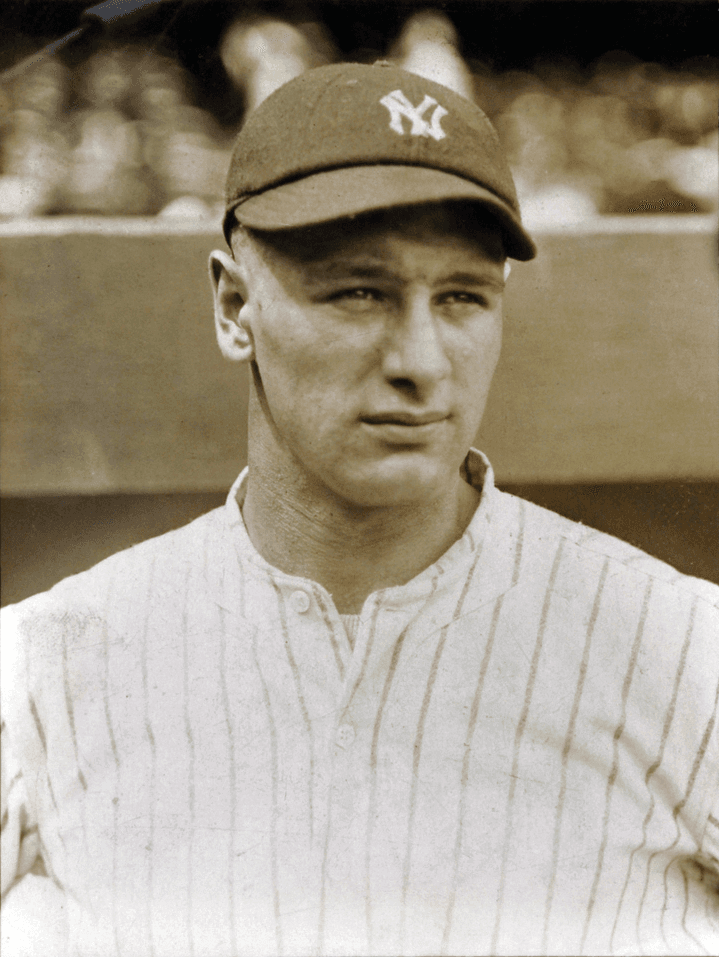
Lou Gehrig during his 1923 rookie season.
Photo credit: Wide World Photos via Wikimedia Commons (Public domain)
Lou Gehrig played 2,130 consecutive games for the New York Yankees. He pinch-hit on June 1, 1925, and started at first base the following day, replacing Wally Pipp, and didn't leave the lineup until May 2, 1939, when he walked into manager Joe McCarthy's office in Detroit and took himself out. The streak spanned fourteen full seasons, two World Wars' worth of calendar time, and a career that produced a .340 batting average, 493 home runs, 1,995 RBIs, and a reputation as the most durable athlete American sports had ever seen.
By the time he removed himself from the lineup, something was visibly wrong. He could not run. His swing had lost its force. Teammates watched him struggle to bend down for ground balls during infield practice. The man who had been the strongest player in the American League for more than a decade could barely tie his cleats.
The Streak and the Man Behind It
Gehrig's consecutive games record was a reflection of his personality. He was the son of German immigrants, raised in the Yorkville neighborhood of Manhattan, quiet by temperament and overshadowed by circumstance. He played his entire career alongside Babe Ruth, the most famous athlete on the planet, and then alongside Joe DiMaggio, who inherited Ruth's aura of effortless greatness. Gehrig was neither effortless nor flashy. He showed up. He played hurt, playing through broken fingers, back spasms, and beanballs that would have sidelined other players for weeks.
The 1927 Yankees, widely considered the greatest team ever assembled, featured Ruth hitting 60 home runs and Gehrig hitting 47 with 175 RBIs. Gehrig won the MVP. He turned 24 that June. In 1934, he won the Triple Crown with a .363 average, 49 home runs, and 166 RBIs. These numbers would have made him the defining player of his generation on any other team. On the Yankees, he was the second-most famous player in his own clubhouse.
Gehrig accepted this dynamic without apparent resentment. He preferred privacy. He married Eleanor Twitchell in 1933, lived modestly, and saved his money. His contract negotiations were brief. He gave few interviews that produced memorable quotes. The streak was the perfect expression of who he was, a man who defined himself through showing up and doing the work, day after day, without drama.
The Decline
The 1938 season was the first sign that something was wrong beyond normal aging. Gehrig hit .295 with 29 home runs, respectable numbers for most players but a steep decline from his career norms. He had hit .351 with 37 home runs in 1937. The drop was sudden enough that sportswriters speculated about his health, though Gehrig dismissed the questions.
Spring training in 1939 removed all doubt. Gehrig could not hit with any power. He stumbled on the basepaths. His reflexes at first base, once sure and quick, had slowed to the point where routine plays became adventures. In the first eight games of the season, he went 4-for-28 with one RBI. On May 2, in Detroit, he told McCarthy he was done.
"I'm benching myself for the good of the team," Gehrig said. McCarthy offered to let him play one more game. Gehrig refused. He carried the lineup card to the umpire at home plate, a formality that was also a goodbye. When the public address announcer read the lineups and Gehrig's name was absent, the Detroit crowd gave him a standing ovation.
The Diagnosis
Gehrig checked into the Mayo Clinic in Rochester, Minnesota, on June 13, 1939. Six days later, on his 36th birthday, doctors delivered the diagnosis. Amyotrophic lateral sclerosis, a progressive neurodegenerative disease that destroys the motor neurons controlling voluntary muscle movement. The disease had no treatment and no cure. Average life expectancy after onset was two to five years.
The Yankees announced the diagnosis on June 21. The medical term meant nothing to most fans. They understood only that Gehrig was dying, and that the disease was moving fast. Eleanor Gehrig later said that the doctors told her the truth privately. Lou was given less than two years.
July 4, 1939
The Yankees organized Lou Gehrig Appreciation Day for July 4, a doubleheader against the Washington Senators. The ceremony took place between games. Members of the 1927 Yankees, including Ruth, gathered on the field. The current roster stood along the first base line. The crowd filled Yankee Stadium to its capacity of 61,808.
Gehrig stood at home plate in his pinstripes, visibly weakened, holding his cap in his hands. Mayor Fiorello LaGuardia spoke. Postmaster General James Farley spoke. Manager Joe McCarthy spoke and broke down before finishing. The Yankees retired Gehrig's number 4, making him the first player in major league history to receive that honor.
Then the microphone was handed to Gehrig. By most accounts, he had not planned to speak. The emotion of the ceremony and the sight of his former teammates had overwhelmed him, and he later said he almost walked away from the microphone without saying anything. But he spoke.
The commonly accepted SABR transcription of Gehrig's words reads as follows.
"Fans, for the past two weeks you have been reading about the bad break. Today I consider myself the luckiest man on the face of the earth. I have been in ballparks for seventeen years and have never received anything but kindness and encouragement from you fans.
"When you look around, wouldn't you consider it a privilege to associate yourself with such a fine looking men as they're standing in uniform in this ballpark today? Which of you wouldn't consider it the highlight of his career just to associate with them for even one day? Sure, I'm lucky.
"Who wouldn't consider it an honor to have known Jacob Ruppert? Also, the builder of baseball's greatest empire, Ed Barrow? To have spent six years with that wonderful little fellow Miller Huggins? Then to have spent the next nine years with that outstanding leader, that smart student of psychology, the best manager in baseball today, Joe McCarthy? Sure, I'm lucky.
"When the New York Giants, a team you would give your right arm to beat, and vice versa, sends you a gift - that's something. When everybody down to the groundskeepers and those boys in white coats remember you with trophies - that's something. When you have a wonderful mother-in-law who takes sides with you in squabbles with her own daughter - that's something. When you have a father and a mother who work all their lives so you can have an education and build your body - it's a blessing. When you have a wife who has been a tower of strength and shown more courage than you dreamed existed - that's the finest I know.
"So I close in saying that I might have been given a bad break, but I have an awful lot to live for. Thank you."
The stadium went silent and then erupted. Ruth, who had feuded with Gehrig for years and had barely spoken to him since 1934, walked across the infield and wrapped his arms around him. Photographs of the embrace became one of the most reproduced images in sports history.
The Speech's Afterlife
Writers often call Gehrig's farewell the greatest speech in American sports history, and they most often compare it to Lincoln's Gettysburg Address. Both were brief. Men who didn't seek the spotlight delivered both speeches. Both reframed their circumstances as occasions for gratitude rather than grief.
Newsreel cameras didn't record the speech in its entirety. Different cameras at different angles captured the surviving versions, and editors reconstructed the full audio from multiple sources. This has contributed to minor discrepancies in transcriptions over the decades, but the core text is established beyond dispute.
The speech endures because Gehrig chose gratitude over self-pity. He spoke plainly, and his voice carried a slight tremor from the disease that was already weakening his respiratory muscles. The power came from the contrast between what the audience knew and what Gehrig chose to say. Everyone in the stadium understood he was dying. He chose to talk about luck.
After the Speech
Gehrig served briefly as a member of the New York City Parole Commission, a position arranged by Mayor LaGuardia. He attended Yankee games occasionally, sitting in the stands rather than the dugout. His physical deterioration accelerated through 1940 and into 1941. He lost the ability to walk, then to write, then to feed himself.
Lou Gehrig died on June 2, 1941, sixteen years to the day after he replaced Wally Pipp in the Yankees lineup. He was 37 years old. Eleanor Gehrig lived until 1984, spending decades working with ALS research organizations and protecting her husband's legacy.
After Gehrig's death, people quickly came to call ALS Lou Gehrig's disease, a designation that persists worldwide even though French neurologist Jean-Martin Charcot had described the condition in 1869. Gehrig's name gave the disease a human face and accelerated public awareness and research funding that continues today.
His consecutive games record stood for 56 years until Cal Ripken Jr. of the Baltimore Orioles played his 2,131st straight game on September 6, 1995. Ripken acknowledged Gehrig repeatedly during his pursuit of the record, and the moment he broke it was treated as a tribute to both men rather than a replacement of one legacy by another.
His number 4 was never reissued. The speech, 277 words long and delivered by a man who didn't want to give it, remains the standard against which every retirement ceremony in American sports is measured.