Era Overview
The Expansion Era
1961–1976
Baseball spread to new cities, survived a pitching crisis, saw its home run record broken twice, and lost the reserve clause that had bound players to teams for nearly a century.
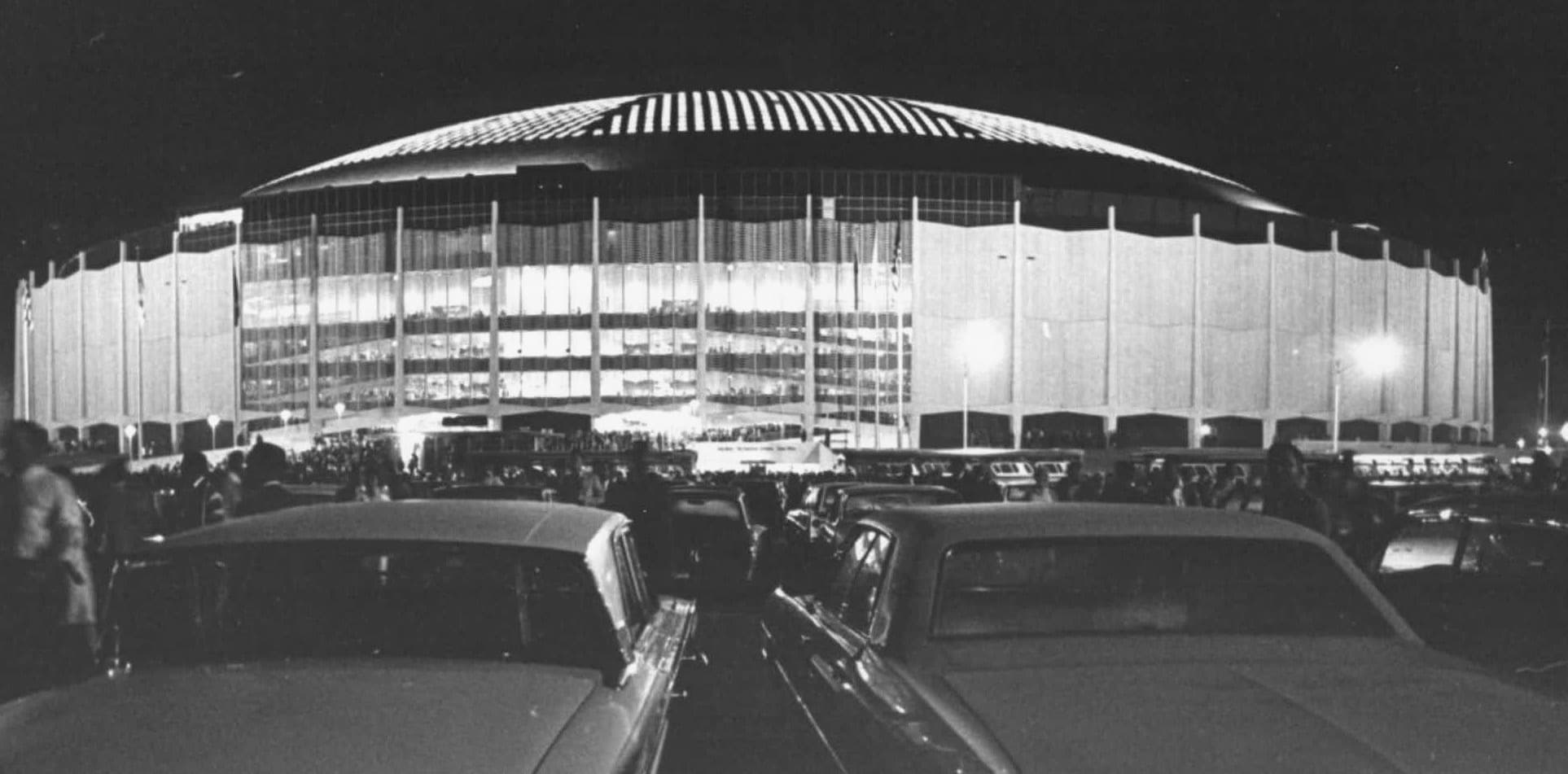
Houston Astrodome, circa 1965. The Astros entered Major League Baseball in 1962.
Photo credit: Ted Rozumalski via Wikimedia Commons
Between 1961 and 1976, major league baseball doubled in size, nearly suffocated under an avalanche of pitching dominance, rebalanced its rules to save offense, and watched its labor system crack apart. The sport added ten new franchises, moved into domed stadiums and artificial turf, and produced some of the most dramatic individual performances in its history. By the end of it, the reserve clause was dead, and the players were about to become free.
New Teams, New Cities
The American League expanded first, adding the Los Angeles Angels and a new Washington Senators franchise in 1961. The National League followed in 1962 with the New York Mets and Houston Colt .45s, who became the Astros in 1965 when they moved into the Astrodome, baseball's first indoor stadium. The Astrodome's artificial turf, installed after the original grass died under the translucent roof, spread across the sport through the 1970s and changed the way the game was played on the ground. A second wave of expansion in 1969 brought the Kansas City Royals, Seattle Pilots, Montreal Expos, and San Diego Padres, pushing both leagues to twelve teams and creating divisional play for the first time.
The 1962 Mets lost 120 games, the worst record of the twentieth century. Their manager, Casey Stengel, had won seven World Series with the Yankees. He surveyed his new roster and asked, "Can't anybody here play this game?" The Mets drew over 900,000 fans anyway, filling the Polo Grounds with a loyalty that had nothing to do with winning.
Roger Maris and the Asterisk
In 1961, Roger Maris hit 61 home runs for the Yankees, breaking Babe Ruth's single-season record of 60. The achievement should have been celebrated. Instead, Commissioner Ford Frick, a former ghostwriter for Ruth, announced that because the schedule had expanded from 154 to 162 games, Maris's record would carry a "distinctive mark" in the record books. The public understood this as an asterisk, and Maris spent the rest of his career resenting it. His hair fell out from the stress during the chase. Mickey Mantle, his teammate and the fans' preferred record-breaker, hit 54 home runs that same season, and the dual pursuit captivated the country even as Maris absorbed hostility for being the wrong man to pass Ruth.
The Year of the Pitcher
By 1968, pitching had overwhelmed the sport. Bob Gibson of the St. Louis Cardinals posted a 1.12 ERA, the lowest since the dead-ball days. Denny McLain of the Detroit Tigers won 31 games, a number no pitcher has approached since. Don Drysdale threw 58 and two-thirds consecutive scoreless innings. The American League batted .230 as a whole. Carl Yastrzemski won the AL batting title with a .301 average, the lowest for a batting champion in either league's history.
Baseball responded drastically before the 1969 season. The pitcher's mound was lowered from 15 inches to 10 inches, and the strike zone was tightened. Offense recovered immediately. The changes also coincided with the Miracle Mets, who went from ninth place in 1968 to World Series champions in 1969, beating the heavily favored Baltimore Orioles in five games. Tom Seaver, the team's 24-year-old ace, won 25 games and became the face of a franchise that had been a national joke seven years earlier.
Sandy Koufax and Roberto Clemente
Sandy Koufax's peak was the most dominant stretch by any pitcher in the live-ball era. From 1963 through 1966, he went 97-27 with a 1.86 ERA, threw four no-hitters including a perfect game, and won three Cy Young Awards. Arthritis in his left elbow forced him to retire at 30, at the absolute peak of his abilities.
Roberto Clemente played right field for the Pittsburgh Pirates with a defensive brilliance and throwing arm that no one in the sport could match. He collected exactly 3,000 hits, drove the Pirates to World Series titles in 1960 and 1971, and won twelve Gold Gloves. On December 31, 1972, Clemente died in a plane crash while delivering earthquake relief supplies to Nicaragua. He was 38. The Hall of Fame waived its five-year waiting period and inducted him in 1973.
Hank Aaron Catches Ruth
On April 8, 1974, in front of 53,775 fans at Atlanta-Fulton County Stadium, Hank Aaron hit a fastball from Al Downing of the Los Angeles Dodgers into the left-field bullpen for home run number 715, passing Babe Ruth's career record. Aaron had endured a winter of racist hate mail and death threats as he approached the record. He needed a police escort and a bodyguard traveling with him on the road. The moment itself was joyful, with teammates and his mother meeting him at home plate, but the path to it exposed the ugliness that still ran through American sports.
The Reserve Clause Falls
Curt Flood, a Gold Glove center fielder for the Cardinals, refused a trade to the Philadelphia Phillies after the 1969 season and sued Major League Baseball, arguing that the reserve clause, which bound a player to his team indefinitely, violated antitrust law. Flood lost his case at the Supreme Court in 1972 but won the argument. His sacrifice, he never played meaningfully again, laid the groundwork for what came next.
In December 1975, arbitrator Peter Seitz ruled that pitchers Andy Messersmith and Dave McNally, who had played without signing contracts, were free agents. The reserve clause was finished. The Big Red Machine in Cincinnati, featuring Pete Rose, Johnny Bench, Joe Morgan, and Tony Perez, won back-to-back World Series in 1975 and 1976 as the last great team of the old economic order. Everything after Seitz's ruling would operate under new rules.
Related Articles
The 25-Inning Game
On September 11, 1974, the Cardinals and Mets played 25 innings at Shea Stadium. The game lasted 7 hours and 4 minutes and ended at 3:12 AM. The era of the all-night baseball game is over.
Continue Reading
The Astrodome and Baseball Under Glass
When the Astrodome opened in 1965, it was nicknamed the Eighth Wonder of the World. Then the grass died, AstroTurf was born, and the building became the most influential problem in stadium history.
Continue Reading
Bang the Drum Slowly and the Saddest Baseball Movie Ever Made
In 1973, Robert De Niro played a slow-witted catcher dying of Hodgkin's disease. The film is the baseball movie for people who don't need a home run to end the story.
Continue Reading
When Baseball Went Coast to Coast
The Dodgers and Giants left New York after the 1957 season, breaking Brooklyn's heart and bringing major league baseball to the West Coast. The moves transformed a regional sport into a national one.
Continue Reading
The Batting Helmet and the Decades Baseball Refused to Protect Its Hitters
From Roger Bresnahan's inflatable head protector to mandatory earflaps, MLB took more than seven decades to fully require basic head protection for hitters.
Continue Reading
Ron Shelton, Minor League Baseball, and the Making of Bull Durham
Ron Shelton's years in the Orioles' farm system gave Bull Durham its point of view, baseball from inside the clubhouse instead of from the cheap seats.
Continue Reading
Candlestick Park and the Wind
Candlestick Park was built on a point of land jutting into San Francisco Bay, and the wind that came off the water defined everything about the place. It was supposed to be a monument. Instead, it became a cautionary tale about site selection.
Continue Reading
The Last Flight of Roberto Clemente
Roberto Clemente boarded a cargo plane on New Year's Eve 1972 to deliver earthquake relief supplies to Nicaragua. He never arrived.
Continue Reading
Cleveland Municipal Stadium and the Lake
Cleveland Municipal Stadium was built for 78,000 fans and regularly drew 5,000. The wind off Lake Erie made night games brutal. It was also the site of Ten Cent Beer Night.
Continue Reading
Comiskey Park and Eighty Years on 35th Street
Built on a city dump for $750,000 and christened the Baseball Palace of the World, Comiskey Park stood at 35th and Shields for eighty seasons, hosting the first All-Star Game, the Black Sox scandal, and Disco Demolition Night before the wrecking ball arrived in 1991.
Continue Reading
County Stadium, Milwaukee
County Stadium was built in 1953 to lure a major league team to Milwaukee. The parking lot became the best tailgating venue in baseball. The smell of grilling sausage was as much a part of the experience as the game.
Continue Reading
Floodwater, Floodlights, and the Hill in Left Field at Crosley
Crosley Field hosted the first night game in major league history, survived a flood that put 21 feet of water over home plate, and featured a left field terrace that no visiting outfielder ever fully trusted.
Continue Reading
The Curse of Rocky Colavito
On April 17, 1960, the Cleveland Indians traded Rocky Colavito, the most popular player in the city, for Harvey Kuenn. It destroyed the Indians for a generation.
Continue Reading
The Curse of the Bambino
The Red Sox sold Babe Ruth to the Yankees in January 1920 and didn't win a World Series for the next 86 years. The drought produced so many near-misses, so many collapses in exactly the wrong moment, that it stopped looking like bad luck and started looking like something else.
Continue Reading
The Designated Hitter and the 50-Year War Between the Leagues
For 49 years, the AL and NL played by different rules. The designated hitter split the sport in 1973 and stayed a fault line until the universal DH arrived in 2022.
Continue Reading
Dock Ellis, June 12, 1970
Dock Ellis threw a no-hitter in San Diego on June 12, 1970, in a game he later said he pitched under LSD. The stat line is real, and so is the complicated life around it.
Continue Reading
Ebbets Field and the Soul of Brooklyn Baseball
Built on a garbage dump called Pigtown and demolished before its fiftieth birthday, Ebbets Field packed more history per square foot than any ballpark in America.
Continue Reading
The Exploding Scoreboard
In 1960, Bill Veeck installed a scoreboard at Comiskey Park that shot off fireworks every time a White Sox player hit a home run. It was the direct ancestor of every modern stadium celebration.
Continue Reading
Steel, Ivy, and Sixty-One Years at Forbes Field
Forbes Field stood in Pittsburgh's Oakland neighborhood for sixty-one years, hosted the only walk-off home run in a Game 7, and left behind a section of outfield wall that still marks its original location on the University of Pittsburgh campus.
Continue Reading
Free Agency and the Messersmith Decision
For a century, baseball's reserve clause allowed teams to control a player's career indefinitely. It took a Cardinals outfielder willing to sacrifice his own career, a Supreme Court loss, and two pitchers who played a season without contracts to break it.
Continue Reading
Gaylord Perry and the Grease Ball
Gaylord Perry won 314 games and two Cy Young Awards. He was also, by virtually everyone's estimation including his own, a cheat. He was ejected for doctoring a baseball exactly once in 22 seasons.
Continue Reading
715 in Atlanta
Hank Aaron's 715th home run on April 8, 1974 is one of baseball's defining moments, but the full weight of his career is in the consistency that got him there.
Continue Reading
Jimmy Piersall Runs the Bases Backwards
On June 23, 1963, Jimmy Piersall hit his 100th career home run and ran the bases backwards. Two days later, the Mets released him. What made the story more than a blooper was Piersall's history with mental illness.
Continue Reading
Lost Ballparks and the Artifact Market
When Ebbets Field came down in 1960, pieces of the Dodgers' home scattered across the country. Seats, signs, bricks, and structural pieces from demolished ballparks now form a niche collectibles market where provenance is the central pricing driver.
Continue Reading
Mazeroski's Walk-Off and the Game 7 They Found in a Wine Cellar
On October 13, 1960, Bill Mazeroski hit the only walk-off home run in a Game 7 in World Series history. The NBC broadcast was lost for decades until a copy was found in Bing Crosby's wine cellar.
Continue Reading
Minnie Miñoso Opened the South Side
Minnie Miñoso broke the White Sox color barrier on May 1, 1951, became a South Side star, and helped define what a Latino superstar could look like in major-league baseball.
Continue Reading
The Miracle Mets of 1969
The 1969 New York Mets went from the worst franchise in baseball history to World Series champions in seven years. Nobody saw it coming, and the story still resists rational explanation.
Continue Reading
Morganna the Kissing Bandit
Between 1969 and 1999, a burlesque dancer named Morganna Roberts ran onto the field at major league games and kissed players. She was arrested repeatedly and became one of the most recognizable figures in American sports.
Continue Reading
The Polo Grounds and the Ghosts of Coogan's Hollow
For more than half a century, the Polo Grounds sat in the shadow of Coogan's Bluff, its horseshoe shape producing some of the strangest and most famous plays in baseball history.
Continue Reading
RFK Stadium and the Fans Who Stole the Final Game
On September 30, 1971, the Washington Senators led the Yankees 7-5 with two outs in the ninth. One out from a victory in their final game, several hundred fans stormed the field and stole everything they could carry.
Continue Reading
The Concrete Cathedral at 21st and Lehigh
Baseball's first steel-and-concrete stadium opened on April 12, 1909, in a North Philadelphia neighborhood where chickens still pecked in empty lots, and stood for sixty-seven years through seven World Series, two tenants, a spite fence, a riot, and a fire.
Continue Reading
A Century of Baseball at Sportsman's Park
For ninety years, the northwest corner of Grand Boulevard and Dodier Street hosted professional baseball in St. Louis, and no other intersection in America held two major league tenants for as long or produced a World Series played entirely in one park.
Continue Reading
The Fastest Pitcher Nobody Ever Saw
Teammates, coaches, and Hall of Famers swore Steve Dalkowski threw harder than anyone in history, but baseball never measured it on the record.
Continue Reading
Ten Cent Beer Night
On June 4, 1974, the Cleveland Indians offered fans beer for 10 cents a cup. An estimated 60,000 cups were consumed. What followed was a full-scale riot that ended in a forfeit.
Continue Reading
104 Years of Baseball at Michigan and Trumbull
From a wooden grandstand built on a former hay market in 1896 to Robert Fick's rooftop grand slam in 1999, the corner of Michigan and Trumbull hosted professional baseball longer than any other site in America.
Continue Reading
Veterans Stadium and the Jail in the Basement
Veterans Stadium installed a courtroom and holding cell in the basement, staffed by a municipal judge during games, to process fans arrested for fighting. The jail became the stadium's most famous feature.
Continue Reading
The Year of the Pitcher and the Mound That Came Down
1968 pushed pitching dominance to the edge, and MLB responded by lowering the mound and shrinking the strike zone for 1969 to restore offense.
Continue Reading
Profiles from This Era
Andre Dawson
Right Field · b. 1954
Hall of Fame 2010
Continue Reading
Bert Blyleven
Pitcher · b. 1951
Hall of Fame 2011
Continue Reading
Bill Mazeroski
Second Base · 1936–2026
Hall of Fame 2001
Continue Reading
Bill Veeck
Executive · 1914–1986
Hall of Fame 1991
Continue Reading
Bruce Sutter
Pitcher · 1953–2022
Hall of Fame 2006
Continue Reading
Carlton Fisk
Catcher · b. 1947
Hall of Fame 2000
Continue Reading
Dave Winfield
Right Field · b. 1951
Hall of Fame 2001
Continue Reading
Dennis Eckersley
Pitcher · b. 1954
Hall of Fame 2004
Continue Reading
Dick Williams
Manager · 1929–2011
Hall of Fame 2008
Continue Reading
Dock Ellis
Pitcher · 1945–2008
Continue Reading
Doug Harvey
Umpire · 1930–2018
Hall of Fame 2010
Continue Reading
Eddie Murray
First Base · b. 1956
Hall of Fame 2003
Continue Reading