Profile
Dick Williams
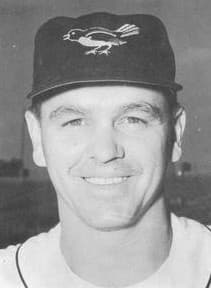
Dick Williams portrait, 1957.
Photo credit: Unknown photographer via Wikimedia Commons
Dick Williams managed like a man who expected to be fired and intended to win first, a hard, brilliant disciplinarian who turned losers into champions faster than almost anyone and wore them out just as fast. He took over six franchises in 21 years, won the 1967 American League pennant with the Impossible Dream Red Sox, won back-to-back World Series with the Oakland Athletics, and carried the San Diego Padres to their first pennant, three different teams he led to the World Series. The Veterans Committee elected him to the Hall of Fame in 2008.
A Utility Man Who Studied the Game
Williams was born on May 7, 1929, in St. Louis and reached the Brooklyn Dodgers in 1951 as a promising young outfielder, until a diving catch in August 1952 separated his shoulder and ruined his throwing arm. He turned himself into a utility man who survived on versatility and a sharp baseball mind, and he spent 13 seasons studying every manager he played for. "I learned from every manager what to do and what not to do," he said. He owed the most to Bobby Bragan in the minor leagues. "There should be a note under every one of my records that says, See Bobby Bragan," Williams said, "because a bit of every one of my wins belongs to him."
The Impossible Dream
The 1966 Red Sox had finished ninth in a 10-team league, half a game out of last, and nobody expected anything from them when Williams took over. He promised otherwise, telling them in spring training, "I honestly believe we'll win more games than we lose," which sounded like nonsense at the time. Then Carl Yastrzemski won the Triple Crown, the Red Sox took a four-team pennant race on the final day of the season, and a city that had not seen a winner in a generation fell for the team Boston still calls the Impossible Dream. The Cardinals beat them in a seven-game World Series, and Williams was named Manager of the Year. Two years later the same hard edge that drove the turnaround got him fired, after he benched Yastrzemski over a lazy play and called the owner Tom Yawkey a front-runner who shared the wins and ducked the losses.
Oakland's Dynasty
Charlie Finley hired Williams to manage his young, talented, quarrelsome Athletics, a clubhouse of Reggie Jackson, Catfish Hunter, and Rollie Fingers, and together they won everything. "This team was basically 25 versions of me," Williams said, "25 guys who didn't care about anything but winning." The Athletics took the 1972 World Series from Cincinnati and the 1973 Series from the Mets, the heart of a dynasty that would win three straight, and Williams ran it with a steady hand and a quick hook, once benching an All-Star catcher for a backup who promptly won two Series games with home runs.
The Mike Andrews Affair
The winning could not hold the partnership together. During the 1973 World Series, second baseman Mike Andrews made two errors in a loss, and Finley forced him to sign a false affidavit calling himself injured, trying to wipe him off the roster. The team taped Andrews's number to their sleeves in protest, the commissioner ordered him reinstated, and Williams, sick of working for a man who would humiliate a player like that, told his team before the next game that he would resign when the Series ended. He won the title and walked out the door.
The Wandering Years
Williams never stayed anywhere long, because the discipline that won quickly grated over time. He ran six franchises in 21 years, and the pattern repeated at nearly every stop, fast success followed by friction. After Oakland he failed to revive the California Angels, then took a 107-loss Montreal Expos club and built it into a near-contender before his hard edge wore on the pitchers and got him fired during a 1981 pennant drive. He was an early adopter of videotape, breaking down games on borrowed equipment, a modernizer underneath the old-school bark. "Dick showed us how to study the game," said George Scott, who played for him in Boston. "He pressed the right buttons for everyone."
The First Pennant in San Diego
Williams found one more winner in San Diego, a Padres franchise that had never finished above fourth. In 1984 he took them to the National League West title, and in the playoffs they fell behind the Chicago Cubs two games to none before winning three straight to take the pennant, the first in the team's history, on a Steve Garvey walk-off home run in Game 4 and a Cubs error in Game 5 that swung the door open. The Detroit Tigers beat them in a five-game World Series, but Williams had done something only Bill McKechnie had done before him, carrying a third different franchise to the World Series.
The Hardest Man in the Dugout
Williams ran his teams on fundamentals, accountability, and fear, and he never apologized for it, titling his memoir No More Mister Nice Guy. He was thrown out of 57 games, wore out his welcome again and again, and won wherever he went anyway. The players who chafed under him tended to respect him later. "He's one of the best managers of all time," Goose Gossage said, "and the best manager I've ever played for." Williams managed his last game in 1988, finished 1,571-1,451, and went into the Hall of Fame in 2008 with an Oakland cap on his plaque. He died on July 7, 2011, in Henderson, Nevada, at 82.