Profile
Carl Yastrzemski
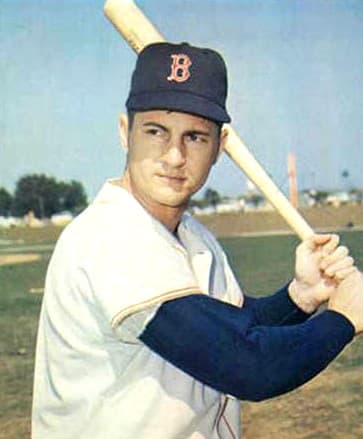
Carl Yastrzemski portrait, 1969.
Photo credit: Unknown author via Wikimedia Commons (Public domain)
Carl Michael Yastrzemski grew up on a 70-acre potato farm on Long Island where his father played shortstop for the semipro Bridgehampton White Eagles, turned down offers from the Dodgers and Cardinals because he preferred farming during the Depression, and raised his son to hit a baseball the way other fathers taught theirs to drive a tractor. Yastrzemski played 23 seasons for the Boston Red Sox, all of them, collected 3,419 hits and 452 home runs, won the 1967 Triple Crown during the most dramatic pennant race of his generation, led the American League in batting three times, won seven Gold Gloves, and became the first AL player to reach both 3,000 hits and 400 home runs. He replaced Ted Williams in left field at Fenway Park and spent two decades proving that the impossible job of following the greatest hitter who ever lived could be done if you showed up every day and refused to give in. "I loved the game," Yastrzemski said. "I loved the competition. But I never had any fun." The BBWAA elected him to the Hall of Fame in 1989 on 94.6 percent of the ballot.
Bridgehampton
Yastrzemski was born on August 22, 1939, in Southampton, New York, to Karol and Hattie Yastrzemski, both children of Polish immigrants. The family's potato farm in Bridgehampton was "a legacy from Poland," and his father played alongside him on the White Eagles through Carl's teenage years, retiring from the field only when his son signed professionally. The Yankees offered $60,000. Carl's father countered at $100,000, and when the scout flipped his pencil in the air at the number, the elder Yastrzemski threw him out of the house. "Nobody throws a pencil in my house," he said. "Get the hell out and never come back." The Red Sox signed Carl in November 1958 for a $108,000 bonus. His father raised his weekly allowance from $5 to $7.50.
Yastrzemski attended Notre Dame on a baseball and basketball scholarship, studied business, and completed his degree at Merrimack College in 1966. He spent two minor league seasons in Raleigh (.377, Carolina League MVP) and Minneapolis (.339, American Association championship) before debuting at Fenway Park on April 11, 1961, as Williams' replacement in left field. He singled in his first at bat and finished the rookie year at .266 with 11 home runs. "I started off very slow, trying to emulate Ted," Yastrzemski said. "I could never be a Ted Williams as far as hitting was concerned."
The Impossible Dream
The Red Sox finished ninth in 1966, and nobody expected anything different in 1967. Yastrzemski changed that. He won the Triple Crown with a .326 average, 44 home runs, and 121 RBI, carried the team through a pennant race so tight that four teams were within one game of first place with two weeks to play, and delivered a final two weeks that remains the most sustained clutch performance a hitter has produced in the history of the sport. Over the last 12 games he went 23-for-44 with 16 RBI and 14 runs scored. In the final two games against Minnesota, with the pennant on the line, Yastrzemski went 7-for-8 with six RBI. George Scott, his teammate, summarized the year. "Yaz hit 44 homers that year, and 43 of them meant something big for the team."
Yastrzemski won the AL MVP (one writer voted for Cesar Tovar) and Sports Illustrated's Sportsman of the Year. The Red Sox lost the World Series to the Cardinals in seven games, but the pennant race transformed the franchise from an afterthought into a civic institution. No player matched the Triple Crown until Miguel Cabrera in 2012, 45 years later. In 1968, the Year of the Pitcher, Yastrzemski won the batting title at .301, the lowest average ever to lead a league, because he was the only AL hitter above .300.
Fenway
Yastrzemski won his first batting title in 1963 at .321 with 40 doubles and his first Gold Glove, establishing himself as the best left fielder in the league while the adjustment to replacing Williams receded. He won the 1970 All-Star Game MVP with four hits at Riverfront Stadium in Cincinnati, and in February 1971 he signed a three-year contract worth $500,000, the largest in the history of the game at that point.
The 1975 Red Sox reached the World Series against the Big Red Machine, and Yastrzemski hit .350 across 10 postseason games that October. The Series went to seven games after Carlton Fisk's 12th-inning home run won Game 6, and in Game 7, with the Reds leading 4-3 in the ninth, Yastrzemski flew out to center field for the final out. He played in two World Series (1967 and 1975), lost both in seven games, and made the last out in both Game 7s.
Dan Shaughnessy wrote, "There can be little doubt that Carl Yastrzemski was the master of wall-ball defense." Yastrzemski played caroms off the Green Monster with a precision that turned Fenway's left field into a weapon, studying the angles of the wall the way his father studied potato rows in Bridgehampton. He won seven Gold Gloves and led the league in assists seven times, and runners learned that hitting one off the Monster with Yastrzemski in left was often worse than hitting one to the gap.
Yastrzemski set the Red Sox career record for hits on July 14, 1977, passing Ted Williams at 2,655. On July 24, 1979, he hit his 400th home run off Oakland's Mike Morgan, and on September 12 he singled off Jim Beattie of the Yankees for his 3,000th hit, becoming the first American Leaguer with both milestones. He played 3,308 games across 23 seasons, made 18 All-Star teams, and held the major league record for career games until Pete Rose passed him in 1984. Bill Lee, the pitcher who shared a clubhouse with Yastrzemski for years, offered the tribute that only Lee could give. "He's a dull, boring potato farmer from Long Island who just happened to be a great ballplayer."
On October 1, 1983, Yastrzemski walked around Fenway Park shaking hands with fans in the stands before his final game, broke down at the microphone during the ceremony, and closed with five words. "New England, I love you." His grandson Mike Yastrzemski debuted for the San Francisco Giants in 2019 and hit a home run at Fenway Park on September 17 of that year, with his grandfather in the stands throwing out the ceremonial first pitch the following night.