Era Overview
The Integration Era
1942–1960
Jackie Robinson broke baseball's color line in 1947, the sport's greatest stars overlapped in New York, and the game's geography shifted west for the first time.
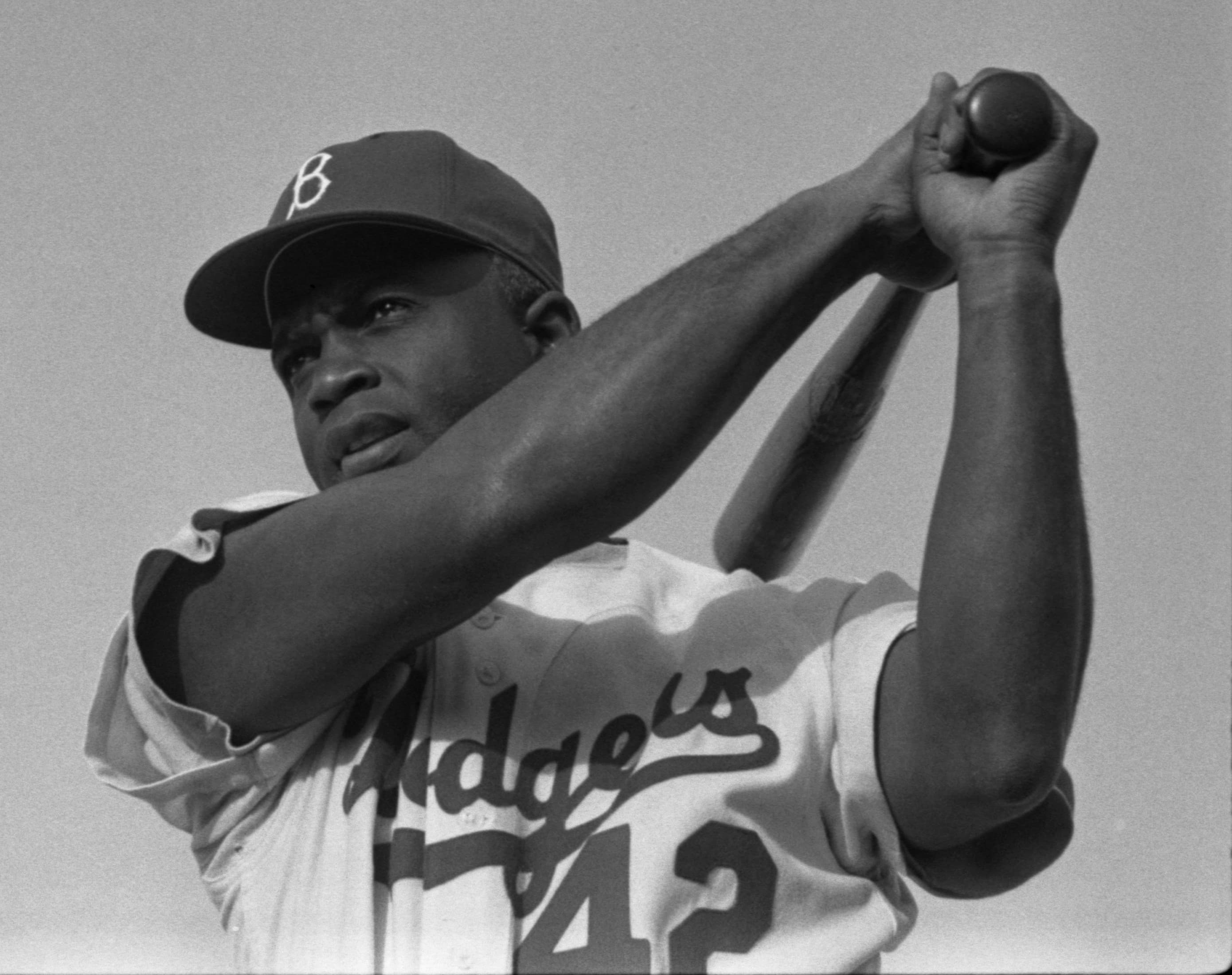
Jackie Robinson, 1954. First black player in modern Major League Baseball.
Photo credit: Bob Sandberg / LOOK Magazine / LOC via Wikimedia Commons
The Integration Era began with a war and ended with a migration. Between 1942 and 1960, baseball absorbed the shock of World War II, confronted its most shameful tradition, produced a generation of transcendent talent, and watched two of its most storied franchises leave New York for California. The game that emerged was faster, more diverse, and more national than anything that came before.
The War Years
World War II drained major league rosters of their best players. Ted Williams, Joe DiMaggio, Bob Feller, Hank Greenberg, and hundreds of others traded uniforms for military service. Williams had just hit .406 in 1941, the last .400 season in baseball history, and he gave up three full seasons of his prime to serve as a Marine aviator. Feller enlisted the day after Pearl Harbor and missed nearly four complete seasons. Teams filled gaps with aging veterans, teenagers, and players previously considered too limited for the majors. The St. Louis Browns employed one-armed outfielder Pete Gray in 1945. The quality of play dropped visibly, and attendance fluctuated, but the games continued.
Women filled part of the void. The All-American Girls Professional Baseball League, founded by Philip Wrigley in 1943, operated through 1954 and put competitive baseball in front of fans across the Midwest. The league peaked at over 900,000 total attendance in 1948.
Jackie Robinson
On April 15, 1947, Jackie Robinson walked onto Ebbets Field as the Brooklyn Dodgers' first baseman and became the first black player in the major leagues since the 1880s. Branch Rickey, the Dodgers' general manager, had recruited Robinson specifically for his ability to withstand abuse without retaliating. Robinson endured death threats, racial slurs from opponents and fans, and cold treatment from some of his own teammates. He hit .297 with 12 home runs and 29 stolen bases and won the inaugural Rookie of the Year award.
Robinson's arrival was the start of a slow, uneven process. Larry Doby integrated the American League with the Cleveland Indians on July 5, 1947, just eleven weeks after Robinson's debut. Doby faced similar hostility with less public support. By 1950, only five of the sixteen major league teams had black players. The Boston Red Sox didn't integrate until 1959, making them the last team to do so.
The Negro Leagues, which had thrived for three decades, saw their audience and their talent drain toward the majors throughout the 1950s. The Negro American League folded in 1962. Integration was liberation for individual players and extinction for the institutions that had sustained black baseball.
New York's Golden Age
From 1947 through 1957, New York City fielded three teams, and at least one of them played in the World Series every single year. The Yankees, Dodgers, and Giants produced an extraordinary concentration of talent. Mickey Mantle patrolled center field at Yankee Stadium with a combination of speed and power that made him the American League's most dangerous hitter for a decade. Willie Mays, who debuted with the Giants in 1951, played center field with a joyful recklessness that produced The Catch, an over-the-shoulder grab in the 1954 World Series that remains the most replayed defensive play in baseball history.
The Dodgers had Robinson, Roy Campanella, Duke Snider, Pee Wee Reese, and a pitching staff anchored by Don Newcombe. They finally beat the Yankees in the 1955 World Series after five previous losses, a championship that Brooklyn treated as a civic miracle. The rivalry between these three teams defined an era, and arguments about which center fielder was the best, Mantle, Mays, or Snider, became a permanent feature of New York bar conversation.
The Franchises Move West
On September 24, 1957, the Brooklyn Dodgers played their final game at Ebbets Field. The New York Giants played their last at the Polo Grounds five days later. Both teams relocated to California for the 1958 season, the Dodgers to Los Angeles and the Giants to San Francisco. Walter O'Malley, the Dodgers' owner, had spent years trying to get New York City to help him build a new stadium in Brooklyn. When Robert Moses, the city's master builder, refused to accommodate him, O'Malley took his team west and brought Horace Stoneham's Giants along.
The moves devastated fans in Brooklyn and upper Manhattan. They also transformed baseball from an eastern and midwestern sport into a continental one. The Dodgers drew nearly 1.85 million fans in their first Los Angeles season, playing in the cavernous Memorial Coliseum while Dodger Stadium was under construction. The expansion that followed in 1961 and 1962, bringing new teams to Houston, New York, Los Angeles, and the Twin Cities, was a direct consequence of the westward shift.
The Talent
Beyond Mays and Mantle, the Integration Era produced some of the deepest talent pools the sport has ever seen. Hank Aaron debuted with the Milwaukee Braves in 1954 and began a 23-year career that would end with 755 home runs. Ernie Banks hit 512 home runs as a shortstop and first baseman for the Chicago Cubs, earning the nickname "Mr. Cub" and the catchphrase "Let's play two." Frank Robinson won MVP awards in both leagues. Roberto Clemente arrived in Pittsburgh in 1955, a 20-year-old from Carolina, Puerto Rico, who would become one of the greatest right fielders in history.
Warren Spahn won 363 games, more than any left-handed pitcher in history. Sandy Koufax signed with the Dodgers in 1955 as a wild, overpowering teenager and would not figure out how to pitch until the next decade. The era ended with the sport richer, broader, and more talented than it had ever been, and the full consequences of integration were still unfolding.
Related Articles
The 14-Year-Old Who Fixed Ted Williams's Bats
In 1948, a 14-year-old named David Pressman left his baseball bat outside overnight, weighed it on a post office scale, and discovered that wood absorbs moisture. He wrote a letter to Ted Williams. Williams listened.
Continue Reading
The 1952 Topps Mickey Mantle and the Most Expensive Baseball Card in History
At 12:28 AM on August 28, 2022, Heritage Auctions sold a 1952 Topps Mickey Mantle for $12.6 million. It was the most expensive baseball card ever sold and the most expensive sports collectible in history.
Continue Reading
42 and the Jackie Robinson Movie That Took 66 Years
Jackie Robinson broke baseball's color line in 1947. Hollywood did not make a major theatrical film about it until 2013. The gap tells its own story.
Continue Reading
A League of Their Own and the History Behind the Story
The 1992 film brought the AAGPBL back into public memory, but the real league history includes stricter gender rules and racial exclusion that the movie only lightly addressed.
Continue Reading
The All-American Girls Professional Baseball League
Philip Wrigley launched the All-American Girls Professional Baseball League in 1943 to fill empty wartime ballparks, and for twelve seasons it drew hundreds of thousands of fans to watch women play professional ball. The league folded in 1954 and was largely forgotten until a Hall of Fame exhibit and a Hollywood film brought it back.
Continue Reading
The Batting Helmet and the Decades Baseball Refused to Protect Its Hitters
From Roger Bresnahan's inflatable head protector to mandatory earflaps, MLB took more than seven decades to fully require basic head protection for hitters.
Continue Reading
Bobby Thomson's Shot Heard Round the World
On October 3, 1951, Bobby Thomson hit a three-run homer in the bottom of the ninth to win the pennant. Fifty years later, the 1951 Giants confirmed they had been stealing signs all season.
Continue Reading
Branch Rickey Built the Farm System (and Then Broke the Color Line)
Branch Rickey made two decisions that changed baseball more than any other executive in the sport's history. The first was an innovation in business. The second was a moral act with economic consequences.
Continue Reading
Cleveland Municipal Stadium and the Lake
Cleveland Municipal Stadium was built for 78,000 fans and regularly drew 5,000. The wind off Lake Erie made night games brutal. It was also the site of Ten Cent Beer Night.
Continue Reading
Comiskey Park and Eighty Years on 35th Street
Built on a city dump for $750,000 and christened the Baseball Palace of the World, Comiskey Park stood at 35th and Shields for eighty seasons, hosting the first All-Star Game, the Black Sox scandal, and Disco Demolition Night before the wrecking ball arrived in 1991.
Continue Reading
County Stadium, Milwaukee
County Stadium was built in 1953 to lure a major league team to Milwaukee. The parking lot became the best tailgating venue in baseball. The smell of grilling sausage was as much a part of the experience as the game.
Continue Reading
Floodwater, Floodlights, and the Hill in Left Field at Crosley
Crosley Field hosted the first night game in major league history, survived a flood that put 21 feet of water over home plate, and featured a left field terrace that no visiting outfielder ever fully trusted.
Continue Reading
Ebbets Field and the Soul of Brooklyn Baseball
Built on a garbage dump called Pigtown and demolished before its fiftieth birthday, Ebbets Field packed more history per square foot than any ballpark in America.
Continue Reading
The Smallest Man to Ever Play Major League Baseball
On August 19, 1951, Eddie Gaedel popped out of a birthday cake at Sportsman's Park, walked to the plate in a Browns uniform with 1/8 on his back, and drew a four-pitch walk. He was 3 feet 7 inches tall. He never played again.
Continue Reading
Effa Manley Ran the Eagles
Effa Manley helped build the Newark Eagles into champions, fought for black baseball in public, and became the first woman elected to the Hall of Fame in 2006.
Continue Reading
The Myth of Fidel Castro's Fastball
There is a famous story that Fidel Castro was scouted by major league teams as a pitching prospect. It is almost entirely false, traceable to a single fabricated magazine article.
Continue Reading
Steel, Ivy, and Sixty-One Years at Forbes Field
Forbes Field stood in Pittsburgh's Oakland neighborhood for sixty-one years, hosted the only walk-off home run in a Game 7, and left behind a section of outfield wall that still marks its original location on the University of Pittsburgh campus.
Continue Reading
Griffith Stadium, Washington
Griffith Stadium hosted the Senators' only World Series championship in 1924 and the Homestead Grays' greatest home runs during the segregation era. It stood at the corner of Georgia Avenue and W Street from 1911 to 1965.
Continue Reading
715 in Atlanta
Hank Aaron's 715th home run on April 8, 1974 is one of baseball's defining moments, but the full weight of his career is in the consistency that got him there.
Continue Reading
How American Oil Brought Baseball to Venezuela
In every other South American country, soccer is the national sport. In Venezuela, it's baseball. The reason involves oil derricks, Cuban cigar workers, a dictator who liked Americans, and one game in Havana that turned a sport into a national religion.
Continue Reading
The Girl Who Struck Out Babe Ruth and Lou Gehrig
In April 1931, 17-year-old Jackie Mitchell faced Babe Ruth and Lou Gehrig in Chattanooga and struck out both Yankees icons in sequence.
Continue Reading
April 15, 1947
Jackie Robinson walked onto Ebbets Field as the Brooklyn Dodgers' first baseman and broke a barrier that had held for more than sixty years. The game itself was almost beside the point.
Continue Reading
Baseball's Dirty Secret Comes From a Hole in the Ground
Every Major League baseball is rubbed with mud harvested from one secret New Jersey location, a supply chain that has lasted for generations.
Continue Reading
Lost Ballparks and the Artifact Market
When Ebbets Field came down in 1960, pieces of the Dodgers' home scattered across the country. Seats, signs, bricks, and structural pieces from demolished ballparks now form a niche collectibles market where provenance is the central pricing driver.
Continue Reading
Minnie Miñoso Opened the South Side
Minnie Miñoso broke the White Sox color barrier on May 1, 1951, became a South Side star, and helped define what a Latino superstar could look like in major-league baseball.
Continue Reading
The Negro Leagues Were Major Leagues
For three decades, the Negro Leagues produced some of the best baseball ever played in the United States, built a parallel economy of black-owned teams and venues, and developed talent that white baseball refused to acknowledge until it could no longer afford to ignore.
Continue Reading
The Polo Grounds and the Ghosts of Coogan's Hollow
For more than half a century, the Polo Grounds sat in the shadow of Coogan's Bluff, its horseshoe shape producing some of the strangest and most famous plays in baseball history.
Continue Reading
The Concrete Cathedral at 21st and Lehigh
Baseball's first steel-and-concrete stadium opened on April 12, 1909, in a North Philadelphia neighborhood where chickens still pecked in empty lots, and stood for sixty-seven years through seven World Series, two tenants, a spite fence, a riot, and a fire.
Continue Reading
A Century of Baseball at Sportsman's Park
For ninety years, the northwest corner of Grand Boulevard and Dodier Street hosted professional baseball in St. Louis, and no other intersection in America held two major league tenants for as long or produced a World Series played entirely in one park.
Continue Reading
The Fastest Pitcher Nobody Ever Saw
Teammates, coaches, and Hall of Famers swore Steve Dalkowski threw harder than anyone in history, but baseball never measured it on the record.
Continue Reading
How "Take Me Out to the Ball Game" Became Baseball's Shared Song
Written in 1908 as a Tin Pan Alley hit, Take Me Out to the Ball Game evolved into baseball's communal anthem through decades of reuse and reinvention.
Continue Reading
Willie Mays, Vic Wertz, and the Catch
On September 29, 1954, Willie Mays turned his back to the plate and ran 425 feet to catch Vic Wertz's drive at the Polo Grounds. It remains the most famous defensive play in baseball history.
Continue Reading
104 Years of Baseball at Michigan and Trumbull
From a wooden grandstand built on a former hay market in 1896 to Robert Fick's rooftop grand slam in 1999, the corner of Michigan and Trumbull hosted professional baseball longer than any other site in America.
Continue Reading
"Who's on First?" How a Baseball Bit Became a Cultural Artifact
Abbott and Costello's routine moved from vaudeville and radio to Cooperstown and the Library of Congress, becoming one of baseball's most durable pieces of popular culture.
Continue Reading
The Man Who Stole a Yankee's Life
In 1948, papers across the country reported former Yankee Julie Wera had died in California. The real Julie Wera was alive in Rochester.
Continue Reading
Profiles from This Era
Al Barlick
Umpire · 1915–1995
Hall of Fame 1989
Continue Reading
Al Kaline
Right Field · 1934–2020
Hall of Fame 1980
Continue Reading
Al Lopez
Catcher · 1908–2005
Hall of Fame 1977
Continue Reading
Alex Pompez
Executive · 1890–1974
Hall of Fame 2006
Continue Reading
Bill Veeck
Executive · 1914–1986
Hall of Fame 1991
Continue Reading
Billy Evans
Umpire · 1884–1956
Hall of Fame 1973
Continue Reading
Billy Herman
Second Base · 1909–1992
Hall of Fame 1975
Continue Reading
Billy Southworth
Manager · 1893–1969
Hall of Fame 2008
Continue Reading
Billy Williams
Left Field · b. 1938
Hall of Fame 1987
Continue Reading
Biz Mackey
Catcher · 1897–1965
Hall of Fame 2006
Continue Reading
Bob Gibson
Pitcher · 1935–2020
Hall of Fame 1981
Continue Reading
Bob Lemon
Pitcher · 1920–2000
Hall of Fame 1976
Continue Reading