Profile
Bob Gibson
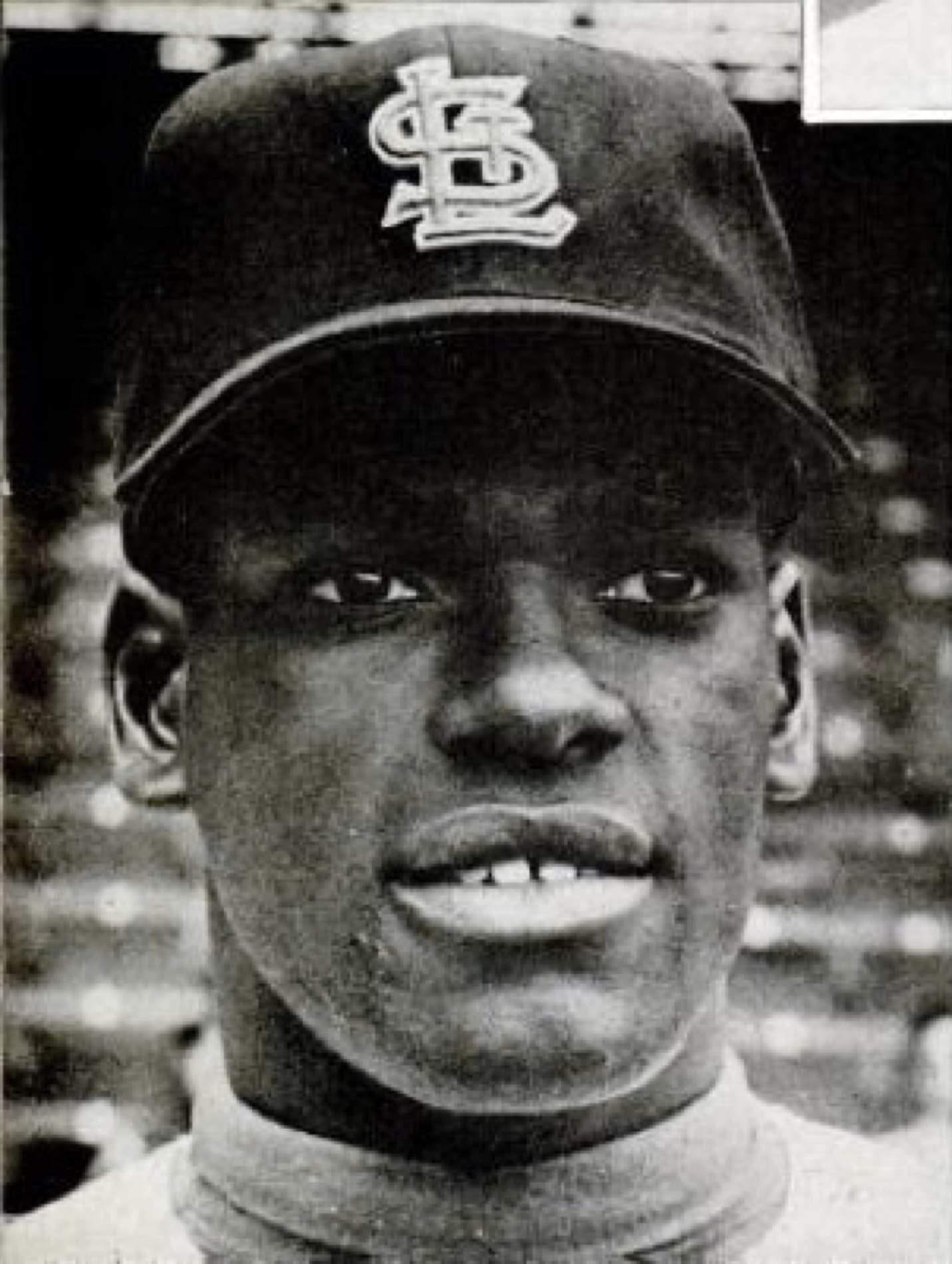
Bob Gibson portrait, 1962.
Photo credit: Unknown author via Wikimedia Commons (Public domain)
Pack Robert Gibson pitched as though he were double parked. That was Vin Scully's line, and it captured everything about the way Gibson worked, the explosive delivery, the cap pulled low, the ball hidden behind his right hip until the last possible instant, the right side of his body hurtling toward first base as his arm came through. Gibson won 251 games, struck out 3,117 batters, and posted a 1.12 ERA in 1968 that was so dominant baseball changed its rules to give hitters a chance. He won two Cy Young Awards, two World Series MVP awards, and nine Gold Gloves. Tim McCarver, who caught him for a decade, called him "the most intimidating, arrogant pitcher ever to kick up dirt on a mound." The BBWAA elected Gibson to the Hall of Fame in 1981 on 84 percent of the ballot.
Omaha
Gibson was born on November 9, 1935, in Omaha, Nebraska, the youngest of seven children. His father Pack Sr. died of tuberculosis three months before Gibson's birth. His mother Victoria worked in a laundry and cleaned houses to support the family in the Logan-Fontenelle housing project on Omaha's north side. Gibson was afflicted with rickets, asthma, and a heart murmur as a child, and his eyesight deteriorated severely in his teenage years. He never wore glasses while pitching. McCarver painted his fingernails so Gibson could see the signs.
Gibson's brother Josh, 15 years older, served as his mentor and father figure. Josh earned degrees from Creighton University and ran a recreation center where he organized the Y Monarchs youth baseball team. In 1951 the Y Monarchs became the first black team to win the American Legion city championship in Omaha, and Gibson was selected to the city team as a utility player. Gibson attended Creighton on a basketball scholarship, the first black athlete to receive one from the university, and averaged 20.2 points per game, among the best in school history. He also pitched and played the outfield on the baseball team.
Gibson played briefly for the Harlem Globetrotters in 1957 before the Cardinals insisted he focus on baseball. He worked through the minor league system, enduring segregated housing in Columbus, Georgia, and a manager in St. Louis named Solly Hemus who treated black players poorly and told Gibson he would never make the majors. Hemus was fired in July 1961, replaced by Johnny Keane, and Gibson called it "a whole new world for the black players."
The Cardinals
Gibson became a permanent starter in 1961 and won 13 games. By 1963 he developed a slider to complement his fastball and began winning 18 or more games consistently. Gibson worked alongside Curt Flood and Bill White to desegregate the Cardinals' team housing and hotels, making the Cardinals the first professional sports team to end segregation, three years before the Civil Rights Act of 1964.
In 1964 the Cardinals climbed from 11 games behind Philadelphia in late August to win the pennant on the final day. Gibson won Games 5 and 7 of the World Series against the Yankees, pitching Game 7 on two days' rest, and set a World Series record with 31 strikeouts in the series. Keane said, "I was committed to this fellow's heart."
On July 15, 1967, a Roberto Clemente line drive hit Gibson's right leg. Gibson pitched to three more batters before his right fibula fractured above the ankle. He returned September 7 and won all three of his World Series starts against the Boston Red Sox, all complete games. Gibson's World Series ERA that October was 1.00. He hit a home run in Game 7 and beat Jim Lonborg for the championship.
1.12
The 1968 season was Gibson's masterpiece. He went 22-9 with a 1.12 ERA, the lowest in the live ball era, and threw 13 shutouts and 28 complete games. From June through July he won 12 consecutive starts, all complete games, with eight shutouts and a 0.50 ERA across 108 innings. Gibson won both the Cy Young Award (unanimously) and the NL MVP.
In Game 1 of the World Series against Detroit, Gibson struck out 17 Tigers, breaking Sandy Koufax's record of 15. Gibson struck out Al Kaline, Norm Cash, and Willie Horton consecutively to end the game. Gibson won Game 4 and took a 1-0 lead into the seventh inning of Game 7, but Jim Northrup hit a fly ball over Curt Flood's head in center field for a triple that scored two, and the Tigers won the game and the series.
Gibson's dominance that year, along with Denny McLain's 31 wins in the American League, prompted baseball to lower the pitcher's mound from 15 inches to 10 and reduce the strike zone for the 1969 season.
Omaha Again
Gibson won his second Cy Young Award in 1970 with 23 victories. On August 14, 1971, he pitched a game without a hit against the Pittsburgh Pirates, striking out 10 and driving in three runs. On July 17, 1974, Gibson reached 3,000 strikeouts, the second pitcher after Walter Johnson to do so and the first in the National League. Gibson's final season was 1975. The Cardinals retired his number 45 on September 1.
Gibson worked alongside Curt Flood and Bill White throughout his career to challenge racial boundaries, and he lived in Omaha rather than St. Louis during the season because of discriminatory housing practices. "I'd like to think that the term 'intensity' comes much closer to summarizing my pitching style than do qualities like meanness and anger," Gibson wrote in his autobiography. Hank Aaron told Dusty Baker, "Don't dig in against Bob Gibson. He'll knock you down. He'd knock down his own grandmother. Don't stare at him, don't smile at him, don't talk to him. He doesn't like it."
Gibson coached for the Mets in 1981 and the Braves from 1982 through 1984, served as a special instructor for the Cardinals, and chaired the board of a bank in Omaha that served the black community. Gibson was diagnosed with pancreatic cancer in July 2019 and died under hospice care in Omaha on October 2, 2020, at 84. A bronze statue of Gibson stands outside Busch Stadium in St. Louis.
Sources
Related Articles
The Invisible Rectangle That Runs the Game
Rules & Equipment Evolution · May 7, 2026
Continue Reading
Why the Pitcher Stands 60 Feet, 6 Inches Away
Rules & Equipment Evolution · May 7, 2026
Continue Reading
The Year of the Pitcher and the Mound That Came Down
Rules & Equipment Evolution · May 7, 2026
Continue Reading