Profile
Roberto Clemente
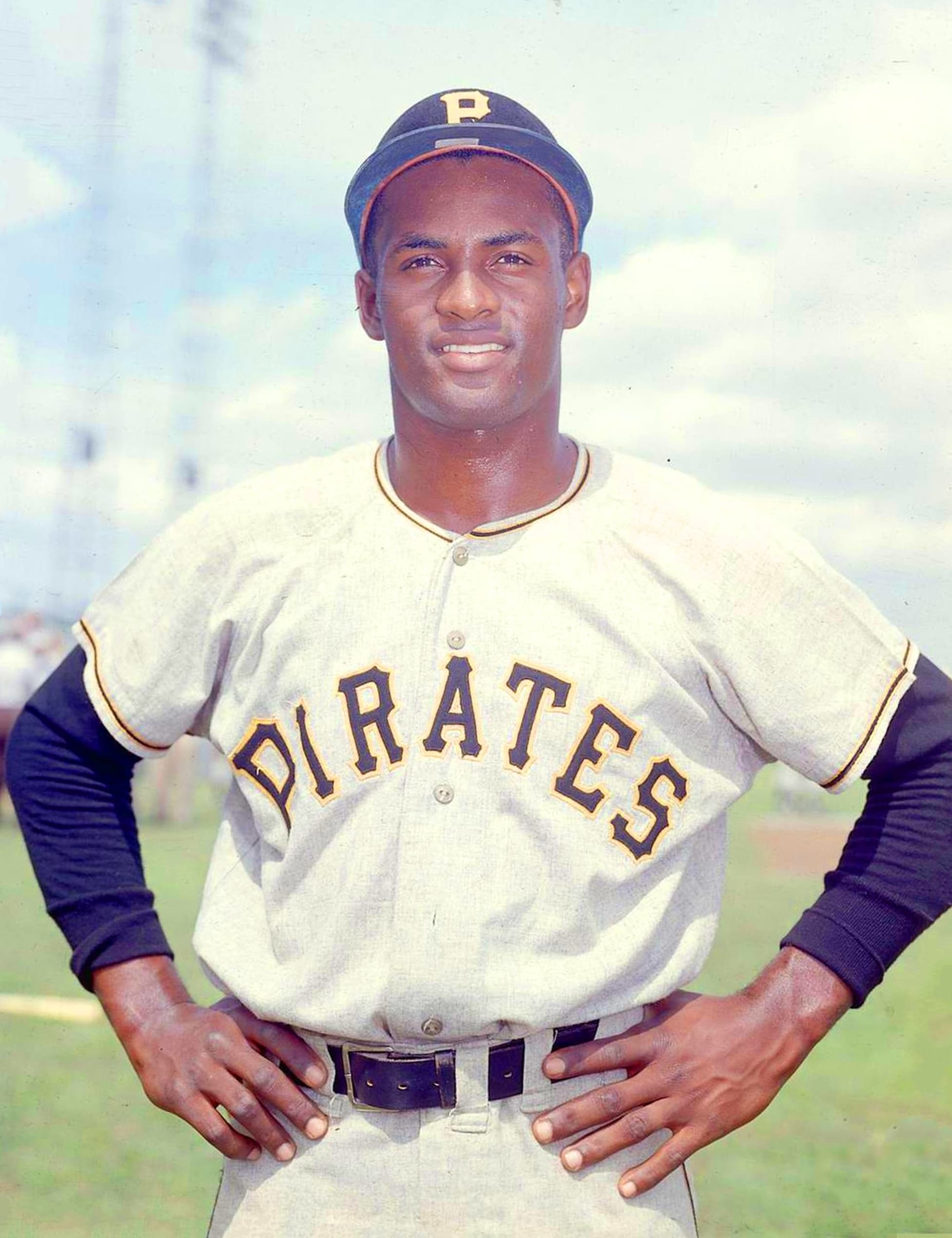
Roberto Clemente with the Pittsburgh Pirates, 1957.
Photo credit: Unknown author via Wikimedia Commons (Public domain)
Roberto Clemente played eighteen seasons for the Pittsburgh Pirates, collected exactly 3,000 hits, won twelve consecutive Gold Gloves in right field, and threw out baserunners with an arm that had no equal in the history of the position. He was also something larger than a ballplayer. He died on New Year's Eve 1972 in a plane crash while delivering earthquake relief supplies to Nicaragua, and the Hall of Fame waived its five-year waiting period and elected him three months later, only the second time it had done so after Lou Gehrig in 1939.
Puerto Rico
Roberto Enrique Clemente Walker was born on August 18, 1934, in Barrio San Anton, Carolina, Puerto Rico, the youngest of seven children. His father Melchor worked as a foreman overseeing sugar cane cutters on a plantation and earned roughly 45 cents a day. His mother Luisa took in laundry and did whatever other work the plantation offered. Clemente grew up squeezing rubber balls to strengthen his hands and hitting tin cans with a broomstick in the yard.
A local businessman named Roberto Marin spotted him at 14 and recruited him for a softball team, and by 18 Clemente was playing for the Santurce Cangrejeros in the Puerto Rico Winter League. Dodgers scout Al Campanis saw him at a tryout camp and gave him the highest marks he had ever given a free agent. Clemente signed with Brooklyn on February 19, 1954, for a $10,000 bonus. He turned down a larger offer from the Milwaukee Braves because he wanted to play in New York, with its large Puerto Rican community, and because he had given Campanis his word.
The Dodgers assigned him to their Triple-A affiliate in Montreal, where he batted .257 in 87 games with limited playing time. The bonus rule required teams to keep high-bonus players on their major league roster or risk losing them in a draft, and the Dodgers gambled that they could hide Clemente in the minors for a year. On November 22, 1954, the Pittsburgh Pirates selected him with the first pick in the Rule 5 draft. Branch Rickey, the Pirates' general manager, had sent scout Clyde Sukeforth to watch Montreal pitcher Joe Black, but Sukeforth came back talking only about Clemente's arm.
Pittsburgh
Clemente arrived in Pittsburgh in 1955 and spent the rest of his life there, though the city and its sportswriters did not always make it easy. Reporters called him "Bob" or "Bobby" even after he told them his name was Roberto. They quoted him phonetically in broken English, printing dialect that bore no resemblance to how he actually spoke. When he missed games with real injuries, including chronic back problems from a car accident, they called him a hypochondriac. He was an Afro-Latino in a segregated country, and the sportswriting culture of the 1950s had no framework for treating him with the dignity he demanded.
He hit .311 in his second season and by 1960 had developed into one of the best players in the National League. In the 1960 World Series against the Yankees, he hit safely in all seven games and batted .310, though Bill Mazeroski's walk-off home run in Game 7 absorbed most of the attention. Clemente finished eighth in the MVP voting that year and reportedly never wore his 1960 World Series ring.
The Arm
Clemente won twelve consecutive Gold Gloves from 1961 through 1972, every remaining season of his career, and his throwing arm from right field remains the standard against which all others are measured. He led the National League in outfield assists five times and finished his career with 266 from right field, far ahead of anyone else. Baserunners learned not to test him, and the ones who forgot learned quickly. Opposing managers built their baserunning decisions around avoiding his arm entirely. Players and scouts who had watched both Clemente and Willie Mays generally gave Clemente the edge in throwing accuracy.
He won four batting titles, in 1961, 1964, 1965, and 1967, and the 1966 National League MVP award with 29 home runs and 119 RBI. He was an aggressive hitter who swung at pitches out of the zone and turned them into line drives, and Branch Rickey had warned the Pirates not to try to change his approach. His career batting average of .317 across 15 All-Star selections confirmed what everyone in the league already understood about his ability.
1971
Clemente had been an All-Star for a decade, but the 1971 World Series was his introduction to the country. The Pirates faced the defending champion Baltimore Orioles, and Clemente hit .414 with two home runs, played flawless defense, and carried Pittsburgh to a seven-game victory. He hit a solo home run off Mike Cuellar in the fourth inning of Game 7 that proved to be the decisive run in a 2-1 win.
After the final out, NBC's Bob Prince interviewed him on the field. Before answering in English, Clemente spoke to his parents in Spanish, asking for their blessing on the proudest day of his life. It was one of the first times a player had spoken Spanish on a major American broadcast, and it was heard in living rooms across the hemisphere. He was named World Series MVP.
3,000
The day before, Clemente had hit a hard grounder off Tom Seaver that the scoreboard briefly displayed as hit number 3,000, but the official scorer charged second baseman Ken Boswell with an error. On September 30, 1972, at Three Rivers Stadium, he drove a double off Jon Matlack of the Mets into the left-center gap for hit number 3,000. He was the eleventh player in major league history to reach the milestone and the first from Latin America. It was the last regular-season hit of his career.
Nicaragua
On December 23, 1972, a magnitude-6.3 earthquake devastated Managua, Nicaragua, killing thousands and leaving hundreds of thousands without shelter. Clemente went on television in Puerto Rico and raised money for relief supplies, organizing shipments of food, clothing, and medicine. When he received reports that soldiers loyal to the Somoza government were stealing the supplies and reselling them rather than distributing them to survivors, he decided to accompany the next shipment himself, believing that his presence would prevent the theft.
On December 31, 1972, a Douglas DC-7 cargo plane carrying Clemente and four others lifted off from San Juan, overloaded by more than 4,000 pounds. An engine failed less than three minutes after takeoff, and the plane crashed into the Atlantic Ocean roughly a mile and a half offshore. Everyone aboard was killed. Clemente's body was never recovered. He was 38 years old.
Legacy
On March 20, 1973, the Hall of Fame elected Clemente in a special election, waiving its mandatory five-year waiting period for only the second time. He was the first Latin American player enshrined in Cooperstown. MLB renamed its Commissioner's Award in his honor, and it is given annually to the player who best represents the game through character and community service.
Clemente had spent years dreaming of building a sports complex for underprivileged children in Puerto Rico, and his widow Vera eventually saw it completed as the Ciudad Deportiva Roberto Clemente in Carolina. He had refused to let reporters change his name, had insisted on speaking Spanish when the cameras were rolling, and had demanded that the game treat Latin American and black players with the same respect it offered everyone else. Every Latino player who has reached the major leagues since walks through a door that Clemente forced open.