Era Overview
Origins Era
1786–1899
Before modern leagues and the World Series, baseball emerged from local bat-and-ball traditions into a national organized game.
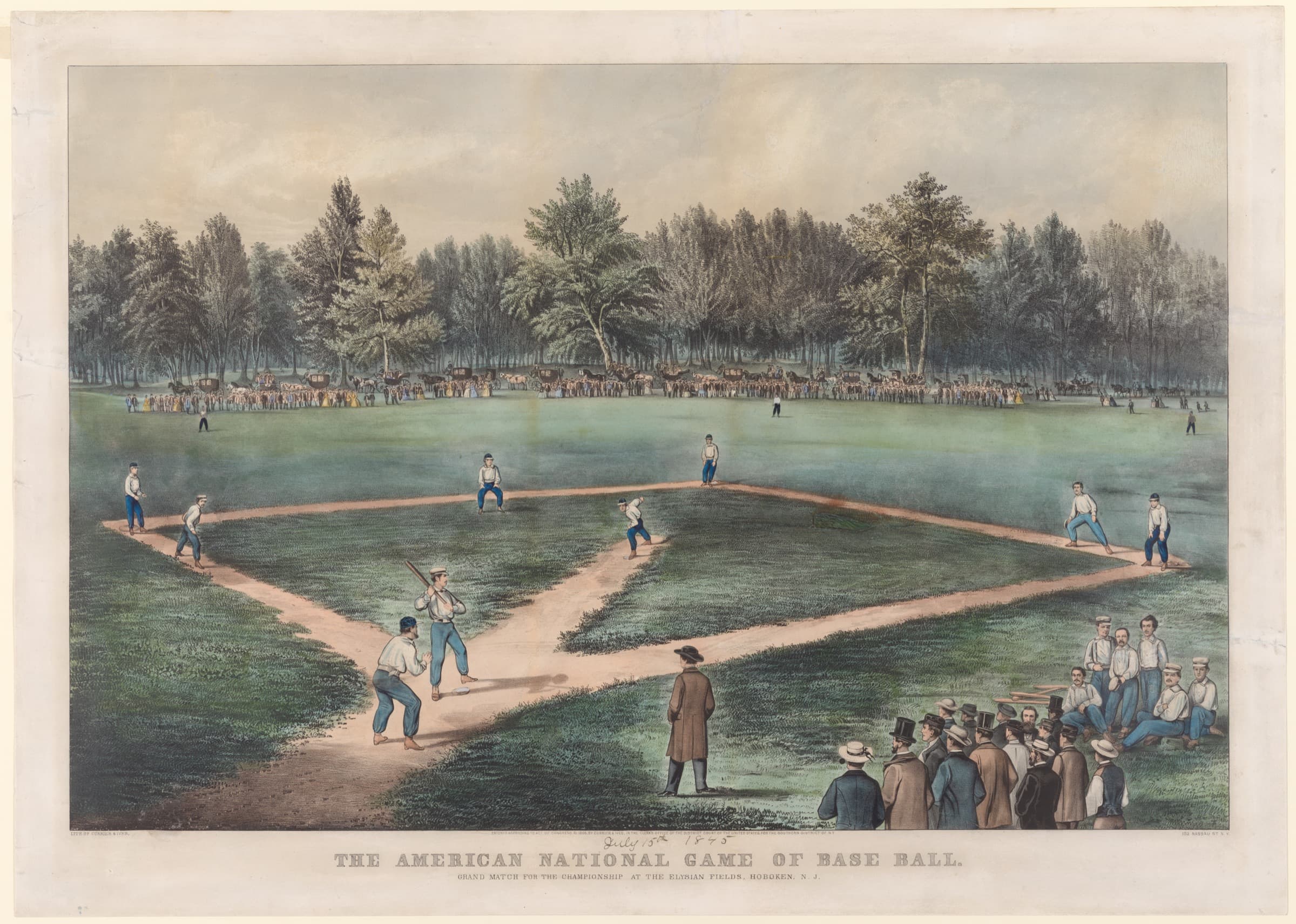
Elysian Fields, 1866. Championship baseball in early organized play.
Photo credit: Currier and Ives / The Met via Wikimedia Commons
Baseball's earliest known handwritten U.S. mention of the game appears in 1786, when Princeton student John Rhea Smith wrote in his diary that he played "baste ball" on campus. In 1791, Pittsfield, Massachusetts passed a bylaw restricting "baseball" near the town meeting house, giving historians the earliest known American municipal use of the word.
From that early reference through the end of the nineteenth century, baseball moved from local custom to organized competition. Rules were inconsistent at first, then gradually standardized through clubs, conventions, and regional adoption of the New York game.
By the 1840s and 1850s, written rules and interclub play made baseball portable across cities. On July 1, 1859, Amherst and Williams played in Pittsfield in what historians generally recognize as the first intercollegiate baseball game in the United States, under Massachusetts rules, with Amherst winning 73-32. By the late 1860s, paid players and professional clubs were no longer exceptions. Cincinnati's 1869 Red Stockings made fully professional baseball explicit, and other clubs followed.
The final decades of the century were unstable but decisive. Leagues formed, collapsed, and reorganized. Owners fought over territory and labor control. Schedules expanded. Competition widened. In 1900, the structure that would become the modern two-league major system was in place.
The Origins Era explains a core truth. Baseball was assembled over decades through rules, money, travel, and argument, then inherited by the twentieth century as a national institution.
Related Articles
Amherst, Williams, and the First Intercollegiate Baseball Game
Amherst and Williams met in Pittsfield on July 1, 1859 in what historians generally recognize as the first intercollegiate baseball game in the United States, played under Massachusetts rules and won by Amherst 73-32.
Continue Reading
Bill Dahlen and the 42-Game Summer
In 1894, Bill Dahlen hit in 42 straight games, then started a 28-game streak the next day. A century later, his name is still a test of how baseball remembers its own history.
Continue Reading
Casey at the Bat and Baseball's First Viral Moment
On June 3, 1888, the San Francisco Examiner published a 13-stanza poem about a mighty slugger who strikes out. Ernest Thayer was paid $5. It became the most famous piece of baseball literature ever written.
Continue Reading
The 1869 Cincinnati Red Stockings, Baseball's First Fully Professional Team
When Cincinnati paid every player on its roster in 1869, baseball crossed from club recreation into a professional entertainment business.
Continue Reading
The Death of the Complete Game
Complete games once defined ace pitching. Over the last century, bullpens, role specialization, and third-time-through data pushed the complete game from expectation to rarity.
Continue Reading
Abner Doubleday Didn't Invent Baseball
The Doubleday creation myth was manufactured by a commission with a predetermined conclusion, built on a single uncorroborated letter, and debunked within years. Baseball was not invented. It evolved.
Continue Reading
When Bare Hands Were the Only Glove in Baseball
Players once caught barehanded as a matter of pride. Gloves arrived slowly, drew ridicule, and eventually transformed defense through Bill Doak's web-pocket innovation.
Continue Reading
The Gotham Club Era, 1840 to 1843
Before the Knickerbockers wrote their famous 1845 rules, New York's Gotham club and its offshoots had already been organizing games, grounds, and procedures for nearly a decade.
Continue Reading
The History of Baseball Cards, from Tobacco Inserts to Modern Hobby Culture
Baseball cards began as photographic keepsakes in the 1860s, became marketing tools for tobacco companies, survived a monopoly in the gum era, and evolved into a collectibles market shaped by professional grading.
Continue Reading
The Invisible Rectangle That Runs the Game
The strike zone has shifted for more than a century, but the core argument never changes: who controls the boundary between pitcher and hitter, the rulebook or the umpire?
Continue Reading
John Rhea Smith and Baseball's Earliest Known U.S. Mention in 1786
A March 22, 1786 diary entry by Princeton student John Rhea Smith is the earliest known handwritten U.S. mention of baseball, decades before the Knickerbocker rules.
Continue Reading
The Knickerbocker Rules and When Baseball Started Looking Modern
On September 23, 1845, the Knickerbocker Base Ball Club of New York adopted twenty written rules that helped transform scattered local games into a sport clubs could share, copy, and argue over in public.
Continue Reading
An Early Organized Base Ball Association in 1823 New York
A newspaper notice from April 1823 places an organized base ball association on Broadway in Manhattan, two full decades before the Knickerbockers wrote their rules.
Continue Reading
William Wheaton and the 1837 Rules
In 1887, an aging New York lawyer named William Wheaton told a San Francisco newspaper that he had written the laws of baseball fifty years earlier. The document has never been found, but the claim reshaped how historians understand the game before the Knickerbockers.
Continue Reading
Pittsfield, 1791, and an Early U.S. Use of the Word "Baseball"
A Massachusetts bylaw from September 5, 1791 records one of the clearest early U.S. uses of the exact word 'baseball' in civic law, and it helps define the game's documentary timeline.
Continue Reading
A Century of Baseball at Sportsman's Park
For ninety years, the northwest corner of Grand Boulevard and Dodier Street hosted professional baseball in St. Louis, and no other intersection in America held two major league tenants for as long or produced a World Series played entirely in one park.
Continue Reading
Why Foul Balls Became Strikes (and How It Saved the Game)
Before 1901, hitters could foul off pitches forever with no penalty. Counting foul balls as strikes changed at-bats, sped games, and reset the balance between pitcher and batter.
Continue Reading
Why the Pitcher Stands 60 Feet, 6 Inches Away
Baseball tried multiple pitching distances before settling on 60 feet, 6 inches in 1893, a rules change that restored offense and has endured for more than a century.
Continue Reading
Profiles from This Era
Barney Dreyfuss
Executive · 1865–1932
Hall of Fame 2008
Continue Reading
Frank Grant
Second Base · 1865–1937
Hall of Fame 2006
Continue Reading
John Clarkson
Pitcher · 1861–1909
Hall of Fame 1963
Continue Reading
John Montgomery Ward
Pitcher / Shortstop · 1860–1925
Hall of Fame 1964
Continue Reading
Ned Hanlon
Manager · 1857–1937
Hall of Fame 1996
Continue Reading
Pud Galvin
Pitcher · 1856–1902
Hall of Fame 1965
Continue Reading
Sol White
Second Base · 1868–1955
Hall of Fame 2006
Continue Reading
Tim Keefe
Pitcher · 1857–1933
Hall of Fame 1964
Continue Reading