William Wheaton and the 1837 Rules
In 1887, an aging New York lawyer named William Wheaton told a San Francisco newspaper that he had written the laws of baseball fifty years earlier. The document has never been found, but the claim reshaped how historians understand the game before the Knickerbockers.
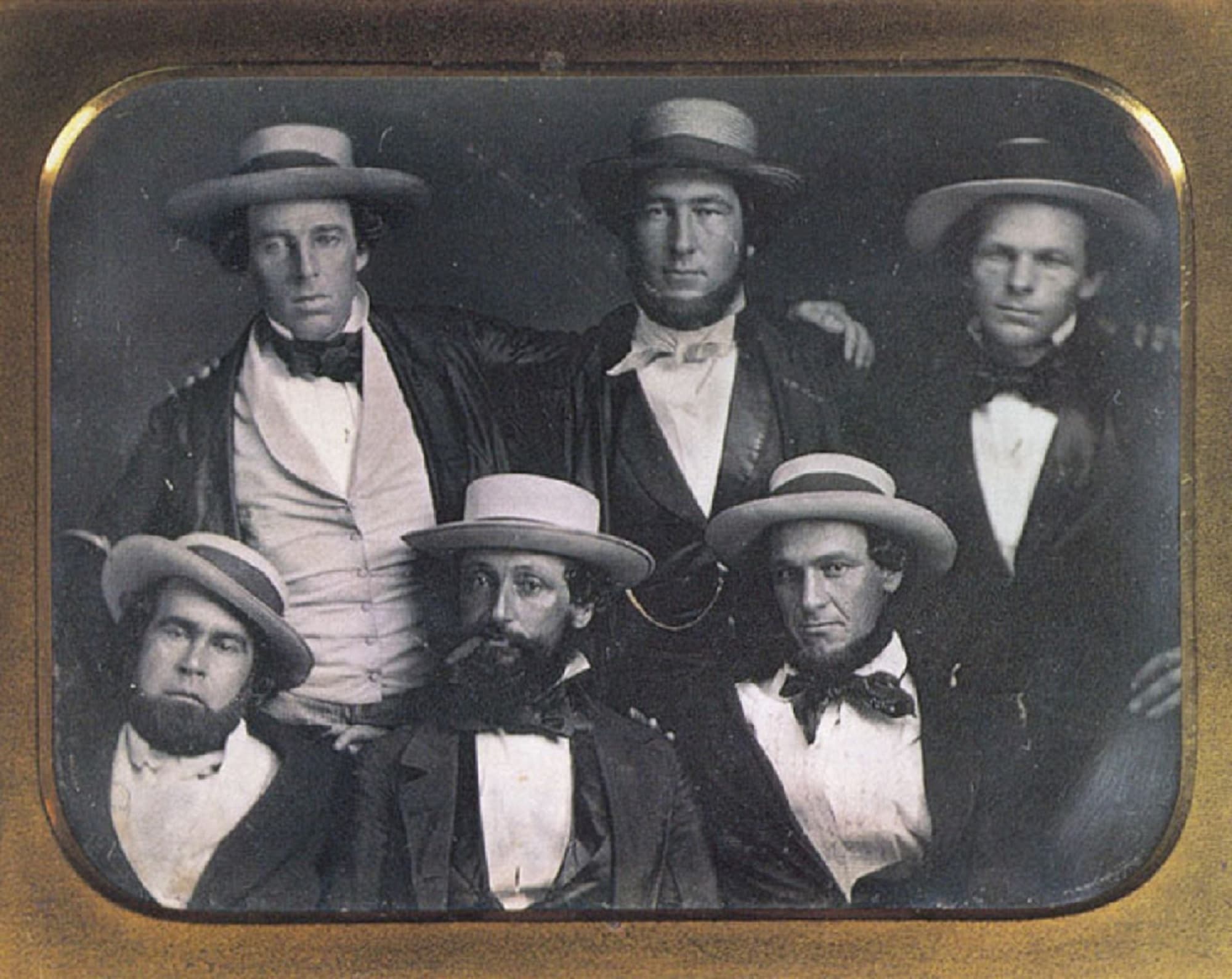
New York Knickerbockers, circa 1847. Top row includes William Wheaton at far right.
Photo credit: Unknown author via Wikimedia Commons (Public domain)
On November 27, 1887, the Daily Examiner in San Francisco published an interview under the headline How Baseball Began -- A Member of the Gotham Club of Fifty Years Ago Tells About It. The interview subject was not named in the article, but the details he provided, including club affiliations and biographical facts, allowed researcher Randall Brown to identify him in 2004 as William Rufus Wheaton, a seventy-three-year-old attorney living in California. The story he told pushed the timeline of organized baseball back by eight years. Wheaton claimed that in 1837, half a century before the interview, he had written down the rules of the game for a club in New York.
In the circa-1847 Knickerbockers team photograph, Wheaton is the player in the upper row, far right.
"This work fell to my hands," Wheaton said, "and the code I then formulated is substantially that in use to-day."
No copy of that 1837 code has ever surfaced. No box of club records from the period has turned up in an archive or an attic. What survives is Wheaton's account, delivered in old age and published in a newspaper three thousand miles from where the events took place. For more than a century after that interview, the claim attracted no scholarly attention, in part because Wheaton went unnamed in the original text. The standard origin story of organized baseball pointed to 1845, when the Knickerbocker Base Ball Club of New York adopted its famous set of twenty rules. Wheaton's earlier work was unknown to most writers until Brown's discovery.
That started to change after Brown published extensive excerpts from the interview in 2004. John Thorn, who would later become the official historian of Major League Baseball, began re-examining the pre-Knickerbocker clubs of New York. What they found was that the Knickerbocker rules of 1845 didn't emerge from nothing. They grew out of at least a decade of organized play, club formation, and written rule-making in lower Manhattan and its surroundings. Wheaton was at the center of that process, and his 1887 interview became a primary source for understanding the game's earliest institutional life.
The Man Behind the Rules
William Rufus Wheaton was born in New York City on May 7, 1814. He attended the Union Hall Academy, located at the corner of Madison Avenue and Oliver Street, and read law under John Leveridge, a well-known attorney on the East Side. By 1836, at twenty-two, he had passed the bar exam and begun practicing law in the city. He married Elizabeth A. Jennings on February 1, 1837, the same year he would later say he wrote the baseball rules.
Wheaton was a young lawyer building a practice in one of the fastest-growing cities in America. New York in the 1830s was a place of voluntary associations, fraternal clubs, and organized recreation among the city's professional class. Men of Wheaton's station joined fire companies, debating societies, and athletic clubs as a matter of social routine. Ball-playing fit naturally into that world.
Wheaton was successful enough as an attorney to be admitted to practice by Chancellor Walworth in the Court of Chancery during the 1840s. In 1849, caught up in the California Gold Rush, he sailed for San Francisco with a mining company. The mining venture failed quickly. He tried a mercantile partnership in Sacramento with a man named Alonzo Hamilton, which dissolved after two years. Eventually he returned to what he knew, opening a law office on Montgomery Street in San Francisco. He practiced law there for the rest of his life and died on September 11, 1888, less than a year after the Examiner interview, at the age of seventy-four.
His obituaries didn't mention baseball.
The Gotham Club and Its Playing Ground
The club Wheaton described in his 1887 interview was variously known as the Gotham Base Ball Club, the New York Base Ball Club, and sometimes the Washington Base Ball Club. The overlapping names have created confusion for historians, but the weight of modern scholarship, particularly the work of John Thorn, treats these as essentially the same organization under different names at different times during the 1830s and 1840s.
Wheaton told the Examiner that "we first organized what we called the Gotham Baseball Club. This was the first ball organization in the United States, and it was completed in 1837." He named several fellow members. Dr. John Miller was a prominent physician. John Murphy was a well-known hotel keeper. James Lee served as president of the New York Chamber of Commerce. These were not idle young men playing after school. They were established professionals and businessmen who treated baseball as a structured recreational pursuit, the same way they might have treated a rowing club or a rifle association.
The club played on an unused Army parade ground at what is now Madison Square, the area bounded by 23rd and 26th Streets between Fifth Avenue and Madison Avenue. In the 1830s, this area was well north of the city's dense settlement. Wheaton described it as "out in the country, far from the city limits." The open ground gave them room to lay out a field, and because the site was not yet built up, they could play without the interference that crowded downtown lots would have presented.
The Gothams used sand bags for bases and arranged them in a diamond shape, with a home plate at one corner. They played intra-club games for exercise and recreation. They were not yet competing against other organized clubs in anything resembling a league or formal schedule. The structure was closer to a fraternal athletic society than a sports team in any modern sense.
What the 1837 Rules Likely Contained
No written copy of the 1837 rules survives, so historians have to work from Wheaton's retrospective description and from what is known about the rules he later helped write for the Knickerbockers in 1845. Despite the absence of the original document, his interview was specific enough on several points to allow reasonable reconstruction.
The most significant rule change Wheaton described was the elimination of plugging, or soaking, the practice of putting a runner out by hitting him with a thrown ball. Under the older informal rules common in schoolyard games and the various regional forms of town ball, a fielder could retire a runner by throwing the ball and striking the runner's body.
Wheaton told the Examiner that his first major reform abolished the throw-at-the-runner rule and required fielders to throw to a baseman, who then had to touch the runner before he reached base.
This was a foundational change. Eliminating plugging made it possible to use a harder ball, which in turn changed how the game was hit and fielded. A soft ball was necessary when runners could be struck by thrown balls, because a hard ball would injure them. Once plugging was gone, the ball could be wound tighter, pitched faster, and hit farther. The downstream consequences of that single rule change reshaped the entire character of the game.
Wheaton also described the diamond-shaped infield layout, four bases arranged in a square rotated forty-five degrees, which became the standard geometry of baseball and remains so. He mentioned that the club adopted the fly rule for catching batted balls, meaning a batter was out only if a fielder caught the ball before it hit the ground, not on the first bounce. This was a departure from what the Knickerbockers would later allow. The 1845 Knickerbocker rules permitted outs on both fly catches and catches on the first bound, a more forgiving standard. The Gothams, by Wheaton's account, had originally required fly catches only, and the Knickerbockers relaxed that requirement when they wrote their own version.
Other probable elements of the 1837 code, inferred from the overlap between Wheaton's description and the 1845 Knickerbocker rules, include foul territory (with foul balls treated as do-overs rather than live play), three strikes for a strikeout, and fixed base paths. Baseball historian Jeffrey Kittel has concluded that none of the Knickerbocker rules of 1845 was original, with the possible exception of three-out innings, suggesting that the core framework was already in place years earlier.
The Bridge to the Knickerbockers
In 1845, several members of the Gotham/New York club felt the organization had grown too large for their preferences. They wanted a more selective, invitation-only club. The breakaway group formed the Knickerbocker Base Ball Club, and Wheaton went with them. He became the Knickerbockers' founding vice president.
The Knickerbockers needed written rules for their new club, and a Committee on By-Laws was formed with two members. Wheaton and William H. Tucker, a tobacconist. On September 23, 1845, the committee presented the rules that the Knickerbockers formally adopted. These are the famous twenty rules that most baseball histories cite as the game's founding document, the first written code of baseball. They covered the diamond layout, the number of players per side, the definition of fair and foul territory, the three-out inning, and other fundamentals.
What Wheaton's 1887 interview implies, and what modern scholarship increasingly supports, is that these 1845 rules were not a fresh invention. Wheaton had already drafted most of the same provisions for the Gothams eight years earlier. When the Knickerbockers asked him to write their rules, he largely reproduced what he had written before, with some modifications. The bound rule was one change. Under Wheaton's original Gotham code, a batter could be retired only on a fly catch. The Knickerbockers reverted to allowing catches on the first bound as well, a concession to less skilled fielders that made the game more accessible.
The practical consequence is that the Knickerbocker rules of 1845 were less an act of invention than an act of formalization. They survive as a written document because the Knickerbockers were a well-organized club that kept records. The Gothams' earlier rules didn't survive because the Gothams were less institutional in their record-keeping, or because the records were simply lost over time. The difference between the two clubs is partly a difference in documentation, not in the substance of what was played.
The Strength and Limits of the Evidence
Wheaton's 1887 interview is a retrospective account, not a contemporaneous document. He was describing events from fifty years earlier, and he was the sole source for much of what he reported. That creates obvious questions about reliability. Memory drifts over half a century. Dates blur. Self-importance can inflate a person's role in past events.
Historians have weighed these concerns and generally found Wheaton's account credible, with caveats. John Thorn has treated Wheaton's testimony as credible and has identified Wheaton as a figure who could reasonably be called a father of baseball. Paul Dickson has placed Wheaton among the small group of men with the strongest claim to that title. The specific details Wheaton provided, including the names of club members, the playing location at Madison Square, and the content of the rules, are consistent with what is known from other sources about New York sporting life in the 1830s. No independent evidence contradicts the interview, though much of it still cannot be independently confirmed.
The distinction between Wheaton's testimony and the 1845 Knickerbocker rules is a distinction in the type of evidence, not necessarily in factual reliability. The Knickerbocker rules survive as a physical document that can be dated, examined, and cited. Wheaton's 1837 rules exist only through his spoken account, published in a newspaper decades later. For historians working with the pre-1845 period, this kind of evidence is typical rather than exceptional. Very little documentary material survives from informal athletic clubs in 1830s New York. The absence of a written copy of the 1837 rules is unsurprising given the era and the nature of the organization.
What the evidence does establish is that written rule-making for baseball in New York was underway by the late 1830s, that it was done by identifiable individuals within organized clubs, and that the innovations usually credited to the Knickerbockers in 1845 had precedent in earlier club practice. The 1837 date doesn't replace 1845 as the benchmark for organized baseball rules, because the 1845 document survives and the 1837 document doesn't. But it reframes 1845 as the culmination of a process rather than the start of one.
Before and After 1837
Placed in the wider timeline of early baseball, Wheaton's claim fills a gap that the traditional narrative left open. The game had references going back decades before 1837. A 1786 Princeton diary entry records "baste ball," and a 1791 bylaw in Pittsfield, Massachusetts, banned ball-playing near the town's new meeting house, mentioning baseball by name in civic law. By the 1820s, organized association play was documented in New York. What was missing from the record was evidence of when and how clubs began turning informal, variable local games into something with fixed, written rules that participants agreed to follow.
Wheaton's account answers that question with a specific date, a specific person, and specific rule content. After 1837, the timeline becomes denser. Club competition culture in New York expanded through the early 1840s, with multiple clubs playing on grounds in Manhattan, Murray Hill, and eventually across the Hudson River in Hoboken, New Jersey, at the Elysian Fields. By 1845, enough clubs existed that written rules were not just useful but necessary for inter-club play. The Knickerbockers' formal adoption of their twenty rules in September of that year gave the game its first surviving canonical document.
The traditional story of baseball's origins, built around Alexander Cartwright and the Knickerbockers, presented 1845 as a founding moment. Wheaton's testimony and the scholarship that followed it show something different and more interesting. The game was built over years by a group of New York men, many of them lawyers, merchants, and professionals, who played on open lots at the edge of the city and gradually converted a loose schoolyard pastime into a structured adult sport. Wheaton was one of those men, and by his own account, the one who first wrote the rules down.
He spent the last four decades of his life in San Francisco, practicing law on Montgomery Street, far from the playing grounds at Madison Square where the game had taken shape. He gave one interview about baseball, less than ten months before he died. The newspaper printed it, and then the story went quiet for more than a century, until historians circled back and found that the old lawyer in California had been telling the truth about something no one had thought to ask about while the people who could confirm it were still alive.