The Knickerbocker Rules and When Baseball Started Looking Modern
On September 23, 1845, the Knickerbocker Base Ball Club of New York adopted twenty written rules that helped transform scattered local games into a sport clubs could share, copy, and argue over in public.
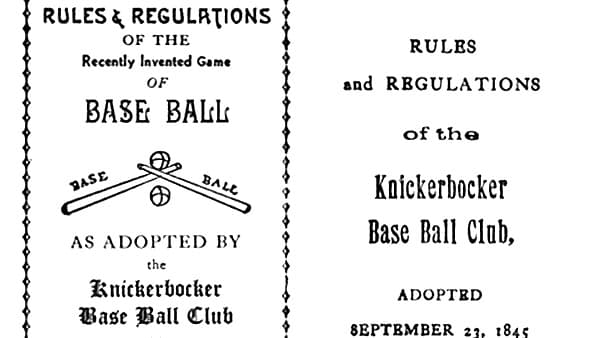
Knickerbocker Base Ball Club rules document cover, 1845.
Photo credit: Knickerbocker Base Ball Club via Baseball Hall of Fame Archives (Public domain)
Baseball was played in America long before 1845. Students at Princeton recorded it in 1786, the town of Pittsfield legislated around it in 1791, and New York clubs were playing organized games by the early 1820s. By the time the Knickerbocker Base Ball Club adopted its twenty written rules on September 23, 1845, bat-and-ball games had been circulating through American towns and campuses for decades.
What the Knickerbockers produced was a framework for agreement. Most of the individual provisions had appeared in earlier club play, but codification changed the way the game traveled. Once a written set existed, other clubs could adopt it, challenge it, or propose revisions in public, and the arguments that followed pushed baseball toward the institutional structures that made a national sport possible.
The Twenty Rules
The Knickerbocker code contained twenty numbered rules, though only about fourteen dealt with gameplay. The rest governed club administration, including punctuality, umpire appointment, team selection procedures, and membership priority for practice days. The game-playing rules addressed the diamond, pitching, batting, base running, outs, and game length, and together they established the basic skeleton of the sport that later conventions would refine.
The most consequential provision was Rule 13, which banned plugging. In earlier forms of play, including the Massachusetts game and most versions of town ball, a fielder could retire a runner by hitting him with a thrown ball. The Knickerbockers eliminated that practice entirely. Rule 13 stated that a runner could be put out only if a fielder touched him with the ball in hand or held the ball on the base before the runner arrived, and it added that "in no instance is a ball to be thrown at him." This had a cascading mechanical effect, because fielders who no longer threw balls at runners could use a harder, denser ball, which in turn changed the physics of hitting and catching for every player on the field.
Rule 10 established foul territory by declaring that any ball hit "outside the range of the first or third base" was foul. The Massachusetts game, by contrast, had no foul territory at all, and batters could hit the ball in any direction across an open field. Rule 18 added that no run or base could be scored on a foul strike. Together these two provisions shaped the spatial geometry of the playing field into something close to its modern form.
Rule 15 set three outs per inning, which may have been the only provision in the code without a clear precedent in earlier New York play. The Massachusetts game used a one-out-all-out format, where a single retirement ended the batting team's turn. Three outs per side created longer innings and gave batting teams a fuller opportunity to build rallies before changing sides, a structural rhythm that persists in every professional game played today.
Rule 4 specified the diamond dimensions as forty-two paces from home to second base and forty-two paces from first to third, equidistant. A pace in mid-nineteenth-century usage equaled roughly two and a half feet, which placed the basepaths at approximately seventy-five feet rather than the modern ninety. Rule 9 required the ball to be "pitched, and not thrown, for the bat," mandating an underhand delivery. Rule 8 set the win condition at twenty-one "aces" (runs), with the stipulation that both sides must complete an equal number of innings before the game could end. Rule 12 allowed a catch to be made "either flying or on the first bound," a provision known as the bound rule that remained in effect for fair balls until 1865. And Rule 11 introduced the dropped third strike, stipulating that if a batter swung and missed three times but the catcher failed to hold the third strike, the batter had to run for first base.
The rules did not specify the number of players per side, did not name fielding positions beyond the pitcher, and did not set a pitching distance. All three of those elements would be formalized over the following twelve years.
Who Wrote Them
The rules were drafted by a Committee on By-Laws. William R. Wheaton and William H. Tucker signed the committee's document, with Duncan F. Curry serving as the club's first president and overseeing the broader organizational effort. Wheaton, a lawyer, had previously written the rules for the Gotham Base Ball Club around 1837, and Tucker had also played with the Gotham Club before joining the Knickerbockers. Their committee adapted and refined provisions that Gotham members had been playing under for years, which is why modern scholars such as Jeffrey Kittel have concluded that few if any of the individual Knickerbocker rules were original to the 1845 document. The innovation was standardization itself, the insistence on a single written code that interclub play had to follow.
Alexander Cartwright served on a separate organizing committee responsible for securing member signatures and managing club logistics, but his name does not appear on the rules committee document. The scholarly record on Cartwright's specific contribution to the rules is thin, and the broader mythology surrounding him has been substantially revised by researchers over the past three decades.
The Cartwright Problem
For most of the twentieth century, Cartwright held the informal title of "Father of Modern Baseball." The Baseball Hall of Fame inducted him in 1938, and his plaque credits him with setting basepaths at ninety feet, establishing nine-player teams, and creating nine-inning games. None of those claims are accurate. The ninety-foot distance came from Doc Adams at the 1857 convention. Nine-player teams were formalized in the same set of changes. Nine-inning games replaced the twenty-one-run format at that same meeting. Cartwright had been living in Hawaii since 1849 and had no involvement in any of it.
The myth took shape in stages. Sportswriter William Rankin published increasingly embellished accounts of Cartwright's role between 1905 and 1908. Cartwright's grandson Bruce Cartwright Jr. promoted the story aggressively in the 1930s and went so far as to alter family journal entries, inserting baseball references that did not exist in the originals. SABR researchers have documented these fabrications in detail. Even Alexander Cartwright IV, the player's own descendant, has acknowledged that the plaque claims are wrong.
Cartwright was a real Knickerbocker member who served as club secretary in 1846 and vice president in 1847 and 1848. He may have umpired the famous June 19, 1846 game at Elysian Fields, though the umpire signature line on the original score sheet is blank. He left New York for the California Gold Rush in March 1849, settled permanently in Honolulu, and never returned to organized baseball. His contributions to the club were genuine but modest, and the vast superstructure of the inventor narrative rests on doctored evidence and wishful repetition rather than primary sources.
Doc Adams and the Deeper Story
The person who did the most to develop the Knickerbocker rules into a working national framework was Daniel Lucius "Doc" Adams, a Yale graduate and Harvard-trained physician who joined the club about a month after its September 1845 founding. Adams served six terms as Knickerbocker president between 1847 and 1861 and held leadership roles in the club across fifteen consecutive years.
Adams created the shortstop position around 1849 or 1850. The original Knickerbocker games used three infielders and four outfielders, and Adams introduced the shortstop as a relay man to compensate for the dead-ball limitations of early play. He later recalled that he "used to play shortstop" and believed he "was the first one to occupy that place." He also manufactured the club's baseballs by hand for years, because no commercial supplier existed, and he supervised bat production as well.
Adams's most lasting work came at the 1857 convention, which met across two sessions in January and February, where sixteen New York-area clubs sent delegates to standardize the rules across all organized play. Adams served as convention president. The delegates fixed the basepath distance at thirty yards (ninety feet), replaced the twenty-one-run win condition with nine-inning games, and established nine players per side. Those three changes define modern baseball's basic geometry, and all of them trace to Adams and the convention delegates rather than to the 1845 document or to Cartwright.
Historian John Thorn has called Adams "first among the Fathers of Baseball." SABR named him its Overlooked 19th Century Baseball Legend in 2014, and his case for Hall of Fame induction remains open.
The 1846 Game at Elysian Fields
On June 19, 1846, the Knickerbockers played the New York Nine at Elysian Fields in Hoboken, New Jersey. The New York Nine won 23 to 1 in four innings, reaching the twenty-one-ace threshold while the Knickerbockers managed a single run, scored by Charles H. Birney. The game is often described as the first baseball contest played under the Knickerbocker rules, though recorded intrasquad and interclub games had already taken place in October 1845, including a seven-a-side match on October 6 that ended 11 to 8, with Wheaton umpiring.
The June 1846 contest was closer to an intramural event than a genuine rivalry. Most of the New York Nine's players were former Knickerbockers who had stopped making the trip across the Hudson to Hoboken for practice. There was no shortstop position yet, and the game used underhand pitching, no gloves, and the bound rule for catches.
The outcome was a blowout, but the visibility of the event drew attention to the idea that baseball could operate under a fixed, repeatable code. Other clubs in the New York area noticed, and within a decade the Knickerbocker framework had become the basis for organized interclub competition across the city and into Brooklyn and New Jersey.
The New York Game Against the Massachusetts Game
Through the 1850s, the Knickerbocker-derived "New York game" competed for dominance with the Massachusetts game, a regional variant that operated under fundamentally different mechanics. Massachusetts rules kept plugging, used a lighter ball of roughly two and a half ounces, allowed hitting in any direction with no foul territory, retired sides after a single out, and required a hundred runs to win. Pitchers in the Massachusetts game threw overhand rather than underhand, and the offensive output of a typical game dwarfed anything the New York rules produced.
The two systems coexisted for years. The 1859 Amherst-Williams game in Pittsfield, often cited as the first intercollegiate baseball game, was played under Massachusetts rules as late as July of that year and ended 73 to 32. The New York game won the national argument during and after the Civil War, when soldiers from New York regiments taught their version in Union camps. Troops from Massachusetts, Ohio, and other states learned the New York rules, carried them home, and the regional version faded. By the time the National Association of Base Ball Players held its conventions in the late 1850s and early 1860s, the New York game was the only framework under serious discussion.
From Code to Convention to Commerce
The Knickerbockers, the Eagles, and the Gothams agreed on a unified rule set on April 1, 1854, the first formal multiclub rules agreement in baseball history. That meeting set the pitching distance at fifteen paces for the first time. Three years later, the sixteen-club 1857 convention expanded the framework with Adams's basepath, innings, and roster changes. In March 1858, a follow-up convention formally established the National Association of Base Ball Players as a permanent governing body, with William H. Van Cott of the Gotham Club elected as its first president.
Rule stability made baseball legible to spectators. Spectator interest made scheduled competition valuable. Scheduled competition made paid players and professional clubs plausible. The line from 1845 codification to the professional era that accelerated after the Civil War and crystallized with openly salaried teams in the late 1860s runs through convention halls, committee meetings, and the unglamorous work of people who argued over basepath distances and out-making procedures until they got the game right.
The 1845 rules were infrastructure. They gave scattered bat-and-ball customs a common language that could travel between cities and survive disagreement. The Knickerbockers inherited much of that language from the Gotham Club, refined it into a written code, and created the conditions for the conventions and associations that followed. Without that framework, there would have been no pennant races, no professional leagues, and no shared national memory of the game at all.
Sources
- National Baseball Hall of Fame Archives - Knickerbocker Base Ball Club Rules (1845)
- SABR - New York's First Base Ball Club
- SABR - The Creation of the Alexander Cartwright Myth
- SABR BioProject - Doc Adams
- SABR BioProject - Alexander Cartwright
- Library of Congress - Baseball Americana (Origins and Early Days)
- Baseball Hall of Fame - Doc Adams
- SABR Games Project - October 1845, the First Recorded Baseball Games in New York