John Rhea Smith and Baseball's Earliest Known U.S. Mention in 1786
A March 22, 1786 diary entry by Princeton student John Rhea Smith is the earliest known handwritten U.S. mention of baseball, decades before the Knickerbocker rules.
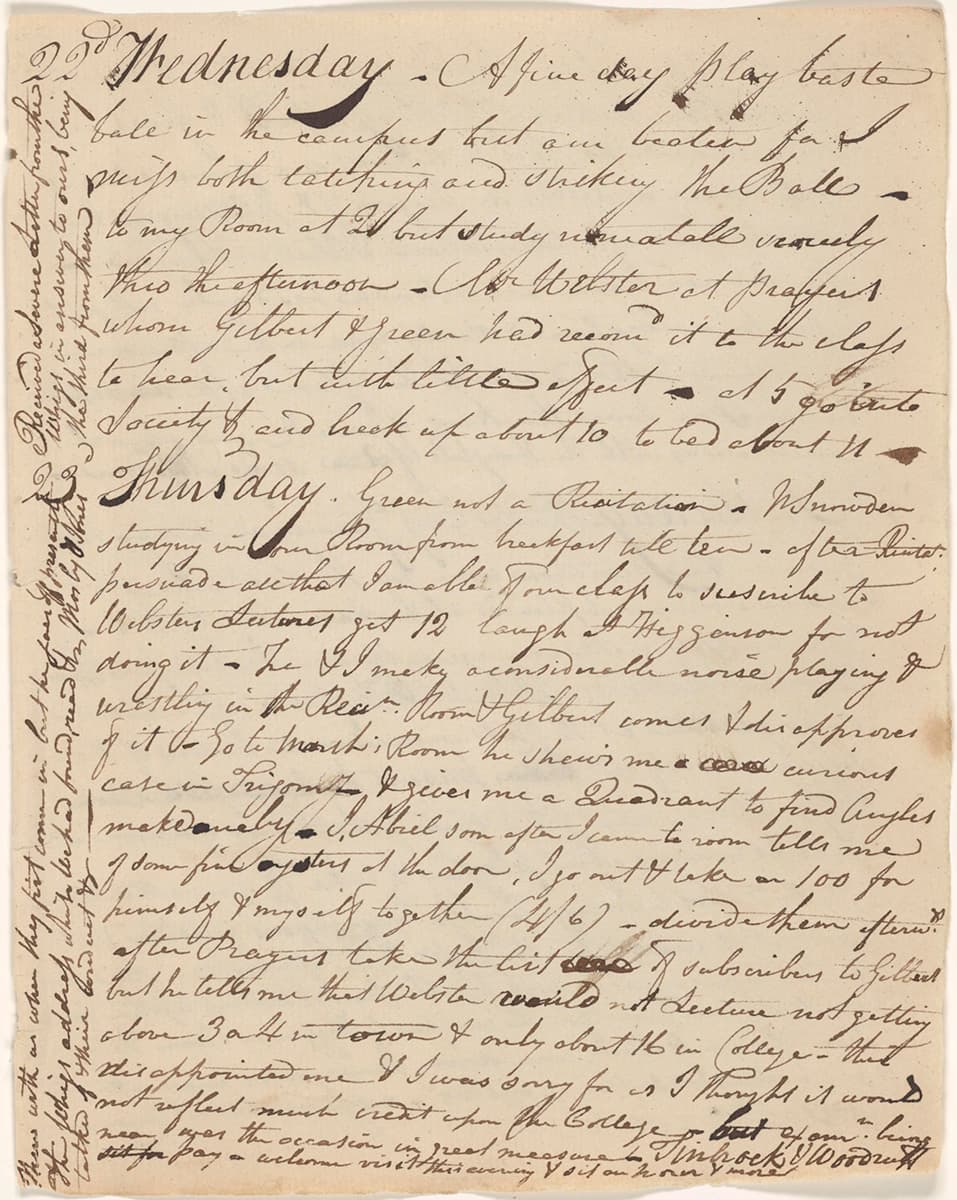
Diary of John Rhea Smith, Princeton, 1786. Earliest known handwritten U.S. mention of baseball.
Photo credit: Manuscript Division, Library of Congress via Library of Congress
Most baseball origin timelines in popular writing still start with 1791 in Pittsfield. That date remains significant, but it is not the earliest known U.S. mention of the game.
The earliest known handwritten American reference currently cited by the Library of Congress comes from March 22, 1786. On that day, Princeton student John Rhea Smith wrote that he had played "baste ball" on campus and played poorly.
The Entry and Its Significance
The line is short, but it is unusually specific for eighteenth-century sports evidence. It gives a date, a place, and an activity, and it was recorded at the time rather than reconstructed decades later from memory.
Smith's wording is familiar to modern readers because it sounds like a recognizable baseball failure. He says he missed both catching and striking the ball. That detail suggests active fielding and batting, not just a vague reference to children with sticks.
The Library of Congress exhibition text treats this as the earliest known handwritten U.S. mention of baseball. The exhibition also notes that the following year, Princeton faculty considered baseball dangerous and unbecoming and banned it on campus, which reinforces that the game was common enough to trigger institutional response.
Why "Baste Ball" Counts
Some confusion comes from spelling. Smith wrote "baste ball," not "baseball," and readers sometimes assume that must refer to a different game.
In practice, eighteenth-century spelling was often irregular, especially in private diaries. Historians generally read Smith's wording as a spelling variant of "base ball," not as evidence of a separate sport with different rules.
This distinction is important because it explains why two dates can both be true in baseball history. 1786 is the earliest known handwritten U.S. mention of the game, while 1791 in Pittsfield remains the earliest known American municipal use of the exact word "baseball."
1786 Versus 1791
The two documents answer different historical questions. Smith's diary tells us what at least one student was doing in 1786 and what he called it in personal writing.
The Pittsfield bylaw tells us that by 1791 local officials in Massachusetts considered baseball common enough to regulate by name in civic law. Together, the records show continuity rather than contradiction.
If you only keep the 1791 date, you understate how early the paper trail begins. If you only keep the 1786 date, you miss the importance of the first known legal usage of the exact term in local governance.
Limits of the 1786 Record
The diary entry is a milestone, but it is not a complete origin document. It does not provide inning counts, team size, basepath distances, or any clear proof that this was the same rule set that later matured in New York clubs.
That limitation is normal for early sports history. Most eighteenth-century evidence survives as fragments, and those fragments only become useful when read in sequence with later records.
For baseball, that sequence runs from scattered references and diary language in the late eighteenth century, to organized association play in 1823 New York, to written club rules in the 1830s and 1840s, and finally to durable codification in 1845 and after.
Why This Changes Site-Wide Timeline Language
If a site says 1791 is the earliest U.S. reference to baseball, it is now incomplete. The stronger, more accurate phrasing is that 1786 is the earliest known handwritten U.S. mention, while 1791 is the earliest known U.S. municipal use of the exact word "baseball."
That wording preserves both documents and avoids collapsing two different categories of evidence into one. It also gives readers a clearer picture of how baseball actually emerged, in local usage, with messy spelling, long before a single national rulebook existed.
The Bigger Historical Point
The 1786 entry does not prove one inventor, one birthplace, or one clean starting gun. It strengthens the opposite conclusion, which is that baseball developed through local practice over decades before formal codification.
That is why the Smith diary carries weight beyond trivia. It moves the documentary floor earlier, sharpens the timeline, and pushes baseball history away from myth and toward evidence.