Amherst, Williams, and the First Intercollegiate Baseball Game
Amherst and Williams met in Pittsfield on July 1, 1859 in what historians generally recognize as the first intercollegiate baseball game in the United States, played under Massachusetts rules and won by Amherst 73-32.
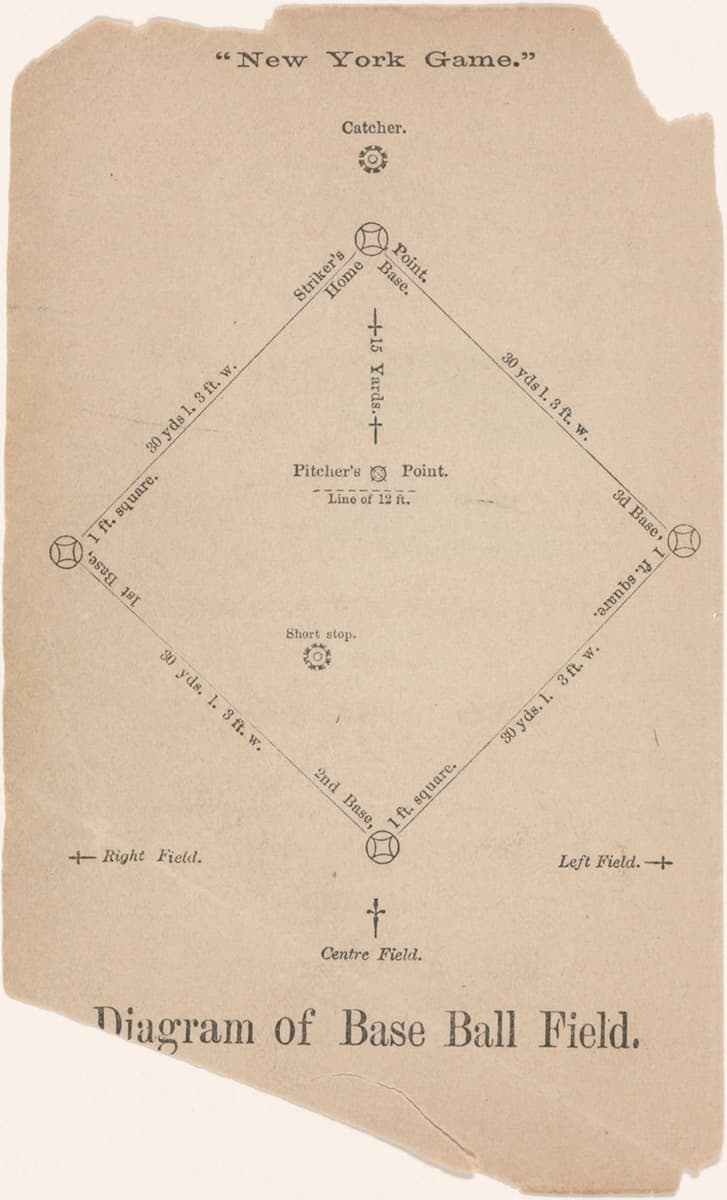
The Base Ball Player's Pocket Companion (1859), diagram of the New York game field and era-defining rules context.
Photo credit: Rare Book and Special Collections Division, Library of Congress via Library of Congress
Baseball's college origin story is documented more clearly than most early baseball milestones. On July 1, 1859, Amherst College and Williams College played in Pittsfield, Massachusetts in what historians generally recognize as the first intercollegiate baseball game in the United States. The most reliable period record reports that Amherst won, 73 to 32.
That score looks strange to modern readers because this was not modern baseball and not NCAA-era structure. The game was played under Massachusetts rules, an earlier regional code that handled innings, outs, and fair territory differently from the later New York model that became dominant.
What Happened in Pittsfield
The game was arranged as part of a two-day Amherst-Williams social and athletic event in Pittsfield, with baseball on July 1 and chess on July 2. Contemporary reporting describes significant local attendance and formal hosting by Pittsfield clubs and civic figures, which tells us this was treated as a public occasion, not an informal campus scrimmage.
The Amherst Express extra edition, preserved by the Library of Congress, is especially useful because it was printed at the time and includes postgame detail. It reports a final score of 73-32 in Amherst's favor and notes that an earlier dispatch had circulated a different total before correction. That correction history is one reason later summaries sometimes disagree on the score.
Why It Is Called the First Intercollegiate Game
The key point is not that no students had played baseball before 1859. College students were playing bat-and-ball games well before this date. The key point is that Amherst and Williams staged an organized contest between two separate colleges, at a neutral site, with agreed procedures and public documentation.
That is why this game holds up better than folklore claims. It has a date, a location, identifiable participants, and surviving printed evidence that can be checked directly.
Why Rule Context Is Essential
The game in Pittsfield used Massachusetts rules, often called "town ball" by later writers. In that format, all ground could be fair, runners could be retired by being hit with a thrown ball, and one out ended an inning. Those mechanics produce high scores that do not translate neatly to modern nine-inning baseball.
This is where precise site language is essential. The strongest phrasing is that the July 1, 1859 Amherst-Williams contest is the first generally recognized intercollegiate baseball game in the United States, played under Massachusetts rules. That preserves both the significance and the historical context.
Where the Pocket Companion Fits
The image on this page comes from The Base Ball Player's Pocket Companion (1859), a rule-era artifact from the same year as the Amherst-Williams game. The booklet highlights the active dispute between Massachusetts and New York styles at exactly the moment college baseball entered the record in a public, documented way.
The Pocket Companion also helps explain why "firsts" in baseball can be true in different ways at the same time. A first known mention, a first municipal legal use, a first organized club contest, and a first intercollegiate game are all different claims and need to be labeled accordingly.
Why This Belongs in the Origins Timeline
By now the early-document trail is clearer than many older baseball histories suggest. We have the 1786 Princeton diary entry ("baste ball"), the 1791 Pittsfield bylaw using "baseball" in civic law, organized association play documented in New York by 1823, codification efforts in the 1830s and 1840s, and then the 1859 Amherst-Williams college match in Pittsfield.
Seen together, these records show growth by accumulation, not sudden invention. Baseball's structure emerged through local play, rule competition, and institutional adoption, with colleges becoming one more engine of formalization before the professional game took over the national narrative.