Profile
Bob Lemon
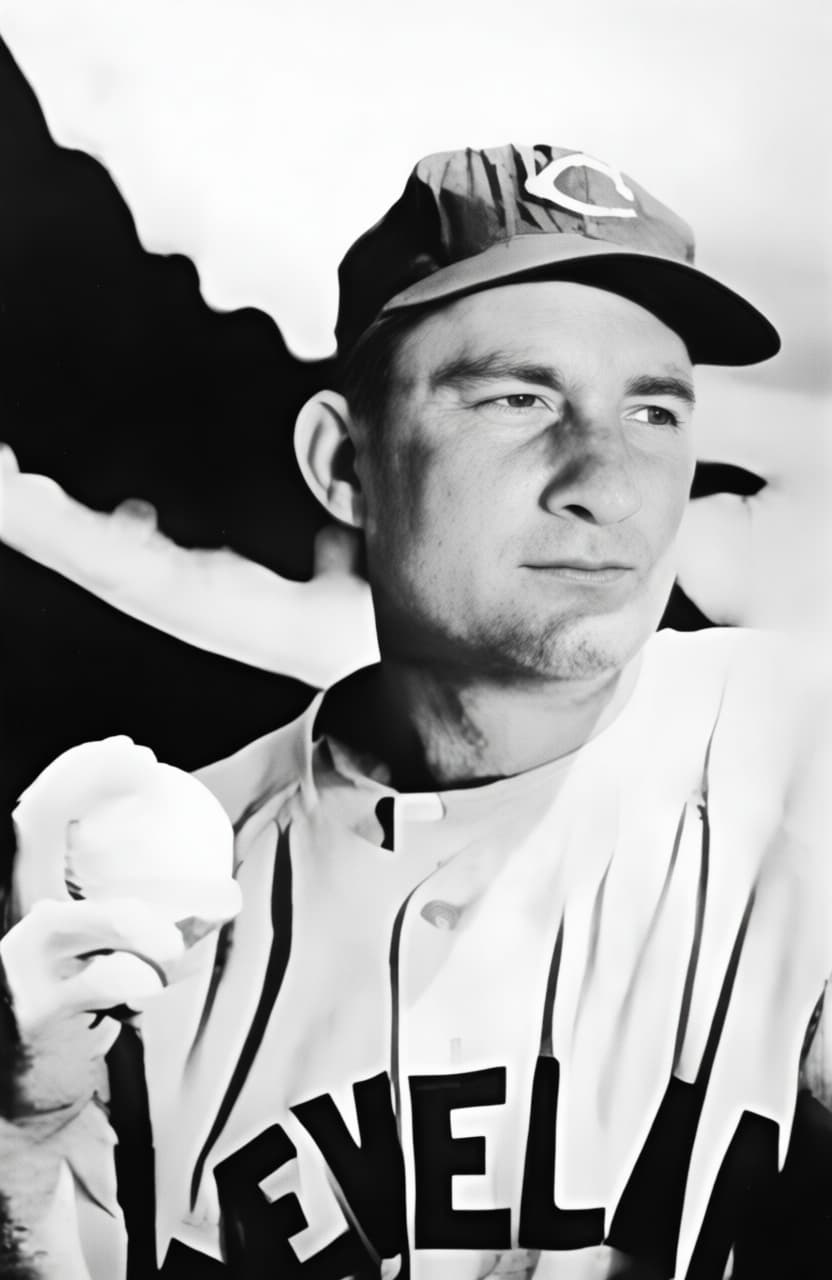
Bob Lemon portrait.
Photo credit: User-provided image via User-provided image
Robert Granville Lemon made his major league debut as a third baseman, spent three years in the Navy, came back as a center fielder, and became a Hall of Fame pitcher because several teammates who had watched him throw during the war told his manager he was wasting his arm at the plate. He won 207 games in 13 seasons, all for the Cleveland Indians, threw a no-hitter, won two games in the 1948 World Series, hit 37 career home runs, and managed the 1978 Yankees to a championship after inheriting a team 14 games out of first place in July. Casey Stengel watched him bat in 1949 and said, "Well, I see where the Indians have nine hitters in the lineup instead of eight." Lemon never took anything home from the ballpark. "I always left it in some bar," he said.
Long Beach
Lemon was born on September 22, 1920, in San Bernardino, California. His father Earl, a former minor league shortstop, owned an ice company and later ran a chicken farm. His mother Ruth was an avid baseball fan. The family settled in Long Beach, where Lemon attended Woodrow Wilson High School and was named California State Baseball Player of the Year in 1938 as a shortstop. The Cleveland Indians signed him out of high school for $100 a month.
He spent four years in the minors as an infielder and outfielder, hitting .300 at times with occasional power. He debuted on September 9, 1941, as a late-inning replacement at third base and got his first major league hit three days later as a pinch-hitter against Washington's Early Wynn. After the 1942 season he enlisted in the Navy and served three years, the last at Aiea Barracks in Hawaii, where he played third base on service teams and tied for second in the Hawaii league with 14 home runs. He also pitched in service games. Bill Dickey, Birdie Tebbetts, Johnny Pesky, and Ted Williams all saw him throw and recommended he try pitching full-time.
The Conversion
When Lemon returned in 1946, his infield skills had deteriorated and manager Lou Boudreau moved him to center field. On Opening Day, April 16, playing center against the Chicago White Sox, Lemon made a full-extension diving catch to rob Jake Jones of a hit in the bottom of the ninth, then doubled off the runner at second for the final out, preserving Bob Feller's 1-0 shutout. Feller called it "the greatest outfield play I have ever seen." Lemon sustained bruises to his elbow, chin, and chest.
But Boudreau could see that Lemon would not hit with consistency as an outfielder, and acting on the wartime recommendations, he converted him to pitcher. Coach Bill McKechnie helped him adjust to the position, and pitching coach Mel Harder taught him the slider. Lemon went 4-5 with a 2.49 ERA in 32 appearances during 1946, broke through at 11-5 in 1947, and arrived fully in 1948.
That season he went 20-14 with a 2.82 ERA and 20 complete games. On June 30, he threw a no-hitter against the Detroit Tigers at Briggs Stadium, winning 2-0 on two unearned runs. In October he won Games 2 and 6 of the World Series against the Boston Braves, beating Warren Spahn with a complete game in Game 2 and getting the win in the clinching Game 6. His Series line was 2-0 with a 1.65 ERA.
He won 22 games in 1949, 23 in 1950, and 22 in 1952, when the Indians rotation produced three 20-game winners alongside Wynn and Mike Garcia. He won 21 in 1953 and pitched a one-hitter on Opening Day while also hitting a home run. His best record came in 1954, when he went 23-7 as the Indians set the American League record with 111 victories. Seven times in his career he won 20 or more games.
The 1954 World Series against the Giants was a different story. Lemon started Game 1 and pitched nine strong innings with the score tied 2-2. In the 10th, pinch-hitter Dusty Rhodes lifted a fly ball that barely cleared the short right-field porch at the Polo Grounds for a walk-off three-run home run. Lemon threw his glove high in the air. A Cleveland writer noted the glove traveled farther than Rhodes's homer. The Giants swept the series in four games.
His sinker moved naturally, a product of short fingers rather than deliberate technique. He never developed an overpowering fastball but stayed ahead of hitters with movement and command. Ted Williams called him "one of the very best pitchers I ever faced. His ball was always moving, hard, sinking, fast-breaking." Lemon also hit 37 career home runs, 35 of them while playing pitcher, tied with Spahn for the second-highest total by a pitcher behind Wes Ferrell's 37. He recorded his 200th victory on September 11, 1956, hitting a two-run homer that accounted for the margin of victory.
Bone chips in his elbow limited him to a 6-11 record in 1957, and surgery that November removed 20 pieces of bone and tissue. He pitched 25 innings in 1958 and retired in March 1959 at 38. In 13 seasons he accumulated 207 wins, 128 losses, 188 complete games, 31 shutouts, and a 3.23 ERA.
The Yankees
Lemon managed the Kansas City Royals from 1970 through 1972, producing an 85-76 season in 1971, and the Chicago White Sox in 1977 and part of 1978, improving the club by 26 wins in his first year. Bill Veeck fired him with a 34-40 record in June 1978.
Less than a month later, George Steinbrenner hired him to replace Billy Martin as manager of the New York Yankees. The team trailed the Boston Red Sox by 14 games. Lemon went 48-20 for the rest of the season, won the one-game playoff against Boston on October 2 (Bucky Dent's home run), took the pennant from the Royals, and defeated the Los Angeles Dodgers in six games to win the World Series. He was the first American League manager to win a championship after taking over mid-season. The New York Times called him "an island of calm in a stormy summer."
Ten days after the World Series, his youngest son Jerry, 26, was killed in an automobile accident. Lemon managed into 1979 but Steinbrenner believed the grief had cost him his motivation. He was replaced by Martin in June. Steinbrenner rehired him late in the strike-shortened 1981 season, and Lemon managed the Yankees to the World Series again before losing to the Dodgers in six games. He was let go early in 1982.
Tommy John, who pitched for him in New York, said, "Lemon was an outstanding manager who never got the credit he deserved. He was like Al Lopez; he let you alone and treated you like an adult." Steinbrenner, who fired most of his managers without sentiment, said of Lemon, "If you needed one word to describe Bob Lemon, it would be 'decent.'"
After the Game
The BBWAA elected Lemon to the Hall of Fame in 1976 with 78.6 percent of the vote on his 12th ballot, alongside Robin Roberts. His mother, 83 years old, made the trip from California. "She says she can die happy now that I've been elected to the Hall of Fame," Lemon said. Cleveland retired his number 21 on June 20, 1998, the 50th anniversary of the 1948 championship.
He married Jane McGee on January 14, 1944, during his Navy service, and they were together for 56 years. Lemon spent his final years at a nursing home in Long Beach after a series of strokes. He died on January 11, 2000, at 79.
"I've had a hell of a life," he once said. "I've never looked back and regretted anything. I've had everything in baseball a man could ask for. I've been so fortunate. Outside of my boy getting killed. That really puts it into perspective. So you don't win the pennant. You don't win the World Series. Who gives a damn? Twenty years from now, who'll give a damn? You do the best you can. That's it."