Profile
Al Simmons
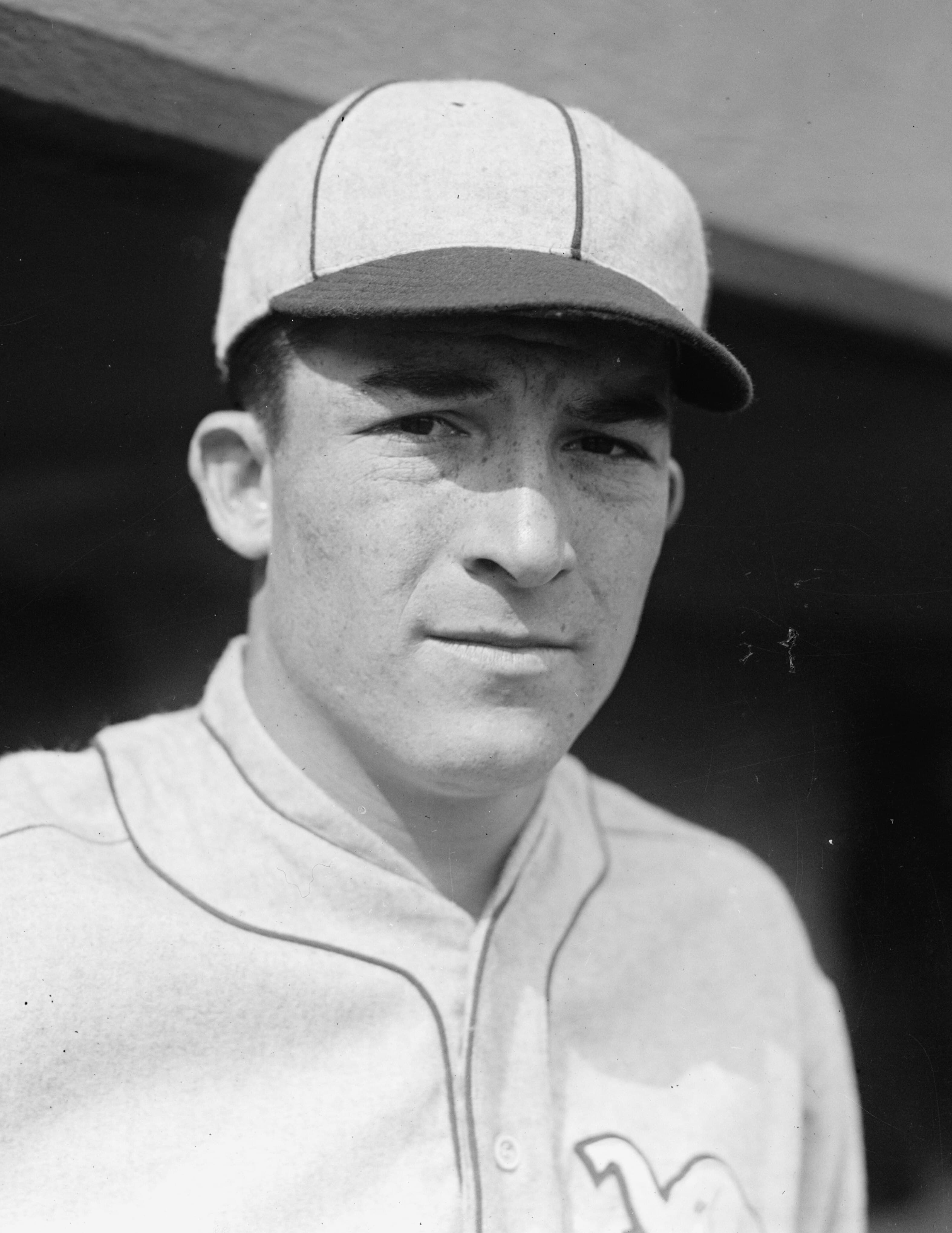
Al Simmons with Philadelphia, 1924.
Photo credit: Library of Congress / Bain News Service via Wikimedia Commons (Public domain)
Aloys Szymanski changed his name, changed the way hitting coaches thought about footwork, and spent 20 seasons punishing American League pitching. As Al Simmons, he batted .334, collected 2,927 hits, drove in 1,828 runs, and played a central role on Connie Mack's last great Philadelphia Athletics teams. He hit the ball on a line with a swing that began with his left foot stepping toward third base, a "bucket foot" approach that every hitting instructor warned against. Simmons made it work by generating enormous bat speed with his wrists and keeping his hands inside the ball.
Milwaukee
Simmons was born Aloysius Harry Szymanski on May 22, 1902, in Milwaukee, Wisconsin, the son of Polish immigrants. He grew up playing sandlot ball and adopted the name Al Simmons early in his professional career, reportedly taking it from an advertisement for the Simmons Hardware company. He played in the minor leagues at Milwaukee and Shreveport before Mack purchased his contract for the Athletics in 1924.
He hit .308 with 102 RBI as a rookie. By his second season he was one of the most dangerous hitters in the American League, and he stayed there for a decade.
The Bucket Foot
Simmons's stance looked wrong. As a right-handed hitter, he planted his left foot toward third base when he swung, pulling his body away from the pitch. Coaches called it "stepping in the bucket." Mack saw Simmons hit and decided not to change a thing. The stride gave Simmons leverage on pitches away, and his quick wrists compensated on inside pitches.
From 1924 to 1934, Simmons drove in 100 or more runs in 11 consecutive seasons. He won back-to-back batting titles in 1930 (.381) and 1931 (.390), and he hit .300 or better in 11 of his first 12 seasons. He finished with a .334 career average, 307 home runs, and 2,927 hits.
Three Pennants
Simmons was the other half of the Athletics' power core alongside Jimmie Foxx, with Mickey Cochrane behind the plate and Lefty Grove on the mound. The team won the American League pennant in 1929, 1930, and 1931 and took the World Series in 1929 and 1930.
In Game 4 of the 1929 World Series, with the Athletics trailing the Cubs 8-0 in the seventh inning, Simmons led off with a home run. The hit started a ten-run rally that turned the game and effectively the Series. The Athletics won in five games.
Simmons hit .329 in 19 World Series games across four October appearances, driving in 17 runs.
Sold Off
After the 1932 season, Mack began dismantling the roster to cover Depression-era losses. He sold Simmons, Jimmy Dykes, and Mule Haas to the Chicago White Sox for $100,000 in September 1932. Simmons played three seasons in Chicago, hitting .331, .344, and .267, before moving to Detroit, Washington, and Boston over the next several years. He returned to the Athletics in 1940 and 1941, played for the Red Sox in 1943, and came back to the Athletics once more in 1944, finishing his career where it started. He served as a coach under Mack from 1945 to 1949.
Death
Simmons died on May 26, 1956, in Milwaukee, at age 54, from a heart attack. He was elected to the Hall of Fame in 1953 by the BBWAA, receiving 199 of 264 votes. He had spent the years before induction coaching for the Athletics and Cleveland Indians and telling anyone who would listen that modern hitters did not know how to use their wrists.