The Concrete Cathedral at 21st and Lehigh
Baseball's first steel-and-concrete stadium opened on April 12, 1909, in a North Philadelphia neighborhood where chickens still pecked in empty lots, and stood for sixty-seven years through seven World Series, two tenants, a spite fence, a riot, and a fire.
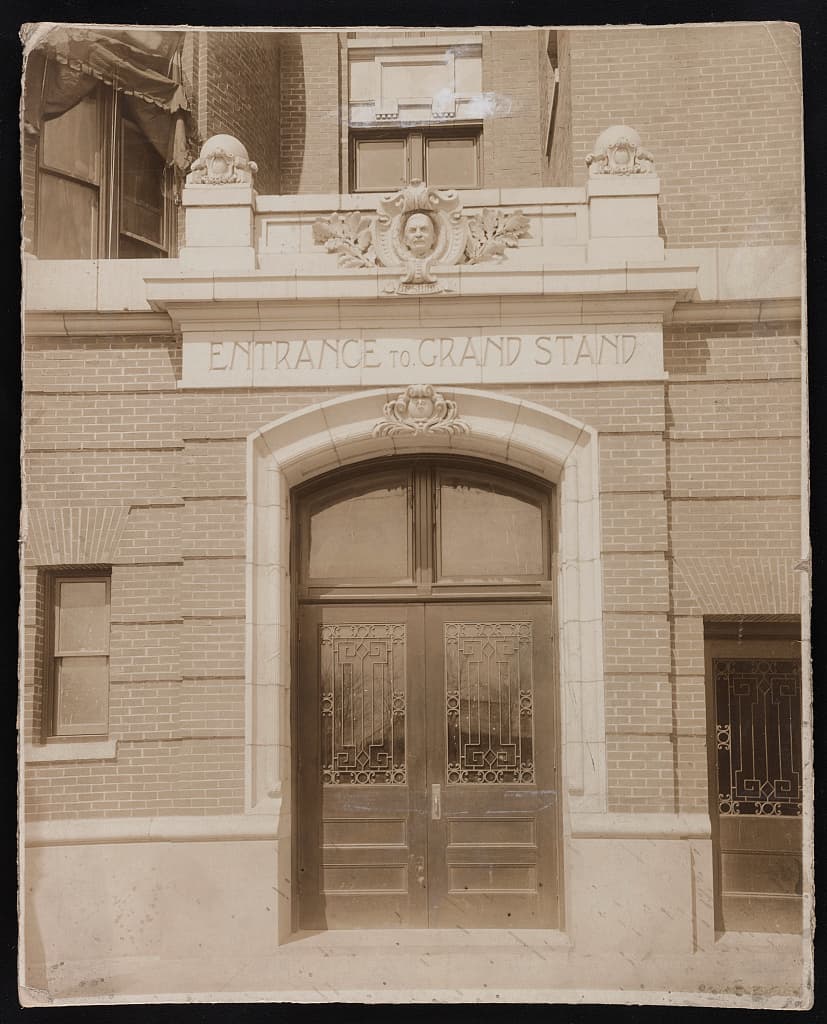
Shibe Park grand stand entrance with carved head of Ben Shibe, circa 1909-1925.
Photo credit: Unknown via Library of Congress
Benjamin Franklin Shibe made his fortune manufacturing baseballs. His A.J. Reach Company held patents on automated stitching machinery and produced most of the balls used in professional play. In 1901, he and his sons bought a fifty percent stake in the new Philadelphia Athletics, with manager Cornelius McGillicuddy, known as Connie Mack, as a part-owner.
By 1907, the Athletics had outgrown Columbia Park, a wooden facility with 9,500 seats that regularly drew 28,000. Shibe purchased six acres at 21st Street and Lehigh Avenue in North Philadelphia, in the Swampoodle neighborhood. The area was rough ground, described at the time as clay bluffs, open fields, and pigs rooting in the mud. Land and construction cost $457,167.
The First of Its Kind
Shibe hired William Steele and Sons to build the park. Ground broke in April 1908, and the stadium was ready in under a year. When the gates opened on April 12, 1909, Shibe Park became baseball's first steel-and-concrete stadium, beating Forbes Field in Pittsburgh by two and a half months.
The building was striking. A French Renaissance facade of red brick and arched windows wrapped the exterior, topped by a copper-trimmed green-slate mansard roof. An octagonal tower at the corner of 21st and Lehigh housed Connie Mack's office beneath a domed cupola. The Philadelphia Public Ledger called it "the most beautiful and capacious baseball structure in the world."
The original capacity was 23,000 seats. On opening day, more than 30,000 crammed inside to watch Eddie Plank throw a complete game as the Athletics beat the Boston Red Sox 8-1. Another 15,000 were turned away. Officials had locked the gates hours before the first pitch, and the crowd outside eventually forced one open, with hundreds pouring in without tickets.
Connie Mack's Dynasties
Shibe Park hosted seven World Series between 1910 and 1931, all featuring Mack's Athletics. The first dynasty won championships in 1910, 1911, and 1913, and returned in 1914 only to be swept by the Miracle Braves. The second arrived in the late 1920s, built around Jimmie Foxx, Al Simmons, Mickey Cochrane, and pitcher Lefty Grove.
The 1929 World Series produced one of baseball's most dramatic single innings. In Game 4 on October 12, the Athletics trailed the Chicago Cubs 8-0 entering the bottom of the seventh. Al Simmons homered to left to start the rally. Mule Haas then drove a fly ball over center fielder Hack Wilson's head after Wilson lost it in the sun, and Haas circled the bases for a three-run inside-the-park home run. By the time the inning ended, ten runs had scored and the Athletics led 10-8. They took the series in five games and repeated as champions in 1930.
But Mack, strapped for cash during the Depression, sold his stars. Simmons, Foxx, and Grove were all gone by 1936. The Athletics sank into the American League basement for most of the next two decades.
The Spite Fence and the Rooftop Entrepreneurs
The original right field wall stood twelve feet high. Across 20th Street, a row of narrow rowhouses looked directly into the park. Residents turned their rooftops into bleachers, built wooden benches, and charged a quarter for admission, half the price of Shibe Park's cheapest seats. By the late 1920s, several thousand people could watch from the rooftops on a busy afternoon, and real estate values on the 2700 block of North 20th Street climbed because of the view.
As long as the Athletics were drawing crowds, the Shibes tolerated the freeloading. But after Mack dismantled the 1929-31 team and attendance collapsed, the family decided they could no longer afford to share customers with the neighbors. During the winter of 1934-35, workers bolted a 38-foot extension of corrugated metal on top of the existing wall, raising the total height to fifty feet and blocking the view completely.
The neighbors sued. They lost. Sportswriters and fans called it the "spite fence." John J. Rooney, who grew up in one of the rooftop houses, later recalled, "We were out of business on Opening Day, 1935." The rooftop bleachers came down, and a neighborhood cottage industry died overnight.
Two Teams Under One Roof
The Phillies moved into Shibe Park on July 4, 1938, abandoning the decrepit Baker Bowl five blocks east. For the next sixteen years, both Philadelphia franchises shared the same field.
The park hosted milestones from both leagues. On September 28, 1941, Ted Williams walked into Shibe Park for a season-ending doubleheader against the Athletics with his batting average at .39955, rounded to .400. Red Sox manager Joe Cronin offered him the chance to sit out. Williams refused. He went 6-for-8 across both games, finishing at .406, the last time any major leaguer has reached the mark. The Phillies' finest hour came in 1950, when the Whiz Kids won the National League pennant and hosted the World Series against the Yankees, though they were swept in four.
After Ben Shibe died in 1922, his sons took over. The Mack family became majority owners in 1940. The Athletics left Philadelphia after the 1954 season for Kansas City. Before the 1953 season, the park was renamed Connie Mack Stadium in honor of the manager who had guided the franchise for fifty years.
The Long Decline
The Phillies inherited an aging ballpark in a changing neighborhood. By the late 1960s, the city was building Veterans Stadium, and Connie Mack Stadium's days were numbered.
The final game came on October 1, 1970. The Phillies beat the Montreal Expos 2-1 in ten innings, Tim McCarver scoring the last run on an Oscar Gamble single. But the game was secondary to the destruction. Fans ripped up seats, tore off railings, and dismantled billboards while play was still going on. A planned ceremony to helicopter home plate to Veterans Stadium was cancelled in the chaos.
On August 20, 1971, two boys sneaked into the abandoned park and started a fire that grew into a five-alarm blaze, gutting the upper deck. The ruin stood for four more years before the city ordered demolition. The wrecking ball finished on July 13, 1976, the corner tower and its cupola the last pieces to fall.
What Stands There Now
In 1980, Deliverance Evangelistic Church purchased the lot. A 5,100-seat sanctuary was completed in 1992 on the site where home plate once sat. A Pennsylvania Historical Commission marker, erected on November 9, 1997, notes the location for anyone who comes looking.
Over sixty-two seasons, the park drew nearly 47 million spectators. They watched Connie Mack build two dynasties and dismantle both, watched Ted Williams refuse to protect an average, watched a ten-run inning erase an eight-run deficit, and eventually tore the place apart seat by seat on the way out. The concrete and steel that made it the first of its kind outlasted the wooden parks it replaced, but not by enough.