Profile
Jimmie Foxx
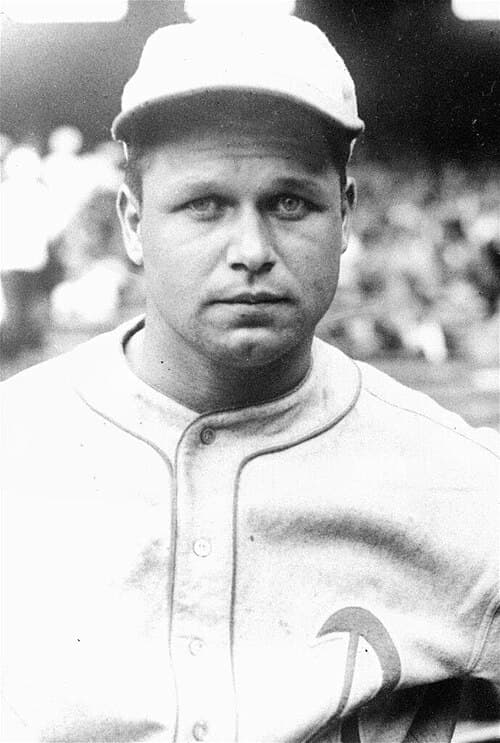
Jimmie Foxx portrait.
Photo credit: Harris & Ewing via Wikimedia Commons (Public domain)
Lefty Grove threw harder than anyone who came before him. Jimmie Foxx hit harder than anyone who came with him. They arrived at the Philadelphia Athletics together and spent the early 1930s forming the core of one of the most dominant teams in baseball history. Foxx was 6 feet tall and 195 pounds, with forearms so thick that Ted Williams later said they were the biggest he had ever seen on a human being.
Sudlersville
James Emory Foxx was born on October 22, 1907, in Sudlersville, Maryland, a small town on the Eastern Shore. He played on local teams as a teenager and signed with the Athletics at 16 after catching the eye of Home Run Baker, the former Athletics and Yankees third baseman who was player-manager of the Easton club in the Eastern Shore League.
Foxx debuted with the Athletics on May 1, 1925, at age 17. Connie Mack used him sparingly for three seasons, playing him at catcher, first base, and third base while he developed. By 1929, at 21, Foxx was the starting first baseman on a team that won three consecutive American League pennants and two World Series.
The Beast
Foxx hit 33 home runs in 1929, 37 in 1930, and 30 in 1931. Then the numbers exploded. In 1932, he hit 58 home runs, falling two short of Babe Ruth's record of 60. He batted .364 with 169 RBI and won the American League MVP award. Contemporaries reported that he hit at least two balls off the tops of stadium roofs or walls that would have cleared the fences in other parks, fueling speculation about what his total might have been under different circumstances.
In 1933, Foxx won the Triple Crown, batting .356 with 48 home runs and 163 RBI. He won his second consecutive MVP award, becoming one of the few players to win back-to-back MVPs. He drove in 100 or more runs in 13 consecutive seasons, from 1929 through 1941, a streak that stood among the longest in history.
Foxx hit with raw physical power that impressed even Ruth. His nickname was "Double X," but teammates and sportswriters also called him "The Beast" for the sheer force of his swing. Lefty Gomez, the Yankees pitcher, was once asked what his strategy was for pitching to Foxx. "I give him my best pitch," Gomez said, "and then I run to back up third base."
Boston and Decline
Connie Mack traded Foxx to the Boston Red Sox after the 1935 season, part of Mack's second dismantling of a championship roster. Foxx remained productive in Boston. He hit 50 home runs in 1938 and won his third MVP award. He batted .349 that year with 175 RBI.
But Foxx's lifestyle wore on him. He drank heavily, and the effects were visible by his early thirties. His production dropped sharply after 1940. He played for the Cubs in 1942 and 1944 and the Phillies in 1945, finishing his career with a .325 batting average, 534 home runs, and 1,922 RBI.
He was the second player in history to reach 500 home runs, after Ruth.
After Baseball
Foxx's post-playing career was defined by financial hardship. He lost money in failed business ventures and struggled with alcoholism. He managed in the minor leagues, coached for the University of Miami, and worked various jobs. Ted Williams and other former teammates occasionally helped him financially.
He died on July 21, 1967, in Miami, at age 59. The cause of death was asphyxiation after choking while eating. He had been in declining health for years.
Foxx was elected to the Hall of Fame in 1951 alongside Mel Ott, receiving 179 of 226 votes.