Profile
Home Run Baker
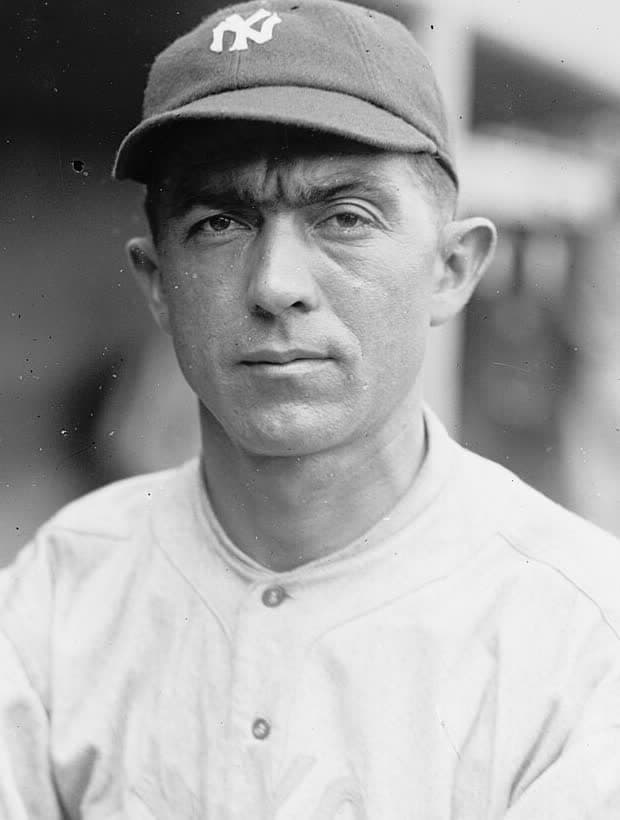
Frank 'Home Run' Baker portrait, New York, 1921.
Photo credit: Bain News Service / Library of Congress via Wikimedia Commons (Public domain)
John Franklin Baker hit 96 career home runs, a total that would not earn a nickname in any other era. In the Dead-Ball Era, it earned him one of the best nicknames in the sport. He led the American League in home runs four consecutive years, hit two of the most consequential home runs of the early twentieth century, and played third base alongside Eddie Collins, Jack Barry, and Stuffy McInnis on a Connie Mack infield the press valued at $100,000. The number was an exaggeration. The talent was not. The Veterans Committee elected him to the Hall of Fame in 1955.
Trappe
Baker was born on March 13, 1886, in Trappe, Maryland, a small farming community on the Eastern Shore of the Chesapeake Bay. He grew up working on his family's farm and played baseball for local teams around the Delmarva Peninsula before signing with a minor league club in the Tri-State League. Connie Mack purchased his contract from the Reading Pretzels in 1908 and brought him to Philadelphia, where he became the starting third baseman in 1909.
Baker hit .305 as a 23-year-old in his first full season, driving in 85 runs and showing a left-handed swing with enough pull power to rank among the league leaders in extra-base hits. By 1911 he was one of the most dangerous hitters in the American League, batting .334 with 11 home runs and 115 RBI. The home run total led the league. He led again in 1912 with 10, in 1913 with 12, and in 1914 with 9, four consecutive home run titles in an era when single digits could win the crown.
The 1911 World Series
The nickname came from the 1911 World Series against the New York Giants. In Game 2, with the score tied 1-1 in the sixth inning, Baker hit a home run off Rube Marquard that gave the Athletics a lead they would not relinquish. In Game 3, he hit a ninth-inning home run off Christy Mathewson to tie a game the Athletics eventually won in extra innings. Two home runs off two of the best pitchers in the National League, both in decisive situations, against the most prominent team in New York. Baker had carried the nickname "Home Run" since at least 1909, when Philadelphia newspapers first applied it, but the 1911 World Series made it nationally famous and permanently attached it to his identity.
The Athletics won the 1911 Series in six games. Baker hit .375 with five RBI across the Series, and his two home runs defined the narrative of the entire October. Mathewson, who rarely allowed home runs to anyone, had to live with the knowledge that Baker's blast had turned a game he was winning into a game he lost.
The $100,000 Infield
Baker played third alongside second baseman Eddie Collins, shortstop Jack Barry, and first baseman Stuffy McInnis. Sportswriters estimated the four players' combined market value at $100,000, an astronomical figure for the time and a name that reflected the public fascination with quantifying athletic talent in financial terms. The infield anchored Athletics teams that won pennants in 1910, 1911, 1913, and 1914 and World Series titles in 1910, 1911, and 1913.
The 1914 World Series brought the dynasty to an abrupt end. The Athletics entered as heavy favorites against the Boston Braves, who had been in last place as late as July. The Braves swept the Series in four games, one of the most shocking upsets in postseason history, and Mack responded by dismantling the roster. He sold or released his highest-paid players rather than compete with the Federal League for their salaries, and within a year the Athletics went from champions to one of the worst teams in the American League.
Holdout and New York
Baker sat out the entire 1915 season in a contract dispute, refusing to play for what Mack offered. He spent the year on his farm in Trappe and did not budge. Mack sold him to the New York Yankees in February 1916, and Baker joined a franchise that was still years away from the dynasty that Babe Ruth and Lou Gehrig would build.
He hit .269 in his first season with the Yankees and .282 in 1917 before his career was interrupted again. He played through 1919, then sat out the entire 1920 season after the death of his first wife, Ottilie, choosing to stay home and care for his two young daughters. He returned to hit .294 in 1921, playing alongside Ruth on the Yankees team that won the American League pennant, before retiring after the 1922 season at age 36.
He finished with a .307 career batting average, 991 RBI, and 96 home runs across 13 major league seasons. The numbers look modest against later eras, but Baker played in a time when the ball was dead, the fields were vast, and a dozen home runs made a man the most feared slugger in his league.
The Eastern Shore
Baker returned to his farm in Trappe after retirement and lived quietly for four decades. He followed baseball from a distance and occasionally attended events, but he was a farmer by temperament and never sought the public life that some retired players pursued. He died on June 28, 1963, in Trappe, at age 77.