Profile
Lou Gehrig
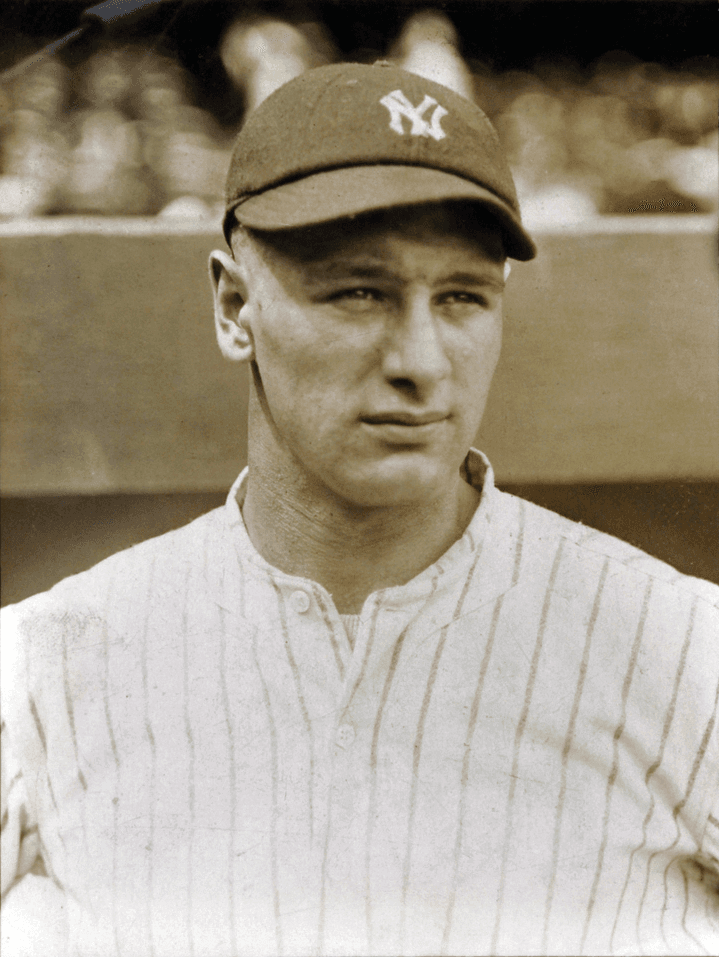
Lou Gehrig during his 1923 rookie season.
Photo credit: Wide World Photos via Wikimedia Commons (Public domain)
Heinrich Ludwig Gehrig was born to German immigrants in East Harlem, weighed nearly 14 pounds at birth, lost three siblings to childhood diseases, and grew into the most durable player the game produced. Gehrig played 2,130 consecutive games for the New York Yankees, a record that stood 56 years, and batted .340 with 493 home runs, 1,995 RBI, and a .632 slugging percentage across 17 seasons. He won two MVP awards, hit .361 in seven World Series, and drove in 100 or more runs 13 consecutive years. Then amyotrophic lateral sclerosis took everything from him in less than two years, and on July 4, 1939, at Yankee Stadium, Gehrig stood at a microphone and called himself "the luckiest man on the face of the earth." The Hall of Fame waived its waiting period and inducted him that December. The Yankees retired his number 4, the first number retired in major league history.
Columbia
Gehrig was born on June 19, 1903, in Manhattan. His father Heinrich worked sporadically in sheet metal and struggled with alcoholism and epilepsy. His mother Christina, the family's primary breadwinner, worked as a maid and cleaned houses. Gehrig was the only surviving child of four. He attended Commerce High School, where he hit a grand slam at Cubs Park during a national high school championship game that the Chicago Tribune said "would have made any big leaguer proud, yet it was walloped by a boy who hasn't yet started to shave."
Gehrig enrolled at Columbia University on a football scholarship and studied engineering. On the baseball team he hit .444 with seven home runs in 19 games and struck out 17 batters in a single game as a pitcher against Williams College, a school record that still stands. Yankees scout Paul Krichell watched Gehrig hit two home runs against Rutgers on April 26, 1923, and told GM Ed Barrow, "I have just seen another Babe Ruth." Gehrig signed for a $1,500 bonus and $400 a month.
The Iron Horse
Gehrig replaced Wally Pipp at first base on June 2, 1925, and did not miss another game for 14 years. Manager Miller Huggins told him, "You're my first baseman, today and from now on." Pipp later said, "I took the two most expensive aspirins in history."
The consecutive games streak reached 2,130 and became inseparable from Gehrig's identity. He played through broken fingers, back spasms, lumbago, and a concussion. When a reporter asked Gehrig in 1933 if he knew the count, Gehrig said he didn't. The reporter told him it was 1,250. Eleanor, whom Gehrig married on September 29, 1933, once suggested stopping at 1,999 because people would remember the number better. Gehrig said Colonel Ruppert would never forgive him. Cal Ripken Jr. passed the record on September 6, 1995.
Murderers' Row
Gehrig hit behind Ruth in the most feared lineup in baseball history and spent most of his career in Ruth's shadow. In 1927, the year Ruth hit 60 home runs, Gehrig batted .373 with 47 home runs and 175 RBI, a record at the time, and won the MVP. In 1931 Gehrig drove in 184 runs, an American League record that still stands, and hit 46 home runs but tied Ruth for the league lead partly because one of Gehrig's apparent home runs was disallowed when a baserunner left the basepath. On June 3, 1932, Gehrig hit four home runs in a single game against the Philadelphia Athletics, the first player to accomplish the feat in the twentieth century. John McGraw's retirement announcement that day pushed Gehrig's four home runs below the fold.
Gehrig won the Triple Crown in 1934 with a .363 average, 49 home runs, and 166 RBI, and won his second MVP in 1936 with 49 home runs and 152 RBI. He played in seven World Series and won six championships. His World Series career line was .361 with 10 home runs and 35 RBI across 34 games. Bill Dickey, his roommate and closest friend on the team, said, "He just went out and did his job every day."
Gehrig hit 23 career grand slams, a major league record that stood until Alex Rodriguez broke it in 2013. He recorded five seasons with 400 or more total bases, something no other player accomplished more than twice. He drove in 100 runs in every season from 1926 through 1938 without interruption.
The Speech
Gehrig's decline began in 1938. He hit .295, his lowest average since his first full season, and teammates noticed he moved differently. In spring training 1939, Joe DiMaggio watched Gehrig miss 19 consecutive fastballs during batting practice and recognized something was deeply wrong. On May 2, 1939, at Briggs Stadium in Detroit, Gehrig told manager Joe McCarthy, "I'm benching myself, Joe, for the good of the team." The streak ended at 2,130 games. Tigers fans gave him a standing ovation.
Gehrig traveled to the Mayo Clinic in June and was diagnosed on his 36th birthday with amyotrophic lateral sclerosis, a degenerative disease that destroys muscle function while leaving the mind intact. The prognosis was two and a half years. Eleanor recalled the phone call from the doctors. "It hit me amidships," she said.
On July 4, 1939, between games of a doubleheader at Yankee Stadium before 61,808 fans, Gehrig stood at a microphone surrounded by his 1927 teammates, including Ruth, and delivered the speech that defined him. "Fans, for the past two weeks you have been reading about a bad break," Gehrig said. "Today I consider myself the luckiest man on the face of the earth." He thanked the owners, the managers, his mother-in-law, his parents, and Eleanor. "When you have a wife who has been a tower of strength and shown more courage than you dreamed existed," he said, "that's the finest I know." Ruth hugged him as the band played "I Love You Truly," and the crowd chanted "We love you, Lou." The stadium stood for nearly two minutes.
Gehrig accepted an appointment as a New York City parole commissioner and served until his health prevented it. Eleanor often guided his hand for signing documents as the disease progressed. Gehrig died on June 2, 1941, at 10:10 p.m. at his home in the Riverdale section of the Bronx, at 37. The date was 16 years to the day after he replaced Wally Pipp. Mayor La Guardia ordered flags across New York lowered to half-staff. Ruth wept at the viewing. Eleanor never remarried. "I had the best of it," she said. "I would not have traded two minutes of the joy and grief with that man for two decades of anything with another."
Sources
Related Articles
The Most Valuable Signed Baseballs in History
Memorabilia & Collectibles · May 17, 2026
Continue Reading
The Pride of the Yankees and the Birth of the Sports Biopic
Baseball in Pop Culture · May 17, 2026
Continue Reading
The Luckiest Man on the Face of This Earth
People · May 6, 2026
Continue Reading
The Girl Who Struck Out Babe Ruth and Lou Gehrig
Strange But True · May 6, 2026
Continue Reading
The Man Who Stole a Yankee's Life
Strange But True · May 6, 2026
Continue Reading