The Man Who Stole a Yankee's Life
In 1948, papers across the country reported former Yankee Julie Wera had died in California. The real Julie Wera was alive in Rochester.
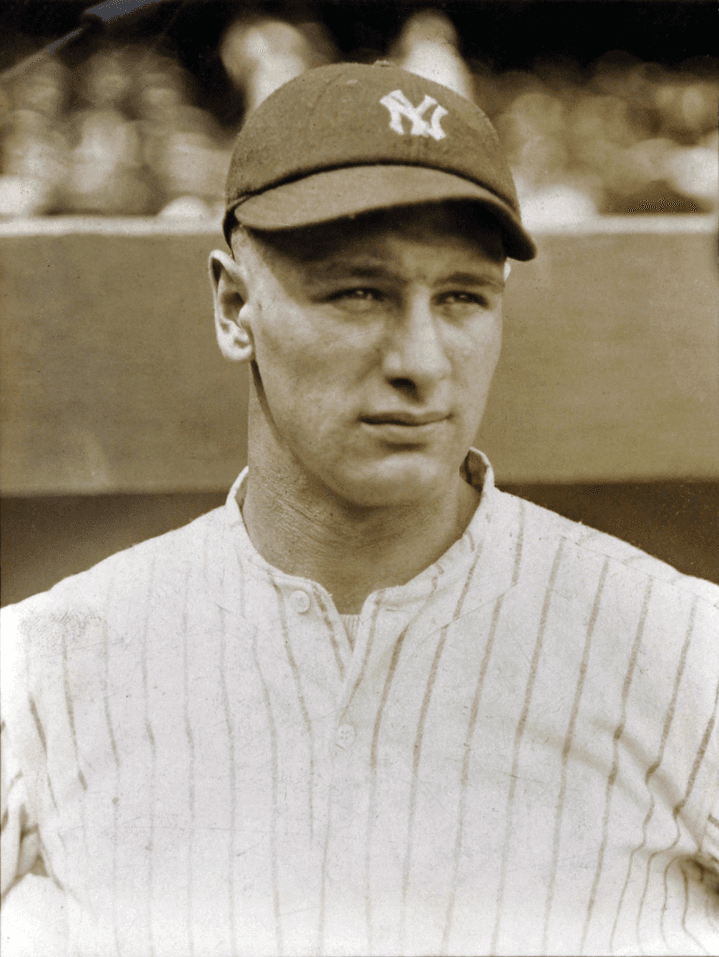
Lou Gehrig during his 1923 rookie season.
Photo credit: Wide World Photos via Wikimedia Commons (Public domain)
On September 13, 1948, the front page of the Oroville Mercury-Register in northern California announced the death of Julian Wera, a member of the 1927 New York Yankees. Wera, who had been serving as the business manager of the local minor league team, the Oroville Red Sox, was found dead in his apartment with a suicide note addressed to his estranged wife. Wire stories about his death ran in newspapers across the country, including the New York Times.
The news came as a surprise in Rochester, Minnesota, where the actual Julian Wera was very much alive, managing the meat department at a Piggly Wiggly grocery store.
The man who died in Oroville was an imposter. His real name was William J. Wera. He was not related to Julian. He had been posing as the former Yankee for roughly a year, and he had fooled everyone.
The real Julie Wera had been a reserve third baseman on the 1927 Yankees, the team known as "Murderers' Row." He was 5-foot-7 and 155 pounds, a backup behind Joe Dugan. He appeared in 38 games that season, batting .238 with one home run. He received the same $5,782 World Series share as Babe Ruth and Lou Gehrig, though he did not appear in the series itself. He came back for five games with the Yankees in 1929, spent several more years in the minors, and retired from professional baseball in 1937. He settled in Rochester and became a butcher.
In 1939, Lou Gehrig visited the Mayo Clinic in Rochester for the medical tests that would confirm his diagnosis of amyotrophic lateral sclerosis. Between appointments, a local reporter asked Gehrig if he'd like to see his old teammate. "Julie?" Gehrig asked. "In town here? Where is he?" Gehrig went to the Piggly Wiggly. The two men visited behind the meat counter.
That was the last time Julie Wera made national news until a man using his name turned up dead in California nine years later.
William Wera had approached Charlie Graham, president of the San Francisco Seals, and asked for a job in baseball. When Graham pointed out that the man in front of him didn't look like the Julian Wera he remembered, William had an answer ready. He said a mine explosion during World War II had disfigured him and forced him to undergo plastic surgery. The Selective Service had classified the real Julian Wera as 4-F, and he never served in the military, but Graham apparently didn't check. He connected William with Jerry Donovan, a former teammate of Julian's who was now president of the Far West League. Donovan didn't question the story either. William knew enough about baseball to be convincing, and the club offered him the business manager job with the Oroville Red Sox, a team owned by the Boston Red Sox organization.
For an entire year, William Wera lived as Julian Wera. He ran the team. He gave interviews to the local paper. When Babe Ruth died in August 1948, William provided the Mercury-Register with "memories" of the Babe, including a fabricated story about Ruth bringing him a glass of milk every night at bedtime because he'd been "just a kid" when he joined the Yankees. He told reporters he'd hit a home run off Walter Johnson in his first major league at-bat. The real Julie Wera never faced Johnson in a regular season game. His only career home run came off Bobby Burke.
On September 13, 1948, after the Oroville Red Sox's season ended, William was found dead of an overdose of sleeping pills. He left a note addressed to his wife, Ruth, who later told reporters she "was as much surprised as anyone else" to learn her husband was not the man he'd claimed to be. William's identity was eventually confirmed through fingerprints on file from a 1947 casino employment application in Reno.
The real Julie Wera lived quietly in Rochester for another 27 years. He worked at Piggly Wiggly, then at Barlow Foods. He served on the Rochester Planning and Zoning Commission. In 1973, his family took him back to Yankee Stadium to see a game. He died of a heart attack at his home on December 12, 1975, at the age of 73. His widow received a letter of congratulations from Yankees owner George Steinbrenner when Julie was inducted into Winona's Polish Hall of Fame posthumously in 1983.
The family never learned why William Wera chose Julie's identity, or how he knew enough to sustain the deception for as long as he did. Some questions in baseball have no answer.