The Girl Who Struck Out Babe Ruth and Lou Gehrig
In April 1931, 17-year-old Jackie Mitchell faced Babe Ruth and Lou Gehrig in Chattanooga and struck out both Yankees icons in sequence.
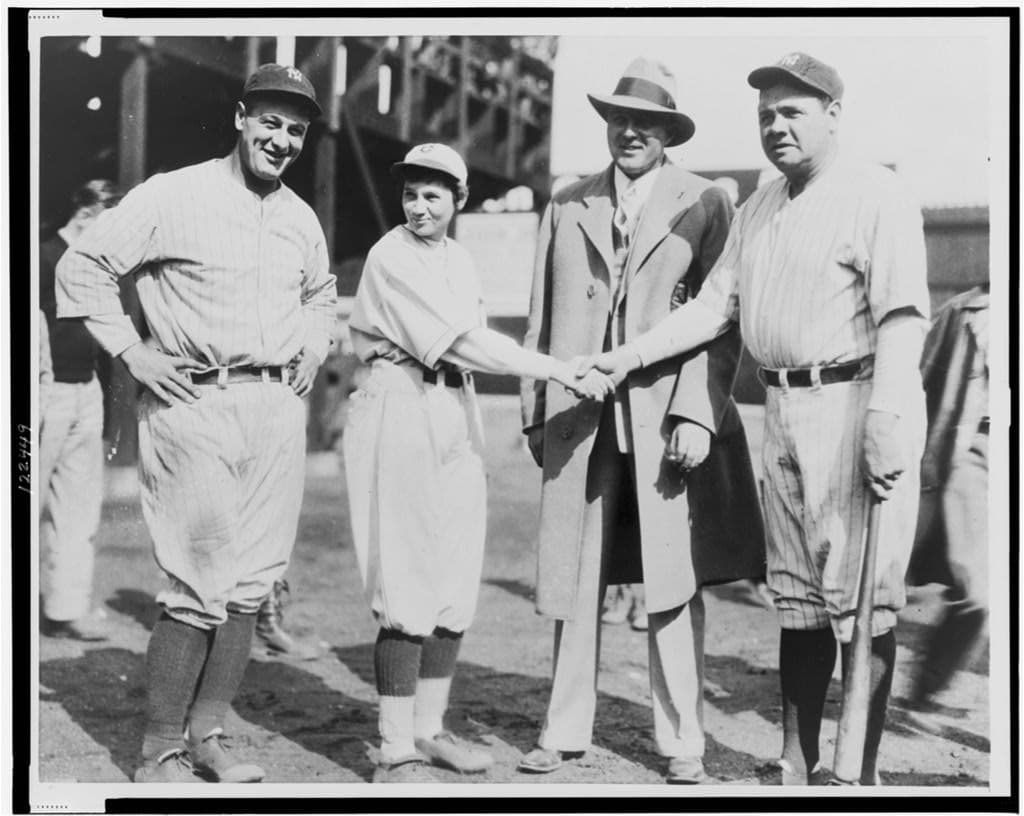
Jackie Mitchell shakes hands with Babe Ruth as Lou Gehrig (left) and Joe Engel look on, 1931.
Photo credit: United Press / New York World-Telegram and the Sun via Library of Congress
On April 2, 1931, a 17-year-old left-handed pitcher named Jackie Mitchell walked to the mound at Engel Stadium in Chattanooga, Tennessee. She was pitching for the Chattanooga Lookouts, a Southern Association club, in an exhibition game against the New York Yankees, and the first two batters she faced were Babe Ruth and Lou Gehrig. She struck them both out. The box score survives and so do the next morning's headlines, but the argument over whether Ruth and Gehrig swung in earnest has run for nearly a hundred years without ever being settled.
The Showman
Jackie Mitchell reached that mound because of Joe Engel. Engel ran the Lookouts for owner Clark Griffith as a Washington Senators farm club, and he was one of the great promoters the game has known, a man who would do almost anything to sell a ticket. He once traded a player for a turkey, had the bird cooked, and served it to the sportswriters. He staged elephant rides and hung cages of singing canaries in the grandstand. So when the Yankees scheduled a pair of exhibition games in Chattanooga on their train ride north from spring training, Engel saw a chance no one else would have considered, and he signed a teenage girl to a contract.
Mitchell grew up in Memphis next door to Dazzy Vance, the Hall of Fame pitcher who taught her a sinking drop ball, and she played organized baseball from childhood on men's and women's teams, once striking out nine men in a game at 16. Her left-handed sinker broke in a direction right-handed batters struggled to track. Her credentials were sound, but the reason Engel signed her was that she was a 17-year-old girl, and he knew exactly what that was worth at the gate.
Ruth and Gehrig at the Plate
The game was set for April 1 and pushed back a day by rain, a wrinkle that only fed the conspiracy theories to come. On April 2, before a packed house, the Lookouts starter Clyde Barfoot gave up a double and a single to open the first inning, and manager Bert Niehoff pulled him and waved Mitchell in from the bullpen.
Ruth stepped in and tipped his cap to the teenager on the mound. Her first pitch missed for a ball, and then Ruth swung hard and missed, swung again and missed, and on the fourth pitch watched a strike cross the plate without offering at it, and the umpire rang him up. Ruth flung his bat toward the dugout and argued the call before stalking back to the bench.
Gehrig followed and went down swinging at three straight pitches, then walked quietly back to the dugout. Mitchell walked the next batter, Tony Lazzeri, and Niehoff took her out, and the Yankees went on to win 14-4, but the score was beside the point, because the story was written the moment Ruth turned for the bench. The New York Times carried it the next morning, and the paper's editorial page added that "the prospect grows gloomier for misogynists."
The Debate Over the Strikeouts
Whether the two Yankees were trying has been argued ever since, and everything about the setting argues for a setup, a showman running the club, an exhibition game with nothing at stake, an original date of April Fools' Day. The case on the other side is sturdier than it first looks. Ruth said publicly that women "will never make good" in baseball because "they are too delicate." Gehrig, by every account of his character, was too earnest and too competitive to throw an at-bat. Tony Lazzeri said the only instruction anyone gave him was "don't hit one up the middle and kill her." And Mitchell's contemporaries kept returning to the matchup itself, a left-handed pitcher with an odd sidearm delivery facing two left-handed hitters who had never seen her, and unfamiliar motion and speed can freeze even a great hitter for a single at-bat.
Mitchell never wavered, insisting until her death in 1987 that the strikeouts were legitimate. The commissioner Kenesaw Mountain Landis was widely reported to have voided her contract within days, declaring the game too strenuous for women, though no record of any such ruling has ever turned up. She went on to pitch for exhibition and barnstorming clubs, including the House of David, but she never threw in organized professional baseball again.
Staged or not, no one who was there ever admitted to fixing it. Ruth and Gehrig took the answer with them.