Profile
Bill Dickey
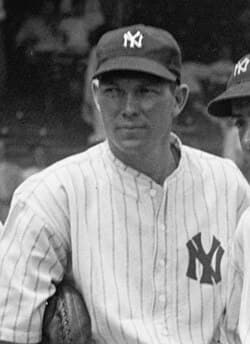
Bill Dickey portrait, 1937.
Photo credit: Bain News Service via Wikimedia Commons (Public domain)
William Malcolm Dickey caught for the New York Yankees across 17 seasons, batted .313 lifetime, and defined the standard for American League catchers during the 1930s and early 1940s. He was quiet where Mickey Cochrane was intense, steady where Gabby Hartnett was colorful, and productive enough that the Yankees never needed to look for a replacement. He won seven World Series championships, earned 11 All-Star selections, and hit for both average and power at a position that rarely produced either. When he finally retired, he taught his successor everything he knew about catching at the major league level. That successor was Yogi Berra. The BBWAA elected Dickey to the Hall of Fame in 1954.
Arkansas
Dickey was born on June 6, 1907, in Bastrop, Louisiana, and grew up in Kensett, Arkansas, a small town in White County where his family settled when he was young. He attended high school in nearby Searcy and played both baseball and football before signing with the Little Rock Travelers of the Southern Association. The Yankees purchased his contract, and he made his major league debut on August 15, 1928, appearing in 10 games at the end of the season. He became the starting catcher in 1929, hit .324 in his first full year, and never let go of the job until the Navy took him away during World War II.
The Best-Hitting Catcher in Baseball
Dickey batted over .300 in 10 of his first 11 full seasons, combining a high average with enough power to drive in runs from the bottom third of a lineup stacked with future Hall of Famers. His finest offensive season came in 1936, when he hit .362 with 22 home runs and 107 RBI on a team where Lou Gehrig hit 49 home runs and Joe DiMaggio arrived as a rookie. Dickey followed that with a .332 average, 29 home runs, and 133 RBI in 1937, stringing together consecutive seasons that no catcher of his era could match. He finished his career with 202 home runs and 1,209 RBI, extraordinary totals for the position in any decade.
Behind the plate, Dickey handled pitching staffs with an intelligence that made him indispensable. He caught Red Ruffing and Lefty Gomez through the heart of the dynasty, calling games with a calm authority that both pitchers trusted completely. He blocked pitches in the dirt, controlled the running game with a strong and accurate arm, and set the tempo for his staff in ways that rarely showed up in a box score. Joe McCarthy, who managed the Yankees from 1931 to 1946, considered Dickey the best catcher he had ever seen, and McCarthy had watched baseball long enough to have a thorough frame of reference.
Seven Championships
Dickey caught for World Series championship teams in 1932, 1936, 1937, 1938, 1939, 1941, and 1943. He was named to the All-Star team 11 times between 1933 and 1946, including the inaugural game in 1933 at Comiskey Park, and he returned to the roster nearly every year afterward. In 38 career World Series games, he batted .255 with five home runs, though his defensive contributions were at least as significant as anything he did at the plate. The Yankees won seven of the eight World Series they entered during Dickey's years as starting catcher, losing only the 1942 Series to the Cardinals.
His one serious blemish came on July 4, 1932, when he punched Washington Senators outfielder Carl Reynolds during a collision at home plate and broke Reynolds's jaw. American League president Will Harridge suspended Dickey for 30 days and fined him $1,000, one of the harshest penalties the league had imposed for an on-field fight to that point. Dickey was not a combative player by nature, and the incident stood out precisely because it contradicted everything else about his temperament.
War and Berra
Dickey enlisted in the Navy in 1944 and served through 1945, missing two full seasons at the tail end of his playing career. He returned to the Yankees in 1946 for a final season and was named player-manager partway through the year, managing 105 games before stepping down at the end of the season. He did not pursue managing further and moved into coaching instead.
His most enduring contribution after playing came as a catching instructor. The Yankees assigned him to work with Berra, a talented but unpolished young catcher who had arrived from the minor leagues during the war years. Dickey taught Berra footwork, positioning, pitch-calling, and the mechanics of receiving at the highest level. Berra credited Dickey with transforming his defensive game, and the famous line attributed to Berra captured the relationship: "Bill Dickey is learning me his experience." The grammar belonged to Berra, but the knowledge was Dickey's, and the handoff between them preserved the Yankees' standard behind the plate for another generation. Berra went on to win three MVP awards and catch in 14 World Series, a career that began with the foundation Dickey built.
Dickey died on November 12, 1993, in Little Rock, Arkansas, at age 86.