Profile
Gabby Hartnett
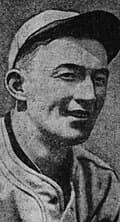
Gabby Hartnett portrait, 1925.
Photo credit: Bain News Service via Wikimedia Commons (Public domain)
Charles Leo Hartnett caught for the Chicago Cubs for 19 seasons and earned the nickname "Gabby" for reasons that inverted over time. Teammates gave him the name as a rookie because he barely spoke, too shy and overwhelmed to make conversation in a major league clubhouse. The shyness wore off. By his prime he talked constantly from behind the plate, directing pitchers, needling hitters, and chatting with umpires in a running commentary that justified the name on entirely different grounds. He batted .297 with 236 home runs across 20 major league seasons, won the 1935 National League MVP award, and hit one home run that outlived all the others. On a darkening September afternoon in 1938, with the pennant race balanced on a single swing, Hartnett drove a pitch into the left-center field bleachers at Wrigley Field and changed the course of the season. The BBWAA elected him to the Hall of Fame in 1955.
Millville
Hartnett was born on December 20, 1900, in Woonsocket, Rhode Island, the eldest of fourteen children. His father, Fred Hartnett, labored at a rubber factory and played semipro baseball as a catcher, managing the town team in Millville, Massachusetts, where the family relocated when Gabby was young. His mother, Ellen Tucker Hartnett, raised the large family while Fred worked and played ball. Gabby grew up catching for local teams in Millville, learning the position from his father, whose throwing arm was locally famous. He finished eighth grade at Longfellow Grammar School at fourteen, worked at Banigan's Millville Rubber Shop, and later attended Dean Academy in Franklin, Massachusetts. He signed his first professional contract with the Worcester Boosters of the Eastern League on March 12, 1921, and spent that season learning behind the plate before the Cubs brought him to Chicago in 1922.
Chicago
Hartnett became the regular catcher in 1924 and hit .299 that year, establishing himself as one of the better offensive catchers in the league. In 1925, he hit 24 home runs, setting a single-season record for catchers and finishing second in the National League only to Rogers Hornsby's 39. By 1927, he was widely acknowledged as the best catcher in the National League, and in 1930 he produced his most devastating offensive season, batting .339 with 37 home runs and 122 RBI. Those numbers would have been remarkable for any position and were extraordinary for a catcher playing in every game and handling a full pitching staff.
An arm injury limited him to just 25 games in 1929 and threatened to end his career. He was limited to pinch-hitting during the World Series that fall, recording no hits as the Cubs lost to the Philadelphia Athletics. He recovered fully and produced his best sustained stretch of play in the mid-1930s, combining elite offense with the defensive mastery that had defined his reputation from the start. He threw out 60 percent of runners attempting to steal in 1926, and his game-calling earned the respect of every pitcher who threw to him. In 1932, he guided the Cubs' pitching staff to a 3.44 ERA, the lowest in the National League, and he was behind the plate for Babe Ruth's "called shot" in Game 3 of that year's World Series.
He was named to six consecutive All-Star teams from 1933 to 1938. In the 1934 All-Star Game, he caught Carl Hubbell's historic performance, in which Hubbell struck out five consecutive future Hall of Famers. On August 28, 1939, he caught his 1,728th game, breaking Ray Schalk's major league record for catchers.
The MVP Season
In 1935, Hartnett batted .344 with 13 home runs and 91 RBI in 116 games and won the NL MVP award, beating out Dizzy Dean and Arky Vaughan. The Cubs won the pennant that year, taking 21 consecutive games in September to overtake the Cardinals, though they lost the World Series to the Detroit Tigers in six games. Two years later, Hartnett finished second in the MVP voting behind Joe Medwick, having batted .354, the highest average by a National League catcher in sixty years.
The Homer in the Gloamin'
On July 20, 1938, the Cubs named Hartnett player-manager, replacing Charlie Grimm with the team in third place, six games behind the Pittsburgh Pirates. Hartnett drove the roster through the late summer and into September.
On September 28, the Cubs trailed the Pirates by half a game in the pennant race. The teams were tied 5-5 in the bottom of the ninth at Wrigley Field, with two outs. Darkness was settling over the ballpark, and the umpires had decided that the ninth would be the final inning. Hartnett, now 37, stepped to the plate against Pirates reliever Mace Brown. Brown threw two curveballs for strikes, the second fouled off, putting Hartnett in an 0-2 hole. The next pitch was a curveball that Brown failed to keep down. Hartnett connected and drove the ball over the fence in left-center field. The crowd erupted. Fans spilled onto the field, and Hartnett rounded the bases through a mob so thick that he later said he did not think he walked a step to the plate. The home run put the Cubs in first place. They clinched the pennant three days later in St. Louis, capping a ten-game winning streak and finishing two games ahead of Pittsburgh.
The "Homer in the Gloamin'" remains one of the most celebrated moments in Cubs history and one of the signature home runs in the sport. The Cubs lost the 1938 World Series to the Yankees in a four-game sweep. Hartnett continued as player-manager through 1940, compiling a 203-176 managerial record before the Cubs fired him on November 13 of that year.
After Wrigley
Hartnett signed with the New York Giants as a player-coach in December 1940 and hit .300 in 64 games during his final major league season in 1941. He finished with a .297 batting average, 236 home runs, and 1,179 RBI across 1,990 games. After leaving the Giants, he managed in the minor leagues for five seasons, leading teams in Indianapolis, Jersey City, and Buffalo. He then opened Gabby Hartnett's Recreation Center in Lincolnwood, Illinois, a suburban Chicago establishment that grew to include twenty bowling lanes, a barbershop, a soda fountain, a cocktail lounge, and a sporting goods store. He coached and scouted for the Kansas City Athletics in the mid-1960s before retiring for good.
He died on December 20, 1972, his seventy-second birthday, in Park Ridge, Illinois, from complications of cirrhosis of the liver. He was buried at All Saints Cemetery in Des Plaines. The BBWAA elected him to the Hall of Fame in 1955, with 195 of 251 votes, in a class that included Joe DiMaggio, Ted Lyons, and Dazzy Vance.