Profile
Joe Medwick
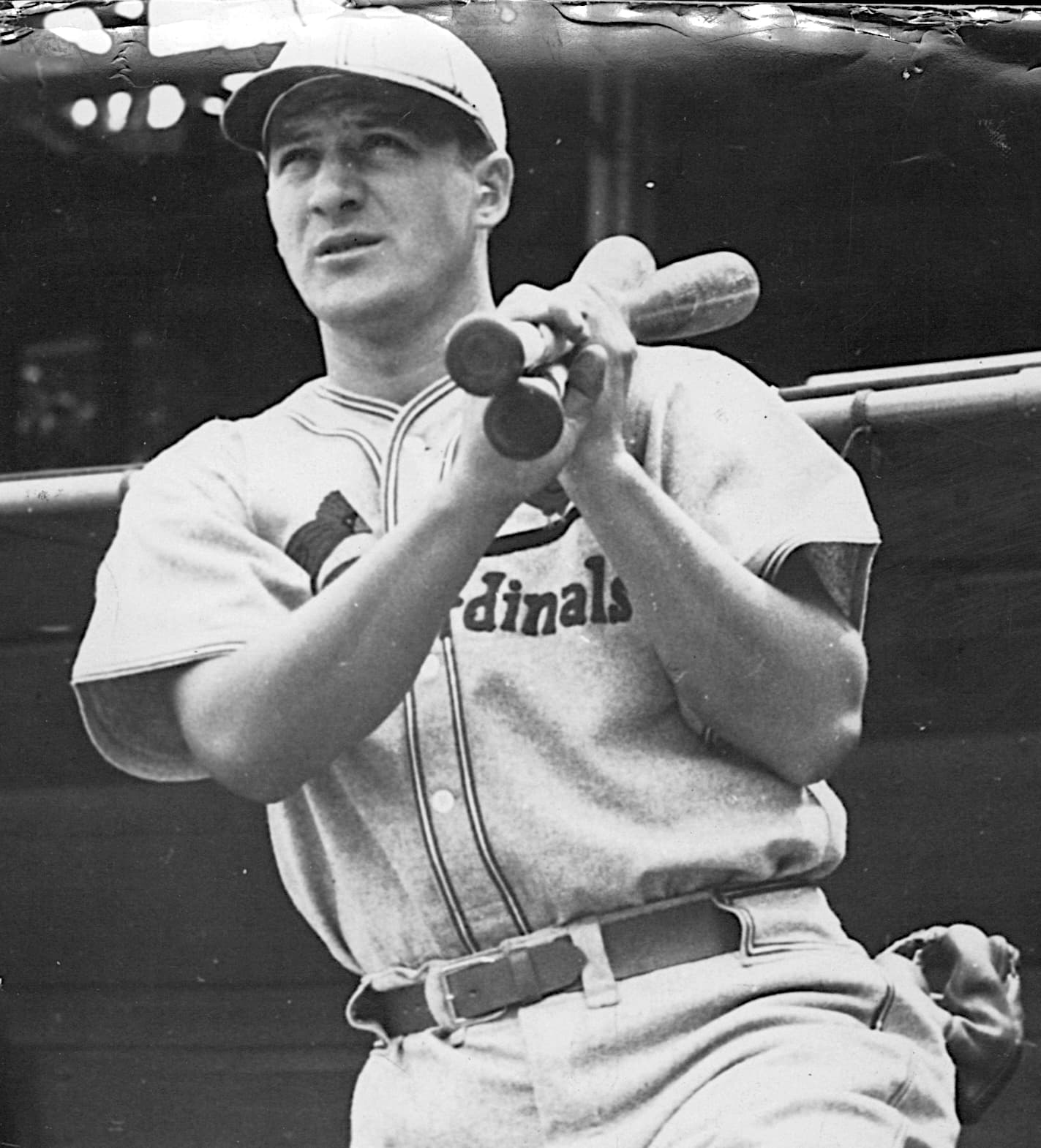
Joe Medwick portrait (1964 crop).
Photo credit: Unknown author via Wikimedia Commons (Public domain)
Joe Medwick won the National League Triple Crown in 1937, batting .374 with 31 home runs and 154 RBI for the St. Louis Cardinals, and no National League player has done it since. He was an aggressive, combative hitter who swung at everything and hit most of it hard, and his temperament matched his approach at the plate. A fan in Houston gave him the nickname "Ducky" during his minor league days, a name he despised, and he played the game with an intensity that occasionally crossed into belligerence. The BBWAA elected him to the Hall of Fame in 1968.
New Jersey
Joseph Michael Medwick was born on November 24, 1911, in Carteret, New Jersey, an industrial town near the coast. He was a multi-sport athlete in high school and signed with the Cardinals organization, reaching the major leagues in 1932 at 20. He was a natural hitter from the start, batting .306 in his first full season in 1933 and establishing himself immediately as one of the most dangerous bats in the National League lineup.
The Gashouse Gang
Medwick was a central figure on the 1934 Cardinals, the team known as the Gashouse Gang for their rough, aggressive style of play. The Cardinals won the pennant and faced the Detroit Tigers in the World Series, and Medwick was at the center of the series' most famous incident. In Game 7, with the Cardinals leading by a large margin, Medwick slid hard into third baseman Marv Owen. When Medwick returned to left field for the bottom of the inning, Detroit fans pelted him with fruit, bottles, and seat cushions. Commissioner Landis, who was in attendance, ordered Medwick removed from the game for his own safety. The Cardinals won 11-0, and Medwick's removal did not affect the outcome, but the scene remains one of the most remarkable episodes of fan behavior in World Series history.
Medwick hit .379 in the 1934 World Series with a home run and five RBI, and the championship validated a Cardinals team that played with more personality than any club in the league.
The Triple Crown
Medwick's 1937 season was the peak of his career and one of the great offensive seasons in National League history. He led the league in batting average (.374), home runs (31), and RBI (154), capturing the Triple Crown. He also led the league in hits (237), doubles (56), slugging percentage (.641), total bases (406), and runs scored (111). He won the National League MVP award, and the breadth of his statistical dominance that year was overwhelming.
His swing was unorthodox by the standards of hitting coaches. He stood deep in the box, lunged at pitches, and attacked the ball with a violence that made pitch selection almost irrelevant. He was a notorious bad-ball hitter who expanded the strike zone in every direction, but he made contact with such force and frequency that the approach worked. He led the league in RBI three consecutive seasons from 1936 through 1938, and he hit .300 or better in seven consecutive full seasons from 1933 through 1939.
Brooklyn and After
The Cardinals traded Medwick to the Brooklyn Dodgers in June 1940, and six days after the trade, St. Louis pitcher Bob Bowman hit Medwick in the head with a fastball. Medwick was hospitalized with a severe concussion, and the beaning became a flashpoint in the ongoing debate about protecting hitters. Some believed Bowman had thrown at Medwick deliberately, given the tensions surrounding the trade. Medwick returned to the lineup but was never the same hitter. His power declined, his batting average dropped, and the fearlessness that had defined his approach at the plate showed cracks that had not been there before.
He played for the Dodgers, Giants, and Braves over the next seven seasons, with a brief return to the Cardinals in 1947 and 1948 to close his career. He finished with a .324 career batting average, 2,471 hits, 1,383 RBI, and 540 doubles. The BBWAA elected him to the Hall of Fame in 1968, recognizing a career defined by the extraordinary peak of the mid-1930s and a Triple Crown season that remains the last in National League history.
Medwick died on March 21, 1975, in St. Petersburg, Florida, at 63.