Profile
Dizzy Dean
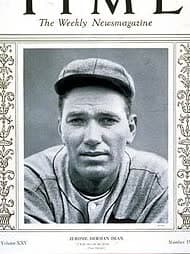
Dizzy Dean portrait from Time magazine cover.
Photo credit: Time magazine via Wikimedia Commons (Public domain)
Jay Hanna Dean won 30 games in 1934, the last pitcher in the National League to reach that number. He was 24 years old. He had told everyone he would do it before the season started, and he had spent the previous two years telling anyone who would listen that he was the greatest pitcher alive. The problem with Dizzy Dean was that he was usually right.
Arkansas
Dean was born on January 16, 1910, in Lucas, Arkansas, the son of an itinerant sharecropper. His childhood was shaped by poverty and transience. The family moved across Arkansas and Oklahoma following harvest work. Dean had minimal formal education and enlisted in the Army at 16, where he pitched for the Fort Sam Houston team in San Antonio and caught the attention of Cardinals scouts.
He debuted with the Cardinals on September 28, 1930, pitching a complete-game three-hitter in his first start. He won 18 games in 1932, 20 in 1933, and then tore the league apart in 1934.
1934
Dean went 30-7 with a 2.66 ERA in 1934 and won the National League MVP award. His younger brother Paul joined the Cardinals' rotation that year and went 19-11. On September 21, the Dean brothers pitched both ends of a doubleheader against the Brooklyn Dodgers. Dizzy won the first game 13-0, throwing a three-hitter. Paul threw a no-hitter in the second game. Dizzy reportedly complained afterward, "If I'd known Paul was gonna throw a no-hitter, I'd have thrown one too."
The Cardinals won the pennant and beat the Detroit Tigers in the 1934 World Series in seven games. Dean won Games 1 and 7. In Game 4, Dean entered as a pinch runner and was hit in the head by a throw during a double play. He was carried off the field and X-rayed that evening. Dean told reporters afterward, "They X-rayed my head and found nothing." Dean pitched the next day and lost, but came back to dominate Game 7 with an 11-0 shutout.
The Broken Toe
Dean won 28 games in 1935 and 24 in 1936, remaining the most dominant pitcher in the National League. In the 1937 All-Star Game, a line drive off the bat of Earl Averill struck Dean on the left foot, breaking his big toe. Dean returned to pitching before the toe had fully healed. He altered his delivery to compensate for the pain, and the changed mechanics ruined his arm. He was never the same.
The Cardinals traded him to the Cubs in April 1938. He went 7-1 with a 1.81 ERA in limited duty and helped the Cubs win the pennant, but his arm was finished. He pitched sparingly through 1941, attempted a one-game comeback in 1947 for the St. Louis Browns as a publicity stunt, and retired with a career record of 150-83 and a 3.02 ERA.
Broadcasting
Dean's second career was louder than his first. He became a baseball broadcaster, first on radio and then on CBS television, and his mangling of the English language delighted audiences and horrified grammarians. He said "slud" instead of "slid," reported that runners "throwed" the ball, and announced that players had "swang" at pitches. When a group of English teachers complained, Dean replied, "A lot of people that don't say 'ain't' ain't eatin'."
He was colorful, opinionated, and enormously popular. His broadcasting career lasted longer than his playing career and kept him in the public eye for two decades.
He died on July 17, 1974, in Reno, Nevada, at age 64, from a heart attack. He was elected to the Hall of Fame in 1953, receiving 209 of 264 votes.