Profile
Ray Schalk
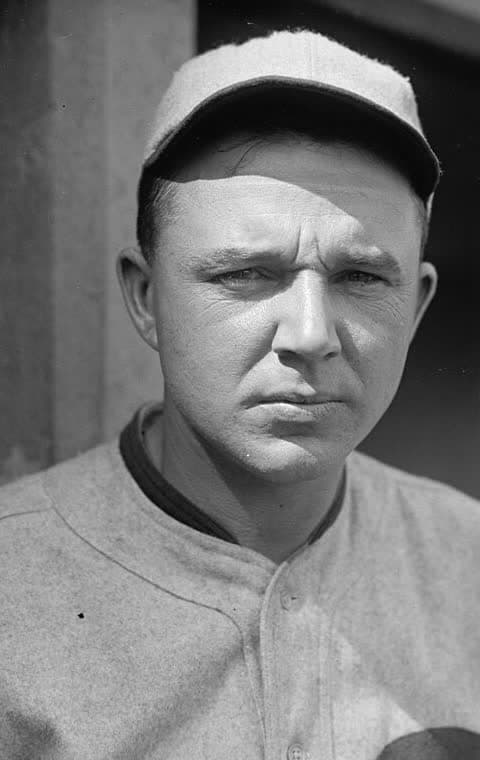
Ray Schalk portrait, Chicago, 1924.
Photo credit: Bain News Service / Library of Congress via Wikimedia Commons (Public domain)
Raymond William Schalk stood five feet nine and weighed 165 pounds, small for a catcher in any era but especially in one that did not yet value quickness over size behind the plate. He caught more than 1,700 major league games over eighteen seasons, nearly all of them for the Chicago White Sox, and redefined the catcher position through agility, intelligence, and a willingness to throw his body in front of pitches in the dirt that other catchers let pass. He caught three no-hitters, including a perfect game, threw out baserunners at a rate that terrified opponents, won a World Series in 1917, and had the misfortune of squatting behind the plate for the most infamous team in baseball history. The Veterans Committee elected him to the Hall of Fame in 1955.
Harvel to Chicago
Schalk was born on August 12, 1892, in Harvel, Illinois, a small farming community south of Springfield. He grew up in Litchfield, Illinois, where he played on local teams and developed the quickness and arm strength that would carry him into professional baseball. He signed with the Milwaukee Brewers of the American Association in 1911, and his performance there was strong enough to draw major league attention within a year. The Chicago White Sox purchased his contract in July 1912, and he became the regular catcher almost immediately.
He was nineteen years old, one day short of his twentieth birthday, and looked younger still. His size invited doubt from skeptics who believed a catcher needed to be big to absorb the physical punishment of the position, but Schalk answered the skepticism with performance that changed how people understood the role. He led American League catchers in putouts nine times and fielding percentage five times during his career, and he caught more games than any AL catcher during his peak seasons. He was among the first catchers to routinely back up plays at first base and third base, positioning himself where most catchers of his era never bothered to go. His arm was strong and accurate, and baserunners learned quickly that attempting to steal against him was a gamble with poor odds.
The 1917 Championship
The White Sox won the 1917 World Series, beating the New York Giants in six games. Schalk caught every game of the Series and hit .263. The 1917 team was loaded with talent. Eddie Collins played second base, Shoeless Joe Jackson hit in the middle of the order, and the pitching staff was led by Eddie Cicotte and Lefty Williams. The championship was the franchise's second and would be its last for eighty-eight years.
Schalk's defensive contribution to the 1917 team went beyond his work behind the plate. He managed the pitching staff with a tactician's instinct, calling games based on his knowledge of opposing hitters and his understanding of what each pitcher could and could not do on a given day. Cicotte and Williams were both effective when they threw the pitches Schalk called, a fact that would take on a darker significance two years later.
1919
The 1919 White Sox won the American League pennant and entered the World Series against the Cincinnati Reds as heavy favorites. What followed became the defining scandal in American sports history. Eight White Sox players conspired with gamblers to lose the Series deliberately, and the fix played out over the course of a best-of-nine series that the Reds won five games to three.
Schalk suspected something was wrong almost immediately. Cicotte and Williams, the two starting pitchers most deeply involved in the conspiracy, ignored Schalk's signs throughout the Series. They shook off calls and threw pitches that made no tactical sense given the situations, and Schalk was furious. He confronted the pitchers during the games and after them, and his anger was visible enough that teammates and reporters noticed it. He was one of the honest players on a team that had split into two factions, and his reaction to the betrayal reflected both his competitive nature and his understanding that the players who were throwing the Series were destroying something that could not be rebuilt.
When the conspiracy became public in September 1920, Schalk was never implicated. He testified before a grand jury and cooperated fully with the investigation. Commissioner Kenesaw Mountain Landis banned the eight conspirators for life. The banned players were Cicotte, Williams, Jackson, Chick Gandil, Swede Risberg, Buck Weaver, Fred McMullin, and Happy Felsch. Schalk continued playing for a White Sox franchise that had been gutted of much of its talent overnight.
After the Scandal
Schalk played through the aftermath and remained with the White Sox through 1928, catching for a club that was no longer competitive but that still needed his leadership behind the plate. He managed the team in 1927 and part of 1928, compiling a record of 102 wins and 125 losses before being replaced. He played his final major league game with the New York Giants in 1929, ending his career where it had begun, behind home plate.
He finished with a .253 career batting average, 11 home runs, and 594 RBI. The offensive numbers were modest even by Dead-Ball Era standards, but his value was never in his bat. He caught no-hitters by Joe Benz in 1914 and Eddie Cicotte in 1917, and he was behind the plate for Charlie Robertson's perfect game on April 30, 1922. He was a defensive catcher whose handling of pitchers, game-calling ability, and physical toughness set the standard for the position during his era.
Schalk coached for the Chicago Cubs and managed in the minor leagues after retiring as a player. He lived out his later years in Chicago, remaining connected to the city where he had spent nearly his entire career. He died on May 19, 1970, in Chicago, at age 77.