Profile
Casey Stengel
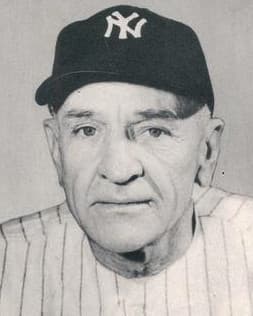
Casey Stengel portrait (Yankees, 1957).
Photo credit: Unknown author via Wikimedia Commons (Public domain)
Casey Stengel managed the New York Yankees to ten American League pennants and seven World Series titles in twelve seasons, a run of sustained excellence that no manager in any sport has matched. He then managed the expansion New York Mets, who lost more games in their first season than any team in modern baseball history, and he treated both experiences with the same antic energy and sideways eloquence that made him one of the most quotable figures the game has produced. The Veterans Committee elected him to the Hall of Fame in 1966.
Kansas City
Charles Dillon Stengel was born on July 30, 1890, in Kansas City, Missouri. The nickname "Casey" came from his hometown, an abbreviation of "K.C." that stuck early and stayed forever. He was a left-handed-hitting outfielder who reached the major leagues with the Brooklyn Dodgers in 1912 and played 14 seasons for five teams, compiling a .284 career batting average with occasional power and a flair for the theatrical that distinguished him from more conventional players.
He hit two home runs in the 1923 World Series for the New York Giants against the Yankees, including an inside-the-park home run that won Game 1 and a blast into the right-field bleachers that won Game 3. After the Game 3 homer, he thumbed his nose at the Yankees' bench and blew kisses to the crowd, drawing a fine from Commissioner Landis. He was 33 years old, and the moment captured something essential about Stengel. He was competitive, irreverent, and unable to resist the gesture that made the scene more entertaining.
Managing Before the Yankees
Stengel managed in the major leagues for nine seasons before the Yankees hired him, and the results were dismal. He managed the Brooklyn Dodgers from 1934 through 1936 and the Boston Braves from 1938 through 1943, and neither team finished higher than fifth place during his tenure. His combined record with those two franchises was 581 wins and 742 losses. A taxicab hit him in 1943, breaking his leg and keeping him out of the dugout for weeks, and a Boston sportswriter observed that the driver had done more for the Braves' pennant chances than Stengel had all season.
The losing years established Stengel's reputation as a clown rather than a serious manager, and when the Yankees hired him before the 1949 season, the New York press greeted the announcement with skepticism. The franchise had just fired Bucky Harris after a third-place finish, and Stengel seemed like a step backward.
The Dynasty
Stengel won the World Series in his first season as Yankees manager and then won it again in each of the next four, giving him five consecutive titles from 1949 through 1953, a streak that has never been equaled. He won the pennant in ten of his twelve seasons with the Yankees, losing only in 1954 and 1959, and won seven World Series. His regular-season record with the Yankees was 1,149 wins and 696 losses.
His tactical innovations during the dynasty years reshaped how managers used their rosters. Stengel platooned players aggressively, alternating left-handed and right-handed hitters based on the opposing pitcher in an era when most managers wrote out the same lineup every day. He rotated players in and out of the lineup to keep them fresh over the long season, and he managed his pitching staff with a flexibility that anticipated modern bullpen usage by decades. Players occasionally resented the platooning, but the results were difficult to argue with.
He managed stars including Mickey Mantle, Yogi Berra, Whitey Ford, Phil Rizzuto, and Joe DiMaggio in the final years of DiMaggio's career, and he handled the transition from one generation of Yankees talent to the next with a shrewdness that his clownish public persona often obscured. The Yankees fired him after the 1960 World Series loss to the Pittsburgh Pirates, citing his age. Stengel was 70. "I'll never make the mistake of being 70 again," he said.
The Mets
The expansion New York Mets hired Stengel as their first manager in 1962, and the 1962 Mets went 40-120, the worst record in modern baseball history. Stengel managed the Mets for four seasons, never winning more than 53 games, and the teams were spectacularly bad in ways that Stengel narrated with a running commentary that sportswriters transcribed with delight. His language, known as "Stengelese," was a stream of connected and disconnected clauses, name-dropping, subject changes, and observations that circled back to a point only he could see. "Can't anybody here play this game?" he asked after watching the early Mets, and the line became the title of Jimmy Breslin's book about the team's first season.
He broke his hip in a fall on July 25, 1965, after managing 95 games that season, and retired on August 30 at 75, ending a managerial career that spanned 25 seasons and 3,766 games. His career record of 1,905 wins and 1,842 losses reflects the two extremes of his career, the dynasty and the disaster, and the gap between them is the full range of what baseball can be.
After Managing
Stengel was elected to the Hall of Fame by the Veterans Committee in 1966. He died on September 29, 1975, in Glendale, California, at 85. The Mets retired his number 37 on September 2, 1965, and the Yankees had already placed a plaque for him in Monument Park. He is the only manager honored by both New York franchises, a distinction that reflects a career spent winning everything with one team and losing everything with the other, and somehow making both experiences worth watching.