The Polo Grounds and the Ghosts of Coogan's Hollow
For more than half a century, the Polo Grounds sat in the shadow of Coogan's Bluff, its horseshoe shape producing some of the strangest and most famous plays in baseball history.
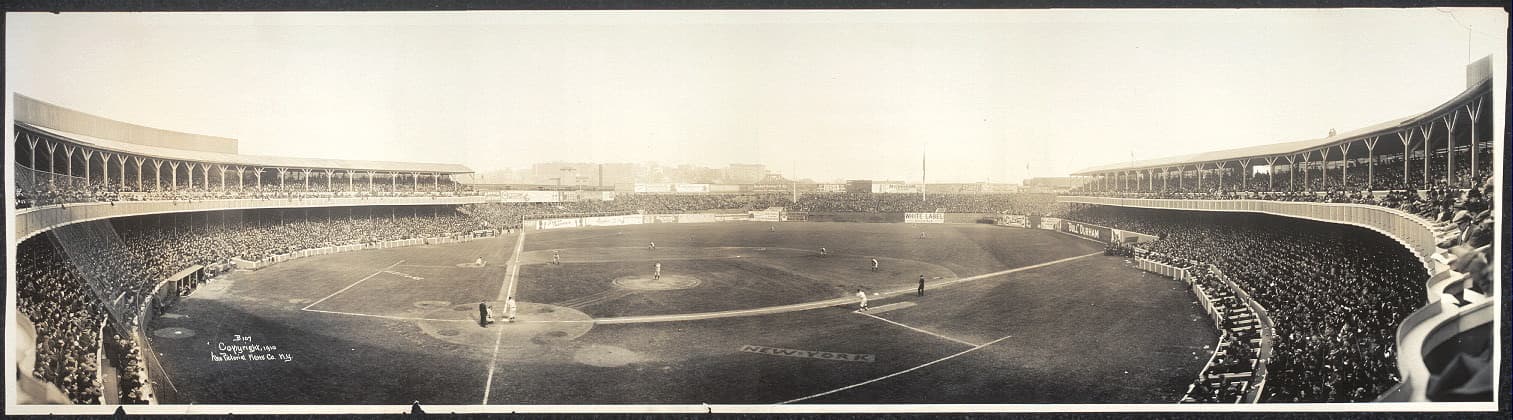
Polo Grounds panorama, October 13, 1910.
Photo credit: Unknown via Library of Congress
The name outlived every structure it was attached to. The original Polo Grounds, opened in 1876 near 110th Street for the sport of polo, became a baseball field in 1880 when the New York Metropolitans leased the property. The New York Gothams, later renamed the Giants, moved in by 1883. When the city carved 111th Street through the outfield in 1888, the Giants relocated to Coogan's Hollow the following year in upper Manhattan, beneath a rocky escarpment called Coogan's Bluff. They brought the name with them. By the time the final version of the Polo Grounds was demolished in 1964, no one alive could remember anyone playing polo there.
Fire and Steel
The ballpark the Giants built in Coogan's Hollow was wooden, and on April 14, 1911, it burned. A fire of undetermined origin swept through the grandstand in the early morning hours, consuming the wood and leaving only steel uprights standing. The outfield bleachers and clubhouse survived.
Giants owner John T. Brush moved fast. Within days, he brought in the Osborn Engineering Company of Cleveland to design a replacement in steel and reinforced concrete. Construction began on May 10, and the rebuilt stadium reopened just eleven weeks later, on June 28, 1911, with Christy Mathewson shutting out Boston in the first game. The initial capacity was roughly 16,000 seats. A major expansion in 1922-23 extended the double-decked grandstand around most of the field, added new bleachers across center field, and pushed total capacity past 54,000. That expansion created the horseshoe shape that earned the stadium its lasting nickname, the Bathtub.
A Stadium That Defied Geometry
The geography of Coogan's Hollow shaped the Polo Grounds, wedged into the narrow floor between the bluff and the Harlem River. The result was a playing field unlike any other in professional baseball. The right field foul pole stood just 258 feet from home plate. Left field was 279 feet. In most parks, those distances would produce a home run carnival. But the walls angled sharply away from the foul lines, and the power alleys stretched to roughly 450 feet on both sides. Straightaway center field reached 483 feet, marked at the base of the clubhouse. No batter ever cleared that wall.
The dimensions made the Polo Grounds a park of contradictions. A routine fly ball down the line could land in the seats for a home run; a 420-foot drive to center field was a loud out. The park rewarded pull hitters with short porches and punished anyone who tried to hit the ball where it was pitched. It made outfield defense a different sport entirely, requiring center fielders who could cover enormous acreage and throw with enough arm strength to keep runners honest across those vast distances.
Two Plays That Define a Building
On October 3, 1951, 34,320 fans gathered at the Polo Grounds for the third and deciding game of the National League pennant playoff between the Giants and the Brooklyn Dodgers. The Dodgers led 4-1 entering the bottom of the ninth. They still led 4-2 with runners on second and third when Bobby Thomson came to the plate against Ralph Branca. Thomson drove a fastball into the left field seats. Three runs scored. The Giants won the pennant. Russ Hodges, broadcasting on WMCA radio, repeated the fact four times in succession. "The Giants win the pennant! The Giants win the pennant! The Giants win the pennant! The Giants win the pennant!" The home run became known as the Shot Heard Round the World, and it remains the single most replayed moment in the stadium's history.
Three years later, on September 29, 1954, the Polo Grounds staged the play that best illustrated its peculiar geometry. In the eighth inning of World Series Game 1, with the score tied 2-2 and two runners on base, Cleveland's Vic Wertz drove a ball to deep center field. Willie Mays turned and sprinted toward the clubhouse wall, catching the ball over his shoulder roughly 420 feet from home plate. In most ballparks, that drive leaves the yard. At the Polo Grounds, it was an out. Then, in the tenth inning, Dusty Rhodes came off the bench and hit a fly ball down the right field line that barely cleared the wall near the foul pole. Home run. Giants win, 5-2. They swept the Series in four games. The Polo Grounds had produced its thesis statement in a single afternoon. A 420-foot out and a 258-foot home run, and neither result was a fluke.
Tenants and Departures
The Giants were never the only occupants. The New York Yankees played at the Polo Grounds from 1913 through 1922, subletting the field after their lease on Hilltop Park expired. Babe Ruth hit many of his early home runs there, and the Yankees drew 1.3 million fans in 1920, outdrawing the Giants in their own park. Giants owner Charles Stoneham declined to renew the lease after 1922, and Yankee Stadium opened across the Harlem River the following April.
The New York Cubans of the Negro National League played at the Polo Grounds during much of their existence from 1939 through 1950. The stadium also hosted professional football for decades, including the New York Football Giants and, later, the AFL's Titans, who became the Jets.
But the departure that ended everything was the Giants' own. On August 19, 1957, owner Horace Stoneham announced the team would relocate to San Francisco after the season. The final Giants game at the Polo Grounds came on September 29, 1957, a 9-1 loss to the Pittsburgh Pirates before 11,606 fans. After seventy-four years of Giants baseball in New York, the stadium went dark.
The Mets and the End
The Polo Grounds sat mostly vacant for nearly three years until the expansion New York Mets, managed by seventy-one-year-old Casey Stengel, moved in as a temporary home while Shea Stadium was under construction. The 1962 Mets went 40-120, one of the worst records in major league history. The 1963 team improved to 51-111. On September 18, 1963, 1,752 fans watched the Mets lose to the Philadelphia Phillies, 5-1, in the last major league game played at the Polo Grounds. Jim Hickman hit the final home run in the stadium's fifty-two-year history.
Demolition began on April 10, 1964. The wrecking ball was painted to look like a baseball, the same one that had been used to demolish Ebbets Field four years earlier. Workers wore Giants jerseys. The four thirty-story towers of the Polo Grounds Towers public housing project, completed in 1968, now stand where the outfield used to be. A plaque marks the approximate location of home plate. The John T. Brush Stairway, the stone steps that once carried fans down Coogan's Bluff to the ticket windows, still exists on the hillside. It is the only original structure that survived.