Profile
Robin Roberts
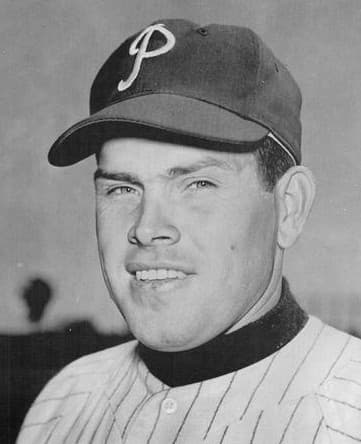
Robin Roberts portrait, 1961.
Photo credit: Unknown author via Wikimedia Commons (Public domain)
Robin Evan Roberts threw roughly 90 fastballs out of every 115 pitches, never developed a changeup, and won 286 games because the fastball rose six to eight inches and he could put it wherever he wanted. He pitched the Phillies to their first pennant in 35 years on the last day of the 1950 season, won 20 or more games six consecutive years, completed 28 of 37 starts in 1952, and gave up more home runs than any pitcher in history because he pitched in the strike zone and refused to pitch anywhere else. He also helped hire Marvin Miller to run the players' union, a decision that transformed baseball's economics more than anything that happened on a mound. Jackie Robinson said, "You can't hit him when it counts. There isn't a tougher competitor in the business."
Springfield
Roberts was born on September 30, 1926, in Springfield, Illinois, the fifth of six children. His father Tom, a Welsh immigrant who had fought at Gallipoli during the First World War, worked as a coal miner. His mother Sarah was English. Roberts grew up a Cubs fan. His mother dropped a dish of potatoes when Gabby Hartnett hit the Homer in the Gloamin' in 1938, and Grover Cleveland Alexander spoke at a Springfield sports banquet when Roberts was in eighth grade. He told his mother as a boy, "Naw, Mom, I'm a ballplayer. You just wait until I get into the major leagues. Then I'll build you a house."
His older brother Tom Jr. was killed in a submarine accident in 1942 at 21. Roberts enrolled in the Reserve Air Corps after graduating from Lanphier High School in 1944, and the Army sent him to Michigan State for university classes. He earned a bachelor's degree in physical education, captained the basketball team, was named Michigan Collegiate Player of the Year in 1947, and walked on to the baseball team by telling coach John Kobs he could pitch. He threw a no-hitter against Great Lakes Naval Training Station, the first in Michigan State baseball history.
During the summers of 1946 and 1947 he pitched for the Twin City Trojans in Montpelier, Vermont, under Ray Fisher, a former Reds pitcher. He went 18-3 with a 2.33 ERA in 1947, winning 17 consecutive games and a Northern League title. The Phillies signed him for a $25,000 bonus, and he used $19,000 of it to buy his parents a house.
Shibe Park
Roberts made 11 starts at Wilmington in the Interstate League, going 9-1 with 121 strikeouts in 96 innings, and was called up on June 17, 1948. He debuted the next day against Pittsburgh at Shibe Park.
His peak arrived in 1950 with the Whiz Kids, a young Phillies team chasing the franchise's first pennant since 1915. Roberts went 20-11 with a 3.02 ERA in 304 innings, but the pennant came down to the final day against the Brooklyn Dodgers at Ebbets Field. Roberts was making his third start in five days, his sixth attempt at his 20th win. He threw against Don Newcombe, and the game went to extra innings tied 1-1. In the bottom of the ninth, with Cal Abrams on second and Pee Wee Reese on first, Duke Snider singled to center. Third-base coach Milt Stock waved Abrams home, but Richie Ashburn fielded the ball and threw to the plate. Abrams was tagged out 15 feet up the line. In the top of the 10th, Dick Sisler hit a three-run homer to left, and Roberts retired the Dodgers in order to clinch the pennant.
The Yankees swept the Phillies in the World Series. Roberts started Game 2 against Allie Reynolds, allowed two runs and 10 hits in 10 innings, and lost 2-1 on a Joe DiMaggio home run in the 10th.
He won 28 games in 1952, the most in the National League since Dizzy Dean won 30 in 1934, completing 30 of 37 starts while walking only 45 batters in 330 innings. He completed 28 consecutive starts spanning 1952 and 1953, including a 17-inning complete game against the Braves on September 6, 1952, in which he shut out Boston over the final nine innings. He won 23 games in each of the next three seasons and led the National League in innings pitched five consecutive years. Curt Simmons, his neighbor and teammate, said, "He was like a diesel engine. The more you used him, the better he ran."
Roberts made 12 consecutive Opening Day starts for the Phillies from 1950 through 1961. He allowed 505 career home runs, a major league record that stood until Jamie Moyer broke it in 2010, and he accepted the number without apology. "They can accuse me of throwing home-run balls," he told Sport magazine, "but they can't accuse me of any prejudice. Just look over my record and you will find that I throw my home-run ball to everyone, irrespective of race or religion."
Baltimore and Beyond
The Phillies sold Roberts to the Yankees after the 1961 season, but rain and off-days prevented him from getting into a game, and the club released him in the spring of 1962. He signed with the Baltimore Orioles and went 42-36 with a 3.09 ERA over three and a half seasons. In 1965, he roomed with 19-year-old Jim Palmer. When Palmer asked the 39-year-old Roberts to teach him about pitching, Roberts replied, "Throw the hell out of the ball and go to sleep." Palmer later called it some of the best advice he ever received.
Roberts finished with the Houston Astros and the Chicago Cubs, where he reunited with Curt Simmons. His final major league game came on September 3, 1966, at Forbes Field. He attempted a comeback at age 40 with the Reading Phillies in 1967, pitching his last game on June 17 to a standing ovation from 3,000 fans.
The Union
Roberts served as the Phillies' player representative beginning in 1951 and later replaced Ralph Kiner as National League player representative. In the mid-1960s, he headed a four-person search committee with Jim Bunning, Harvey Kuenn, and Bob Friend to find a full-time executive director for the Major League Baseball Players Association. Roberts and Friend identified Marvin Miller, an economist with the United Steelworkers of America, who initially agreed to interview only "out of deference to Roberts's heroic on-field accomplishments." Roberts lobbied intensely and extracted a promise from Miller that the union would never strike.
Miller was elected executive director and proceeded to transform baseball's labor structure. In 1972, when Miller led the first player strike, Roberts called him. "Robin, I've been expecting your call," Miller said.
After the Game
Roberts coached baseball at Germantown Academy outside Philadelphia, where his 1972 team went 22-1, and spent nine seasons as head coach at the University of South Florida, leading the program to its first NCAA Tournament in 1982. He developed four future major leaguers there. He co-invested with Simmons in a golf course in suburban Philadelphia, worked as a broker at Lehman Brothers, and broadcast Phillies games for one season in 1976. He co-authored two books about his career with C. Paul Rogers III.
The BBWAA elected Roberts to the Hall of Fame in 1976 with 86.9 percent of the vote, the first Phillie inducted since Grover Cleveland Alexander. The Phillies retired his number 36 on March 21, 1962, the first number the organization ever retired. He promised in his induction speech to attend Hall of Fame weekend every year and kept the promise for 35 consecutive ceremonies.
His wife Mary Ann died in 2005. Roberts died on May 6, 2010, at his home in Temple Terrace, Florida, at 83. The Phillies wore commemorative patches for the rest of the season. Stan Musial, who had hit against him for years, put it simply. "There was no pretense, no trickery. He was going to come after you with that fastball of his that rose, hopped or slid. I never saw another fastball pitcher with such good control."