Profile
Stan Musial
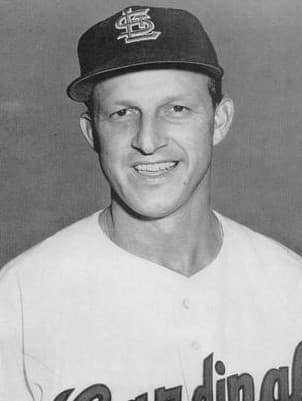
Stan Musial portrait (Cardinals, 1957).
Photo credit: Unknown author via Wikimedia Commons (Public domain)
Stan Musial played 22 seasons for the St. Louis Cardinals and never played for anyone else. He batted .331, collected 3,630 hits, won seven National League batting titles and three MVP awards, and did it all with a consistency so steady that his career totals split almost perfectly between home and road games. He hit 1,815 hits at home and 1,815 on the road, a coincidence that no statistician would have believed if Musial had not produced it himself. The BBWAA elected him to the Hall of Fame in 1969 in his first year of eligibility, with 93.2 percent of the vote.
Donora
Stanley Frank Musial was born on November 21, 1920, in Donora, Pennsylvania, an industrial town along the Monongahela River south of Pittsburgh. His father, Lukasz, had emigrated from Poland, and the family lived in a working-class neighborhood where sports were the clearest path to something beyond the mills. Musial signed with the Cardinals organization as a pitcher in 1938, and a shoulder injury during his time in the minor leagues forced him to abandon the mound and become an outfielder. The conversion saved his career and eventually produced one of the greatest hitters in baseball history.
He reached the major leagues in September 1941, batting .426 in 12 games, and became a full-time starter in 1942. The Cardinals won the World Series that year, beating the Yankees in five games, and Musial was 21 years old.
The Peak
Musial won his first MVP award in 1943, batting .357 and leading the National League in hits, doubles, triples, and slugging percentage. He missed the entire 1945 season while serving in the Navy during World War II, returned in 1946, and won his second MVP by hitting .365 with 228 hits and 103 RBI as the Cardinals won another World Series.
His third MVP came in 1948, when he batted .376 and led the league in virtually every offensive category. He hit 39 home runs that season, one short of the league lead shared by Ralph Kiner and Johnny Mize, and his combined hitting, power, and on-base ability made it one of the finest offensive seasons any player had produced in the National League up to that point. He finished with 230 hits, 46 doubles, 18 triples, 131 RBI, and a slugging percentage of .702.
Musial won seven batting titles in total, in 1943, 1946, 1948, 1950, 1951, 1952, and 1957. His consistency across decades was extraordinary. He hit .330 or better in thirteen different seasons, and his career on-base percentage of .417 and slugging percentage of .559 placed him among the most complete hitters in the history of the game.
Stan the Man
The nickname "Stan the Man" originated at Ebbets Field in Brooklyn, where Dodgers fans groaned every time Musial came to the plate because of the damage he inflicted on their pitching staff. The exact origin is disputed, but multiple accounts trace it to fans muttering "here comes that man again" as Musial walked to the batter's box. He hit .344 lifetime against the Dodgers, and Brooklyn's frustration with him was entirely earned.
His stance was one of the most distinctive in baseball. He coiled into a deep crouch, peering over his right shoulder at the pitcher with his bat held high, and uncoiled into a smooth left-handed swing that generated line drives to all fields. The stance looked uncomfortable, and hitting coaches would never have taught it, but Musial's hand-eye coordination and bat speed turned it into one of the most productive swings the game has seen.
Later Career
Musial moved from the outfield to first base as he aged, and he remained productive deep into his thirties. He hit .351 at age 36 in 1957 to win his last batting title, and he continued playing through 1963, retiring at 42. His career totals included 3,630 hits, 475 home runs, 1,951 RBI, 725 doubles, and 177 triples. The 725 doubles ranked second in major league history at the time of his retirement, behind only Tris Speaker's 792.
He was beloved in St. Louis in a way that transcended typical athlete-fan relationships. He played his entire career for one franchise, lived in the city year-round, and conducted himself with a graciousness that made him a civic institution. The Cardinals retired his number 6 in 1963 and erected a statue of him outside Busch Stadium.
Musial received the Presidential Medal of Freedom from Barack Obama in 2011. He died on January 19, 2013, in Ladue, Missouri, at 92.