Profile
Ralph Kiner
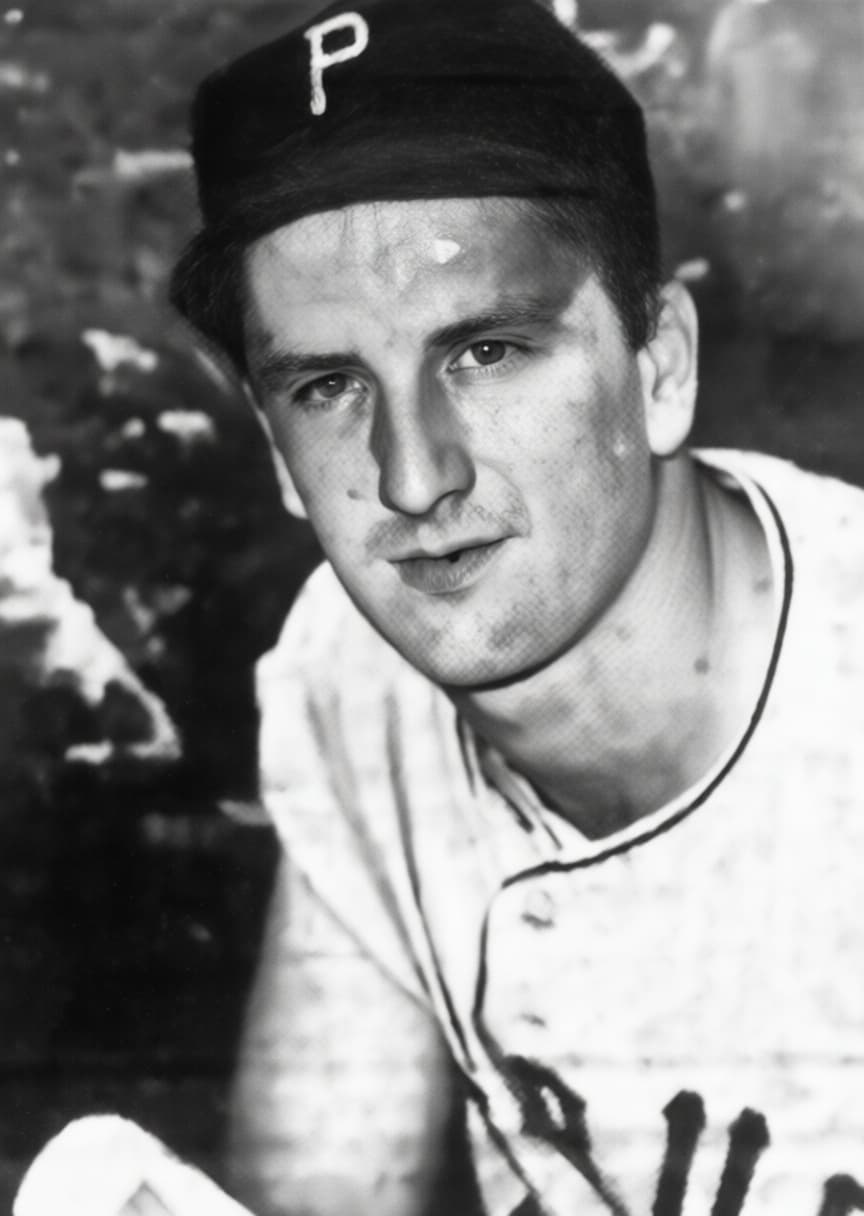
Ralph Kiner portrait.
Photo credit: User-provided image via User-provided image
Ralph McPherran Kiner led the National League in home runs for seven consecutive seasons, hit 369 in a career that lasted only 10 years, and then spent the next 52 years in a broadcast booth making the English language submit to his will. He was born in a New Mexico mining town that no longer exists, raised by a mother who had served as a nurse in France during the First World War, and mentored by Hank Greenberg during one transformative spring that turned a 23-homer outfielder into a 51-homer force. Branch Rickey traded him and told Pittsburgh the club could finish last without him. Pittsburgh finished last anyway. The BBWAA elected Kiner to the Hall of Fame in 1975 by a single vote on his final ballot.
Santa Rita
Kiner was born on October 27, 1922, in Santa Rita, New Mexico, a copper mining town that has since been consumed by an open-pit mine and no longer exists. His father, a baker, died when Ralph was four. His mother Beatrice, who had served as a nurse in France during World War I, moved the family to Alhambra, California, for work. Kiner attended Alhambra High School, where he played baseball and drew the attention of several major league scouts. He signed with the Pittsburgh Pirates for a $3,000 bonus.
After the attack on Pearl Harbor he enlisted in the Navy, trained as a pilot at St. Mary's Pre-Flight School and Corpus Christi, and flew PBM Mariner flying boats on submarine patrols from Kaneohe Bay, Hawaii. He accumulated 1,200 flying hours and missed three seasons of professional baseball.
Forbes Field
Kiner debuted with the Pirates in April 1946 at 23 and hit 23 home runs to lead the National League, the first of seven consecutive home run titles. No one in the history of the game, including Ruth, has matched that streak. His 1946 salary was $5,000.
Greenberg, acquired from Detroit before the 1947 season, took Kiner aside and suggested extra batting practice sessions. He taught him to pull the ball, to wait on pitches early in counts, and to think about power as a skill that could be refined rather than a gift that simply arrived. Kiner jumped from 23 home runs to 51 and batted .313 with 127 RBI. The left-field bullpen area at Forbes Field, previously called "Greenberg Gardens," was renamed "Kiner's Korner." Kiner called Greenberg "the single biggest influence of my adult life." Pittsburgh's attendance surged 71 percent during the 1947 season and set a franchise record of 1.5 million in 1948.
In 1947, he and Johnny Mize tied for the NL lead with 51 each, making Kiner the fifth player to reach 50 home runs in a season. In 1949 he hit 54, the highest National League total since Hack Wilson's 56 in 1930. He led all of major league baseball in home runs for five consecutive years from 1947 through 1951 and reached 100, 200, and 300 career home runs in fewer games than anyone in history at that point, including Ruth. On June 25, 1950, he hit for the cycle. He was a six-time All-Star and drew 1,011 walks against 749 strikeouts across his career, producing a .398 on-base percentage and .548 slugging percentage. Bing Crosby's part-ownership of the Pirates opened Hollywood doors, and during his Pittsburgh years Kiner escorted Elizabeth Taylor to a premiere and dated Janet Leigh and Ava Gardner.
The famous line about power hitting was not his. "Home run hitters drive Cadillacs and singles hitters drive Fords" belonged to teammate Fritz Ostermueller. Kiner adopted it and lived by it, and it followed him for the rest of his life.
Rickey
Branch Rickey became the Pirates' general manager around 1950 and clashed bitterly with Kiner over salary. Rickey wrote a letter, now preserved in the Library of Congress, accusing Kiner of being unable to run, throw, or field. When Kiner protested a pay cut despite leading the league in home runs, Rickey delivered the most famous rebuke in baseball labor history. "Son, we can finish last without you."
On June 4, 1953, the Pirates traded Kiner to the Chicago Cubs in a 10-player deal that also included $150,000 in cash. Pittsburgh fans hanged Rickey in effigy. The Pirates finished last without Kiner that year and the next two after that.
Kiner hit 28 home runs for the Cubs in his first partial season and 22 in 1954. After the season the Cubs sold him to the Cleveland Indians, where Greenberg was now the general manager. Chronic back pain limited Kiner to 113 games and 18 home runs in 1955, his final season. He retired at 32 with 369 career home runs and a ratio of one home run per 14.1 at-bats, second only to Ruth at the time.
The Booth
Kiner served as general manager of the San Diego Padres in the Pacific Coast League from 1956 through 1960 and began broadcasting there when he couldn't afford to hire an announcer. Greenberg hired him to broadcast for the Chicago White Sox in 1961, and the following year the expansion New York Mets brought him aboard as part of their original broadcast team alongside Lindsey Nelson and Bob Murphy.
He stayed for 52 seasons. He called Mets games on WOR-TV, hosted the postgame show "Kiner's Korner," and became as beloved for what he got wrong as for what he got right. He wished fathers a happy birthday on Father's Day, declared that solo homers usually come with no one on base, noted that there was a lot of heredity in a particular family, and once called himself "Ralph Korner." He called Gary Carter "Gary Cooper" and Manufacturers Hanover Trust "Manufacturers Hangover." When he interviewed catcher Choo Choo Coleman and asked what his wife's name was and what she was like, Coleman replied, "Mrs. Coleman, and she likes me, Bub."
His home run call was simple and became a signature. "It is gone, goodbye!" He was the third longest-tenured broadcaster in major league history behind Vin Scully and Jaime Jarrin. Bell's palsy and the effects of a stroke slowed his later years, but the Mets kept him on, typically appearing once a week alongside Gary Cohen, Keith Hernandez, and Ron Darling.
The Numbers
In 10 seasons he accumulated 1,472 games, 1,451 hits, 369 home runs, 1,015 RBI, 1,011 walks, and a .279 batting average. He was a six-time All-Star and led the National League in home runs in each of his first seven seasons with Pittsburgh.
The BBWAA elected him to the Hall of Fame in 1975 with 75.4 percent of the vote on his 13th and final ballot, one vote above the required threshold. He had received 1.1 percent in his first year of eligibility. The Pirates retired his number 4 on September 19, 1987. The Mets inducted him into their own Hall of Fame in 1984 and named the broadcast booth at Citi Field in his honor.
Kiner died on February 6, 2014, at his home in Rancho Mirage, California, at 91. He was buried at Greenlawn Cemetery in Farmington, New Mexico. He had attended every Hall of Fame induction ceremony from 1975 until his death. Warren Spahn, who had pitched against him for years, put it best: "Kiner can wipe out your lead with one swing."