Steel, Ivy, and Sixty-One Years at Forbes Field
Forbes Field stood in Pittsburgh's Oakland neighborhood for sixty-one years, hosted the only walk-off home run in a Game 7, and left behind a section of outfield wall that still marks its original location on the University of Pittsburgh campus.
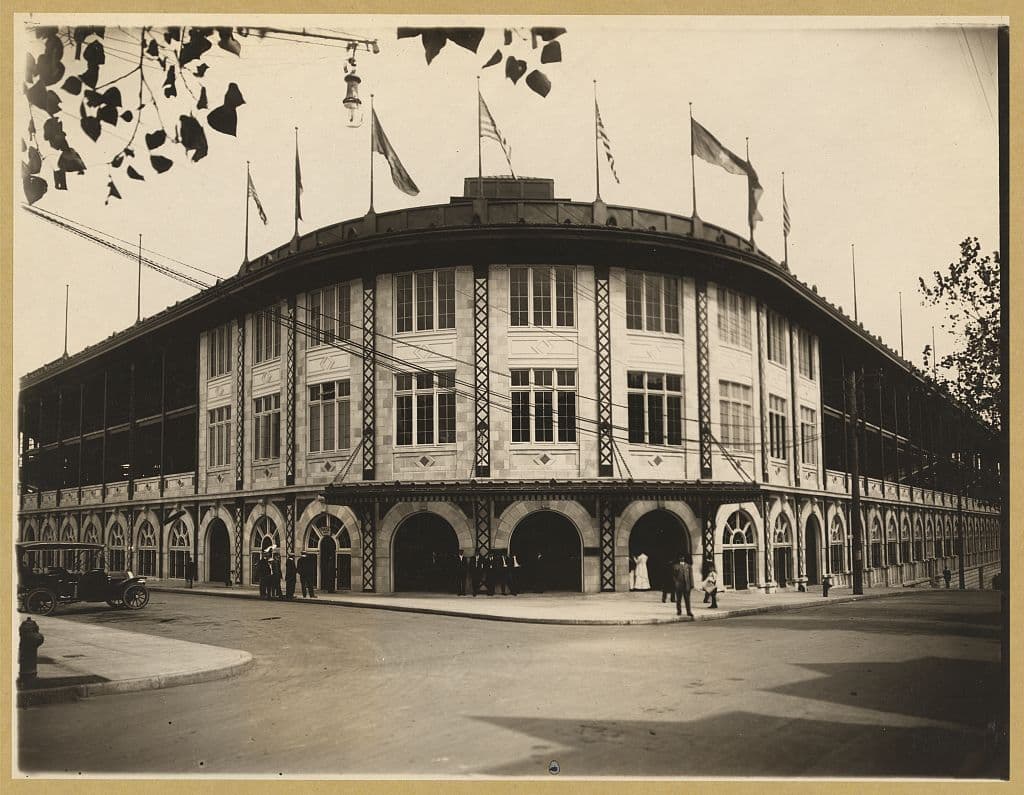
Forbes Field exterior, Pittsburgh, circa 1909.
Photo credit: Unknown via Library of Congress
Pittsburgh Pirates owner Barney Dreyfuss wanted out of Exposition Park. The old grounds flooded regularly from the Allegheny River, and Dreyfuss had grander ambitions for his franchise. In late 1908, with help from industrialist Andrew Carnegie, he purchased seven acres of land in the Oakland neighborhood, adjacent to Schenley Park and the Carnegie Library. Critics called it "Dreyfuss's Folly." Oakland sat a ten-minute trolley ride from downtown Pittsburgh, and skeptics doubted fans would make the trip for a baseball game.
They made the trip. On June 30, 1909, a standing-room crowd of 30,338 packed the new ballpark. The Cubs won that first game 3-2, but the day belonged to the stadium itself. Forbes Field, named for British General John Forbes, who captured Fort Duquesne from the French in 1758 and established Fort Pitt on the site, was the largest ballpark in the National League and one of the most ambitious construction projects in the sport's history.
Steel and Concrete on Forbes Avenue
Shibe Park in Philadelphia had opened two and a half months earlier, on April 12, 1909, and holds the distinction of being baseball's first steel-and-concrete stadium. Forbes Field was the second. But its scale dwarfed the competition. The project consumed approximately 1,074 freight carloads of materials, including 650 carloads of sand and gravel, 130 of structural steel, 110 of cement, 70 of seats, and 40 of ornamental iron. The final cost reached one million dollars, more than three times the $315,248 price tag on Shibe Park.
Charles Wellford Leavitt Jr., a New York architect and civil engineer who had designed grandstands at Belmont and Saratoga racetracks, supervised the design. C.E. Marshall, a Leavitt employee who had worked on the Panama Canal, handled retaining wall construction and drainage. The Nicola Building Company served as lead contractor. Site work began on December 23, 1908, and the ballpark was ready in just over six months.
The original seating capacity was 25,000. Over the decades, remodeling pushed that figure as high as 41,000 in 1925 before settling at roughly 35,000 by the time the Pirates left in 1970.
The Outfield and Its Modifications
Forbes Field's outfield was enormous. The final posted dimensions told the story. Left field ran 365 feet, left-center 406, the deepest point in left-center 457, deep right-center 436, right-center 375, and right field just 300 feet down the line. Center field was a vast prairie that swallowed fly balls and turned routine doubles into adventures.
In 1946, the Pirates replaced the outfield fence in left and center with a brick wall. Groundskeepers planted ivy at its base, restoring a green backdrop for hitters. The following year, with slugger Hank Greenberg arriving in Pittsburgh, the Pirates moved the bullpens from foul territory to the base of the left field scoreboard, cutting roughly 30 feet off the left field distances. Sportswriters dubbed the shortened area "Greenberg Gardens." Greenberg retired after that single season, but Ralph Kiner had already emerged as one of the National League's most prolific home run hitters. After Greenberg retired, the club rechristened the bullpen enclosure "Kiner's Korner" in 1948, and Kiner led the league in home runs for seven consecutive seasons from 1946 through 1952.
October 13, 1960
The 1960 World Series between the Pirates and the New York Yankees remains one of baseball's strangest. The Yankees outscored Pittsburgh 55-27 across seven games, winning three of them by a combined score of 38-3. None of that prevented the Pirates from taking the series to a seventh game at Forbes Field on October 13.
Game 7 was chaos. The lead changed hands repeatedly. In the eighth inning, a ground ball struck Yankees shortstop Tony Kubek in the throat, breaking up a potential double play and helping the Pirates rally. The score was tied 9-9 when Bill Mazeroski led off the bottom of the ninth against Ralph Terry. Terry's first pitch was a high fastball, ball one. Yankees catcher Johnny Blanchard stepped in front of the plate and told Terry to get the ball down. Terry's second pitch didn't get down. Mazeroski drove it over the left-center field wall, just left of the 406-foot marker.
It was 3:36 PM. The 36,683 fans inside Forbes Field poured onto the field. Mazeroski's home run remains the only walk-off homer to end a Game 7 in World Series history. He was inducted into the Baseball Hall of Fame in 2001 and died on February 20, 2026, at the age of 89.
Clemente's Ballpark
Roberto Clemente made his Pirates debut at Forbes Field on April 17, 1955, playing right field and singling off Johnny Podres of the Dodgers for the first of his 3,000 career hits. He played fifteen seasons at Forbes Field before the Pirates moved to Three Rivers Stadium in the summer of 1970, and two more seasons at the new park before his death in a plane crash on New Year's Eve, 1972.
Forbes Field's right field, with its relatively short 300-foot line but deep right-center gap, showcased Clemente's arm and instincts. He played the angles off the wall and the scoreboard with a precision that turned routine singles into outs. On August 5, 1958, he crashed into the right-field wall robbing Willie Mays of an extra-base hit in a 1-0 Pirates win. The collision was violent. Clemente played through it. That was the pattern for eighteen years.
The End and What Remains
The Pirates played their final game at Forbes Field on June 28, 1970, a doubleheader against the Cubs. Pittsburgh won both games, 3-2 and 4-1, in front of 40,918 fans who squeezed into a park that officially seated 35,000. Al Oliver hit the last home run at the stadium, a shot over the right-field screen. Bill Mazeroski, fittingly, recorded the final putout. Fans tore up anything they could carry as souvenirs.
Fires damaged the abandoned park on December 24, 1970, and July 17, 1971. Demolition began on July 28, 1971, clearing the land for the University of Pittsburgh's expansion. But not everything disappeared. A section of the left-center and center field brick wall still stands at its original location, adjacent to Pitt's Mervis and Posvar Halls, with the "457 FT" and "436 FT" distance markers still painted on it. The original flagpole stands nearby. Inside Posvar Hall, home plate is preserved under glass in a first-floor corridor. The plate sits close to, but not precisely at, its original location on the field. The actual spot would have placed it inside a women's restroom, so the university shifted it a few feet into the hallway.
Walk through the University of Pittsburgh's campus today and you can find the wall, the flagpole, and the plate. They are quiet markers of a place where Honus Wagner played his final seasons, where Kiner launched home runs into shortened gardens, where Clemente ran down fly balls for fifteen years, and where Mazeroski's swing ended a World Series with the most dramatic single moment the sport has produced.