Profile
Branch Rickey
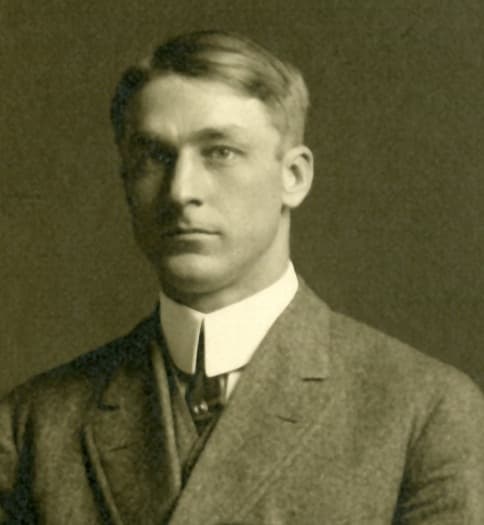
Branch Rickey portrait (1912).
Photo credit: Unknown author via Wikimedia Commons (Public domain)
Branch Rickey changed baseball twice. He invented the modern farm system while running the St. Louis Cardinals, creating a pipeline of minor league affiliates that turned a struggling franchise into the most consistent winner in the National League. Then he signed Jackie Robinson to the Brooklyn Dodgers organization, breaking the color line that had excluded black players from the major leagues for more than half a century. The Veterans Committee elected him to the Hall of Fame posthumously in 1967, two years after his death.
Ohio
Wesley Branch Rickey was born on December 20, 1881, in Stockdale, Ohio, a small farming community in the southeastern part of the state. His parents were devout Methodists, and Rickey's religious convictions shaped his entire life, including his refusal to attend or manage games on Sundays. He attended Ohio Wesleyan University, where he coached the baseball team while still an undergraduate, and the experience planted the seed that eventually grew into his commitment to integration. A black player on the Ohio Wesleyan team, Charles Thomas, was refused a hotel room during a road trip to South Bend, Indiana, and Rickey arranged for Thomas to stay in his own room. Rickey later described the incident as a moment he never forgot.
Rickey played briefly in the major leagues as a catcher, appearing in 120 games across parts of four seasons with the St. Louis Browns and New York Highlanders between 1905 and 1914. He batted .239 and caught poorly enough that opposing baserunners stole at will. His career as a player was unremarkable, but he was already studying the game with the analytical mind that would reshape how franchises operated.
The Cardinals and the Farm System
Rickey managed the St. Louis Browns from 1913 through 1915 and then moved to the Cardinals, where he managed from 1919 through 1925 before transitioning to the front office as general manager. The Cardinals were a poor franchise with limited resources, unable to compete with wealthier clubs on the open market for talent. Rickey's solution was to buy minor league teams outright, stocking them with young players who developed within the organization and could be promoted to the major leagues when ready.
The concept sounds obvious now because every franchise in professional sports uses some version of it. In the 1920s, it was revolutionary and controversial. Commissioner Landis opposed the farm system on principle, arguing that it reduced minor league teams to vassals and limited players' freedom. Landis freed more than 70 Cardinals farmhands in a 1938 ruling. Rickey kept building anyway, and the results justified the approach. The Cardinals won nine National League pennants and six World Series between 1926 and 1946, drawing their talent from a network of minor league affiliates that at its peak included more than 30 teams.
Breaking the Color Line
Rickey became president and general manager of the Brooklyn Dodgers in 1942, and within three years he had set in motion the plan that would define his legacy. He scouted black players through a cover story about starting a new Negro League team, identified Robinson as the player with the talent, intelligence, and temperament to withstand the abuse that would come, and signed him to a contract with the Montreal Royals, the Dodgers' top minor league affiliate, in October 1945.
Robinson joined the Dodgers on April 15, 1947, and the integration of baseball began. Rickey had prepared Robinson for the hostility he would face, famously telling him that he needed a player with the courage not to fight back. The arrangement demanded enormous restraint from Robinson and enormous institutional commitment from Rickey, who faced opposition from other owners, from some of his own players, and from segments of the public. Rickey also signed Roy Campanella, Don Newcombe, and other black players in the years that followed, building the Dodgers into a powerhouse that won six pennants between 1947 and 1956.
The moral and competitive dimensions of the decision were inseparable. Rickey believed integration was right, and he also understood that the untapped talent pool of the Negro Leagues gave the Dodgers an enormous advantage over franchises that refused to sign black players. He was idealistic and shrewd at the same time, and the combination produced one of the most consequential decisions in American sports history.
Pittsburgh and After
Rickey left the Dodgers after the 1950 season following a power struggle with co-owner Walter O'Malley and became general manager of the Pittsburgh Pirates. He spent five years trying to rebuild the franchise through the same farm system principles, drafting Roberto Clemente from the Dodgers' organization in the 1954 Rule 5 draft. The Pirates did not win under Rickey's direct leadership, but the foundation he built contributed to their 1960 World Series championship.
In 1959, Rickey became involved in plans for the Continental League, a proposed third major league that was intended to bring baseball to cities that lacked franchises. The league never played a game, but the threat of its formation pressured the established leagues into expanding, adding four new teams between 1961 and 1962.
Rickey died on December 9, 1965, in Columbia, Missouri, at 83. He had collapsed while giving a speech at his induction into the Missouri Sports Hall of Fame and never regained consciousness. The Veterans Committee elected him to the Baseball Hall of Fame in 1967.