Profile
Jackie Robinson
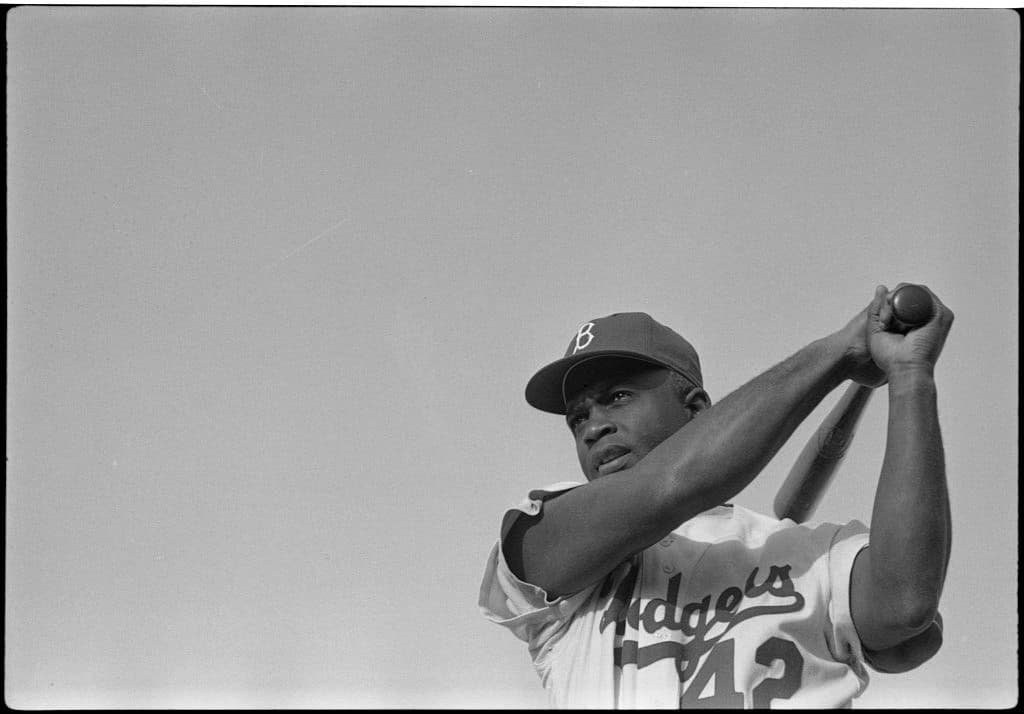
Jackie Robinson, Brooklyn Dodgers, 1954.
Photo credit: Bob Sandberg / LOOK Magazine via Library of Congress
Jack Roosevelt Robinson was named for a president who died 25 days before his birth, raised by a mother who moved five children from Georgia to California with nothing, court-martialed by the Army for refusing to move to the back of a bus, and chosen by Branch Rickey to destroy the color line in professional baseball because Rickey needed "a Negro player with guts enough not to fight back." Robinson broke through on April 15, 1947, at Ebbets Field, endured abuse that nearly cracked him, and played 10 seasons for the Brooklyn Dodgers with a ferocity on the basepaths that Leo Durocher described without exaggeration. "He didn't just come to play," Durocher said. "He came to beat you." Robinson batted .311, won the 1949 MVP, stole home 19 times, and helped Brooklyn win six pennants and the 1955 World Series. Martin Luther King Jr. said, "Jackie Robinson made my success possible. Without him, I would never have been able to do what I did." The BBWAA elected Robinson to the Hall of Fame in 1962 on his first ballot.
Cairo
Robinson was born on January 31, 1919, in Cairo, Georgia, the youngest of five children. His father Jerry deserted the family six months later. His mother Mallie, deeply religious and determined, moved the children to Pasadena, California, in 1920, where white neighbors circulated a petition to remove the family from the block. Robinson's brother Mack finished second to Jesse Owens in the 200 meters at the 1936 Berlin Olympics.
Robinson attended UCLA, where he became the first athlete in school history to letter in four sports. He led the Southern Division of the Pacific Coast Conference in scoring in basketball, carried the football 12.2 yards per attempt in 1939, won the NCAA long jump championship, and hit .097 on the baseball team, the weakest of his four sports by far. Robinson met Rachel Isum, a UCLA freshman, while he was a senior. He left college a few credits short of graduation because of financial problems at home.
Robinson enlisted in the Army in 1942 and was commissioned as a second lieutenant after Joe Louis intervened to get him into Officer Candidate School. On July 6, 1944, at Fort Hood, Texas, a bus driver ordered Robinson to move to the back of the bus. Robinson refused. Military police took him into custody, and his commanding officer authorized charges that included insubordination. Robinson was acquitted by an all-white panel and received an honorable discharge in November 1944.
Montreal
Robinson played shortstop for the Kansas City Monarchs of the Negro American League in 1945, hitting over .300 in 47 games. On August 28, 1945, Rickey summoned Robinson to a three-hour meeting in Brooklyn. "Are you looking for a Negro who is afraid to fight back?" Robinson asked. Rickey said he needed the opposite, a man with the courage not to fight back. Robinson committed to turn the other cheek for an agreed period, and Rickey signed him for $600 a month.
Rickey assigned Robinson to the Montreal Royals for the 1946 season. Robinson moved from shortstop to second base during spring training and opened the season on April 18 at Roosevelt Stadium in Jersey City with four hits, four runs scored, two stolen bases, and two provoked balks. Robinson batted .349 to lead the International League and led the Royals to the championship. After the final game, fans chased Robinson for three blocks. Sam Maltin of the Pittsburgh Courier observed that "it was probably the only day in history that a black man ran from a white mob with love instead of lynching on its mind."
April 15
Robinson made his major league debut on April 15, 1947, at Ebbets Field before 26,623 fans, more than half of them black. A petition from Southern Dodgers players, led by outfielder Dixie Walker, tried to block Robinson's promotion. Rickey and Durocher quashed it. Durocher told the team, "I do not care if the guy is yellow or black, or if he has stripes like a fuckin' zebra. I'm the manager of this team, and I say he plays." Durocher was suspended for the season days later on unrelated charges.
The abuse started immediately. Ben Chapman, the Philadelphia Phillies manager, orchestrated racial epithets from the dugout during Robinson's first visit to Philadelphia. Robinson later admitted, "It brought me nearer to cracking up than I ever been." Eddie Stanky, who originally opposed playing alongside Robinson, challenged the Phillies to pick on somebody who could fight back. Rickey said Chapman "did more than anybody to unite the Dodgers. When he poured out that string of unconscionable abuse, he solidified and united thirty men." By the end of the season Walker himself acknowledged that Robinson "is everything Branch Rickey said he was when he came up from Montreal."
Robinson batted .297 with 29 stolen bases (leading the league), scored 125 runs, and won the inaugural Rookie of the Year award. Pee Wee Reese, the Dodgers' shortstop from Kentucky, reportedly put his arm around Robinson during a game in response to racial abuse from the crowd. Hank Greenberg, who understood bigotry from his years facing antisemitism, collided with Robinson at first base and whispered, "Stick in there. You're doing fine. Keep your chin up."
The Pennants
Robinson consulted Hall of Famer George Sisler, who worked as a Dodgers adviser, before the 1949 season. "Sisler showed me how to stop lunging, how to check my swing until the last fraction of a second," Robinson said. Robinson won the batting title at .342, led the league with 37 stolen bases, drove in 124 runs, and won the NL MVP, the first black player so honored.
Robinson's star shined brightest on the basepaths. He ran with daring that embarrassed opponents into errors and revived the art of stealing home, accomplishing it 19 times in his career, tied with Frankie Frisch for the most since the First World War. Bobby Bragan, who initially opposed Robinson, called him the best he ever saw at getting called safe after being caught in a rundown. David Falkner called Robinson "the father of modern base-stealing."
Robinson played every infield position and left field across his career, moving wherever the Dodgers needed him. In 1953, at 34, Robinson graciously shifted to accommodate rookie Jim Gilliam at second base, playing 76 games in the outfield and 44 at third. The Dodgers won six pennants with Robinson on the roster. The 1955 championship, a seven-game World Series victory over the Yankees, gave Brooklyn its only title. Robinson stole home in Game 1.
Stamford
Robinson retired after the 1956 season at 37. Robinson became a vice president at Chock full o'Nuts, the first black executive at a major American corporation, and co-founded Freedom National Bank in Harlem. Robinson chaired the NAACP's million-dollar Freedom Fund Drive, campaigned for political candidates across party lines, and protested the absence of black managers in baseball until his death.
Robinson's son Jackie Jr. served in Vietnam, was wounded, struggled with substance abuse, and died in 1971 at 24. Robinson's own health deteriorated through diabetes and heart disease. His hair turned white in his forties. On October 15, 1972, Robinson threw out the ceremonial first pitch before Game 2 of the World Series at Riverfront Stadium in Cincinnati. "I'm going to be tremendously more pleased and more proud when I look at that third base coaching line one day and see a black face managing in baseball," Robinson said. Nine days later, on October 24, 1972, Robinson died of a heart attack at his home in Stamford, Connecticut, at 53.
Roughly 2,500 people attended his funeral at Riverside Church in Manhattan. Jesse Jackson delivered the eulogy. Tens of thousands lined the streets of Harlem and Bedford-Stuyvesant for the procession. Robinson's gravestone at Cypress Hills Cemetery in Brooklyn carries the epitaph he chose. "A life is not important except in the impact it has on other lives."
In 1997, MLB retired Robinson's number 42 across every team, the first number retired across an entire American professional sport. Every April 15, on Jackie Robinson Day, every player in the major leagues wears 42.
Sources
Related Articles
42 and the Jackie Robinson Movie That Took 66 Years
Baseball in Pop Culture · May 17, 2026
Continue Reading
Branch Rickey Built the Farm System (and Then Broke the Color Line)
Business & Labor · May 17, 2026
Continue Reading
Kenesaw Mountain Landis and the Invention of the Commissioner
Business & Labor · May 17, 2026
Continue Reading
The Batting Helmet and the Decades Baseball Refused to Protect Its Hitters
Rules & Equipment Evolution · May 7, 2026
Continue Reading
April 15, 1947
People · May 7, 2026
Continue Reading
Ebbets Field and the Soul of Brooklyn Baseball
Lost Ballparks · May 4, 2026
Continue Reading