Ebbets Field and the Soul of Brooklyn Baseball
Built on a garbage dump called Pigtown and demolished before its fiftieth birthday, Ebbets Field packed more history per square foot than any ballpark in America.
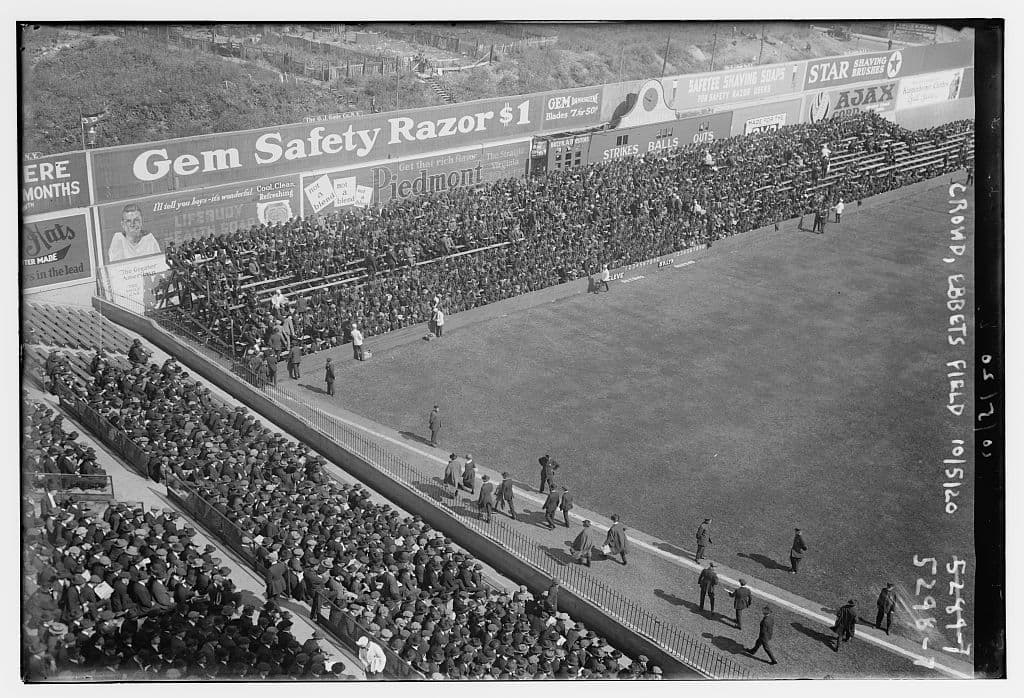
Ebbets Field, October 5, 1920. Crowds fill the park for the World Series.
Photo credit: Bain News Service via Library of Congress
Charles Ebbets spent four years buying a garbage dump. Starting in 1908, the owner of the Brooklyn Dodgers quietly purchased individual lots in an area of Flatbush known as Pigtown, so named for the pigs that rooted through its refuse and the smell that hung over the neighborhood. By 1911 he had assembled 5.7 acres for roughly $100,000. The land sat at the intersection of Bedford Avenue, Sullivan Place, Cedar Place, and Montgomery Street. Ebbets envisioned a permanent concrete-and-steel stadium to replace the aging wooden Washington Park, and he chose this unlikely patch of ground to build it.
Construction began on March 4, 1912. The architect was Clarence Randall Van Buskirk, who designed a brick-and-arched exterior and, at the home plate entrance, an 80-foot circular rotunda floored in Italian marble. The marble tile displayed a baseball with "Ebbets Field" encircling it. A chandelier hung from the 27-foot domed ceiling, its twelve arms shaped like baseball bats, each holding a globe shaped like a baseball. Twelve gilded ticket windows and twelve turnstiles ringed the interior. No other ballpark in the country had anything like it.
The stadium opened on April 5, 1913, with an exhibition game against the New York Yankees before an overflow crowd of approximately 25,000. The first National League game followed on April 9 against the Philadelphia Phillies. Brooklyn lost. The park's original capacity was roughly 23,000, with initial dimensions of 419 feet down the left field line, 507 feet to center, and 301 feet to right.
The Bandbox
Ebbets Field was small and it knew it. The park sat wedged into its city block, and over the decades its dimensions shrank further. By the final season in 1957, left field measured 348 feet, center 393, and right just 297. Like Fenway Park and Tiger Stadium, both of which opened one year earlier, Ebbets Field earned the label "bandbox" from baseball writers who recognized its tight geometry.
The right field wall was the park's signature quirk. Only 297 feet from home plate, it rose 19 feet and included a concave lower section angled outward from the field. Line drives hitting that sloped surface caromed in unpredictable directions, turning routine plays into adventures for right fielders. Above the concrete wall, a wire screen added more height, and above that sat the scoreboard.
Two advertisements on that wall became as famous as the park itself. The Schaefer Beer sign, installed after World War II, featured the company name in neon. Beginning in 1949, the "h" in Schaefer lit up to indicate a hit and the "e" lit up for an error, a piece of corporate ingenuity that served a genuine purpose. Below the scoreboard, clothier Abe Stark's sign read "Hit Sign, Win Suit." The sign measured just three feet high and 30 feet long, positioned where only a ball that got past the right fielder could reach it. Carl Furillo, who patrolled right field for Brooklyn through the 1950s, was so skilled at playing the wall that he personally prevented countless free suits. Mel Ott of the rival New York Giants reportedly hit the sign twice and collected both suits.
Nine World Series
Ebbets Field hosted nine World Series between 1916 and 1956. The Dodgers lost all but one. The 1916 Series against the Boston Red Sox was the first. The 1920 Series, played under a best-of-nine format, required temporary bleachers in the outfield to handle demand. In 1941, the Dodgers returned to the Series for the first time in 21 years, only to lose to the Yankees again. The pattern repeated in 1947, 1949, 1952, and 1953.
Brooklyn's annual refrain became "Wait till next year." Next year finally arrived on October 4, 1955, when Johnny Podres shut out the Yankees 2-0 in Game 7 at Yankee Stadium. The Dodgers had won Games 3, 4, and 5 at Ebbets Field to take a 3-2 series lead, with Duke Snider hitting two home runs in Game 5 and Roy Campanella, Gil Hodges, and Snider all going deep in Game 4. Brooklyn had its first and only World Series championship. The borough celebrated with a fervor that survivors still describe decades later.
Ebbets Field also hosted the 1949 All-Star Game, the first to feature African American players.
April 15, 1947
No single event at Ebbets Field carried more weight than Jackie Robinson's debut on April 15, 1947. Robinson started at first base for the Dodgers against the Boston Braves before a crowd of 26,623. Roughly 14,000 of those fans were black, many attending a major league game for the first time. Robinson went 0-for-3 with a sacrifice bunt, reached on an error in the seventh inning, and scored a run. The Dodgers won 5-3.
The crowd fell short of a sellout. Rumors of one, combined with a team policy that held grandstand tickets for morning-of sale, may have kept some fans away. The modest turnout didn't diminish the occasion. Robinson had broken a barrier that had held since 1884, when Moses Fleetwood Walker last played in the major leagues. Ebbets Field was where it happened.
The park also served as home to black baseball before Robinson's arrival. The Bacharach Giants played there from 1919 to 1921, and the Brooklyn Eagles used it as their home field in 1935, making them the only black team at the time with a major league ballpark as a home venue.
The Characters
Ebbets Field bred a particular species of fan. Hilda Chester, armed with a cowbell and later a large brass school bell, stationed herself in the bleachers and became as recognizable as some of the players. The Brooklyn Sym-Phony, a ragtag band that began performing in the late 1930s and became especially prominent after 1941, serenaded opposing batters with mocking tunes as they walked back to the dugout after striking out. Gladys Goodding became baseball's first full-time ballpark organist in 1942. She had played organ at Madison Square Garden for hockey and other sporting events, but the Dodgers were the first baseball team to install an organ and hire a dedicated organist for every home game.
Red Barber broadcast Dodgers games from Ebbets Field beginning in 1939, and Vin Scully joined him in the booth in 1950 at age 22. The intimacy of the park, where the first row of seats pressed close to the field and the upper deck hung over the action, gave every game the compressed energy of a neighborhood argument.
The End
Walter O'Malley, who had gained controlling interest in the Dodgers by 1950, spent years lobbying New York City for a new stadium site in downtown Brooklyn. Robert Moses, the city's parks commissioner, offered a location in Flushing Meadows, Queens. O'Malley wanted Brooklyn. Neither budged. On October 30, 1956, O'Malley sold Ebbets Field to real estate developer Marvin Kratter for $3 million.
The last game at Ebbets Field took place on September 24, 1957. The Dodgers beat the Pittsburgh Pirates 2-0 behind a five-hit shutout from Danny McDevitt. Gil Hodges drove in a run. The paid attendance was 6,702. Organist Goodding played "May the Good Lord Bless and Keep You" as the remaining fans filed out.
Demolition began on February 23, 1960. A wrecking ball painted to look like a baseball struck the first blow. The Ebbets Field Apartments, a 1,300-unit housing complex, rose on the site and opened in 1962. The complex was later renamed the Jackie Robinson Apartments. Today, a plaque shaped like home plate sits in the parking lot off Sullivan Place, marking the spot where Robinson stood on April 15, 1947, and where Brooklyn's Dodgers played for 44 seasons before heading west.
The marble rotunda is gone. The angled right field wall is gone. The Abe Stark sign, the Schaefer scoreboard, Hilda Chester's cowbell. All of it lives only in photographs, recordings, and the memories of the people who were there. When the Mets built Citi Field in 2009, they included a rotunda at the main entrance modeled after the one at Ebbets Field, dedicated to Jackie Robinson. It is a handsome tribute. It is not the same thing.