Profile
Hank Greenberg
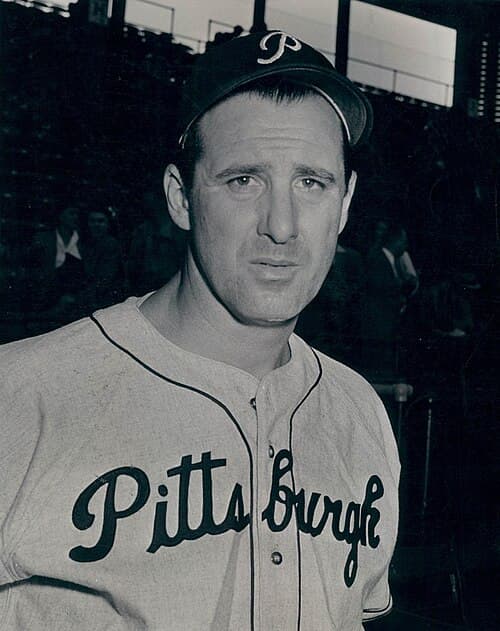
Hank Greenberg portrait, 1947.
Photo credit: Bain News Service via Wikimedia Commons (Public domain)
Henry Benjamin Greenberg hit 58 home runs in 1938, two short of Babe Ruth's record, and did it while absorbing abuse from the stands that had nothing to do with baseball. He was the most prominent Jewish player in the major leagues during the 1930s, a period when antisemitism in American life was open and common. Fans in opposing parks shouted slurs. Opposing players threw at his head and spiked him at first base. He played through all of it and became one of the most feared hitters of his generation.
The Bronx
Greenberg was born on January 1, 1911, in Greenwich Village, New York City, the son of Romanian Jewish immigrants David and Sarah Greenberg. The family moved to the Bronx when he was young. He grew up within walking distance of Yankee Stadium, but when the Yankees and Tigers both offered contracts, he chose Detroit. The Yankees already had Lou Gehrig at first base, and Greenberg wanted to play.
He reached the majors in 1933 and became the regular first baseman . He hit .339 with 139 RBI in 1934 as the Tigers won the pennant. That September, with the pennant race tight, Yom Kippur fell on a game day. Greenberg sat out. The Tigers lost. Poet Edgar Guest published a tribute in the Detroit Free Press the next morning. The gesture made national news and turned Greenberg into a symbol beyond baseball.
58
Greenberg won his first MVP award in 1935, hitting .328 with 36 home runs and 168 RBI. The Tigers beat the Cubs in the World Series, their first championship. He broke his wrist in the 1935 Series and played only 12 games in 1936 before returning to hit .337 with 183 RBI in 1937, a total that remains one of the highest single-season marks in history.
In 1938, he chased Ruth's record. He hit 58 home runs, tying Jimmie Foxx's 1932 total as the second-highest in history. He went homerless over the final five games of the season. Reports that pitchers refused to give him hittable pitches down the stretch circulated widely, and Greenberg himself later acknowledged that he believed antisemitism played a role. He won his second MVP award in 1940, this time as a left fielder, hitting .340 with 41 home runs and 150 RBI. The Tigers won the pennant again.
Military Service
Greenberg had been drafted in May 1941 under the Selective Service Act. He was discharged on December 5, 1941, two days before the attack on Pearl Harbor, and re-enlisted shortly afterward. He served in the Army Air Forces in the China-Burma-India theater with the 58th Bombardment Wing, working as a physical training officer and scouting locations for B-29 bomber bases. He was discharged in June 1945 and returned to the Tigers midseason. On July 1, 1945, he hit a home run in his first game back. On the final day of the season, he hit a grand slam in the ninth inning to clinch the pennant for Detroit. The Tigers won the 1945 World Series.
After Detroit
The Tigers sold Greenberg to the Pittsburgh Pirates after the 1946 season. He played one year in Pittsburgh, hitting .249 with 25 home runs, then retired. He finished with a .313 career batting average, 331 home runs, and 1,276 RBI across 1,394 games. He lost four and a half prime seasons to military service. Extrapolations of what he might have hit are speculative, but 500 home runs was plausible.
After retiring, Greenberg became a front office executive. He served as general manager of the Cleveland Indians and later as part-owner of the Chicago White Sox. He died on September 4, 1986, in Beverly Hills, California, at age 75. He was elected to the Hall of Fame in 1956 by the BBWAA.