Profile
Billy Southworth
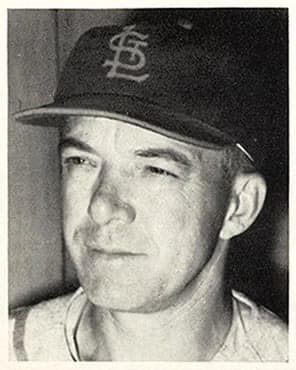
Billy Southworth portrait in St. Louis Cardinals uniform.
Photo credit: Unknown photographer via Wikimedia Commons
Billy Southworth spent 13 years as a steady major league outfielder, won a World Series as a player in 1926, and then became one of the best managers the game has produced, a quiet, players-first man in a profession full of tyrants. His Cardinals won 106, 105, and 105 games from 1942 through 1944, the only team ever to win 105 three years running, and he took four pennants and two titles in the 1940s. He also managed through the worst grief a father can carry, the loss of his only son in the war. The Veterans Committee elected him to the Hall of Fame in 2008, almost 40 years after his death.
Nebraska to a World Series
Southworth was born on March 9, 1893, near Harvard, Nebraska, and grew up in Columbus, Ohio. He reached the majors with Cleveland in 1913 and spent 13 seasons as a dependable outfielder for five clubs, batting .297, before the moment that defined his playing days. The Cardinals acquired him in the middle of 1926, and on September 24 he hit an upper-deck home run at the Polo Grounds that clinched the first National League pennant in St. Louis history, then batted .345 in the World Series as the Cardinals upset the Yankees in seven games.
Learning the Opposite of John McGraw
Southworth had played for John McGraw, the hardest and most tyrannical manager of the age, and he built his own career by doing the opposite of everything McGraw did. He spoke softly, let his players keep their own styles, and made himself a man they could bring their troubles to, on the field and away from it. "He just had a gut feeling about the right thing to do in a situation," said Alvin Dark, who played for him. "Southworth was a genius like that on the diamond." He managed the Cardinals briefly in 1929, lost the job in a swap with Bill McKechnie, and spent more than a decade clawing back through the minor leagues before owner Sam Breadon handed him St. Louis again in 1940.
The St. Louis Swifties
Over the next five years Southworth's Cardinals, young and fast and deep, with Stan Musial just arriving, put together one of the great runs the job has seen. They finished first three years in a row and won at least 105 games each time, the only team that has ever done it. In 1942 they trailed the Brooklyn Dodgers by 10 games in August and won 43 of their last 51 to steal the pennant, then beat the Yankees in the World Series, one of only two Series the Yankees lost in the 30 years between 1923 and 1953. They lost a rematch to New York in 1943 and won it all again in 1944 against the crosstown Browns. No manager before him had taken a team to 100 wins three seasons running.
The Son He Lost
Southworth's only son, Billy Jr., was the light of his life, a handsome young outfielder with a Hollywood screen test who became one of the first professional ballplayers to enlist, signing up in late 1940, about a year before Pearl Harbor. He flew 25 combat missions over Europe in a B-17, won the Distinguished Flying Cross, made major, and wore a cap his father had given him on every flight. On February 15, 1945, ferrying a B-29 on a training run, he went down in Flushing Bay, and his body was not recovered for nearly six months. "My days, weeks and months of waiting have not been in vain," Southworth said when it washed ashore. He was never the same man again.
Spahn and Sain and the Boston Pennant
Southworth took over the Boston Braves in 1946 and built a winner out of thin material. In 1948 he led them to their first pennant in 34 years on the arms of Warren Spahn and Johnny Sain, the rotation a Boston poet reduced to a rhyme, Spahn and Sain and pray for rain. The Braves lost the World Series to Cleveland in six games, and it was, measured against the talent he had, the finest managing he ever did.
The Clubhouse That Turned
The next year fell apart on him. Southworth's drinking, which had cost him jobs in the 1930s and crept back after his son's death, soured the clubhouse, and the same trust-based style that had won pennants stopped working with a postwar team that bridled at his control. Two veterans came to blows in August 1949, the players quietly rebelled, and the Braves gave him a leave of absence for the rest of the season, flying him out of Boston on the owner's plane before the writers could reach him. A poll of the players came back unanimously against his return. He managed into 1951 and resigned that June.
The Best Manager Nobody Remembered
For decades Southworth was called the best manager not in the Hall of Fame, and the record holds up against anyone's. He won 1,044 games against 704 losses, a .597 winning percentage that ranks near the top of the all-time list, took six teams to 90 wins or more, and finished 340 games above .500. As a Braves scout in the 1950s he signed a young Hank Aaron out of the Negro Leagues. Southworth died of emphysema in Columbus on November 15, 1969, and a grassroots campaign finally pushed the Veterans Committee to elect him in 2008, with 13 of 16 votes.