Profile
Biz Mackey
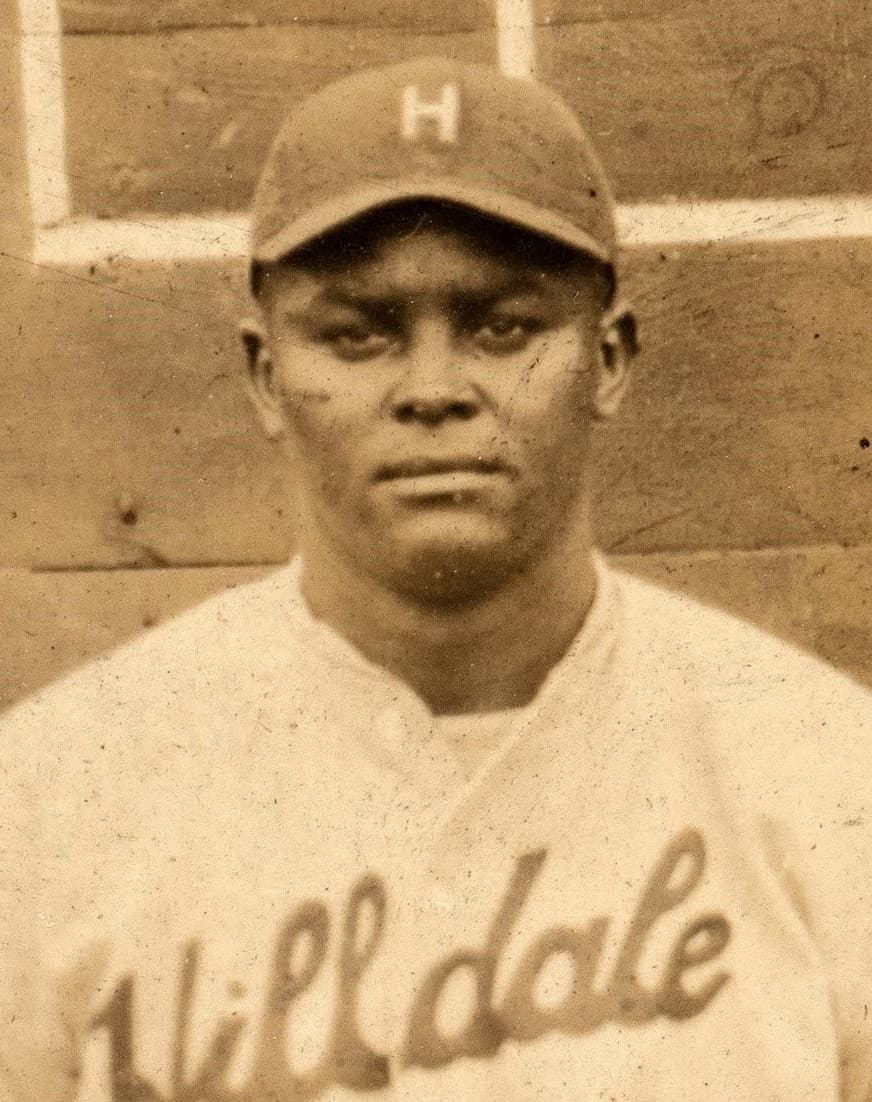
Biz Mackey portrait with Hilldale.
Photo credit: Unknown photographer via Wikimedia Commons (Public domain)
James Raleigh Mackey earned his nickname by talking to hitters from behind the plate, giving them an earful of chatter designed to break their concentration, a practice the press called "giving the batter the business." He caught and managed in the Negro Leagues for 30 years, batted .325 across 1,085 documented games as a switch-hitter, won the 1925 and 1946 Colored World Series, signed Roy Campanella at 15 and taught him everything about catching, and managed a Newark Eagles roster that included Monte Irvin, Larry Doby, and Don Newcombe. Cumberland Posey wrote, "For combined hitting, thinking, throwing and physical endowment, there has never been another like Biz Mackey." Cool Papa Bell said, "I believe Biz Mackey was the best catcher I ever saw." The 1954 Pittsburgh Courier poll ranked Mackey above Josh Gibson as the greatest catcher in Negro Leagues history. The Special Committee on Negro Leagues elected him to the Hall of Fame in 2006.
Luling
Mackey was born on July 27, 1897, in Eagle Pass, Texas, and grew up in Luling. His father John Dee worked in Caldwell County. His mother Beulah Wright married Dee in 1886 and later remarried after Dee's death. Mackey was one of six children. His brothers Earnest and Ray both played baseball. Mackey attended school in Prairie Lea through the tenth grade and joined the Luling Oilers, a barnstorming team, at 16, catching and pitching alongside his brothers.
Mackey played for the Dallas Black Giants in 1918, listed as "Riley" in box scores, and jumped to the San Antonio Black Aces in 1919 on a team that finished 45-10 in the Texas Colored League. In 1920, he debuted in the Negro National League with the Indianapolis ABCs.
Hilldale
Mackey joined the Hilldale Daisies in 1923 and won the Eastern Colored League batting title with a .423 average. He played alongside Judy Johnson and fellow catcher Louis Santop, who was the team's starter until Mackey took over in 1925. Mackey batted .411 in 1922 with the ABCs and .414 in 1930 with Hilldale, rarely dipping below .300 across his career.
In the 1925 Colored World Series, Hilldale defeated the Kansas City Monarchs five games to one. Mackey drove in the lead run in the 11th inning of Game 1 and collected three hits in Game 6, including a home run and a double. In the winter of 1924-25, he won a Cuban championship with Almendares alongside Pop Lloyd, Oscar Charleston, and Bullet Rogan.
Mackey could play anywhere. He caught, played shortstop, third base, outfield, and even pitched when needed. James Riley described him as possessing "all the tools necessary behind the plate" with "surprising agility for a big man." His arms were so accurate from behind the plate that baserunners ran at their own risk, and his ability to frame and funnel pitches made his pitchers more effective.
Japan
Mackey toured Japan twice, in 1927 and 1932. The 1927 tour with the Philadelphia Royal Giants was the first by a black baseball team, spanning 38 games. At Meiji Shrine Stadium in Tokyo, Mackey launched a home run that cleared the venue. During the 1932 return tour, after a relief pitcher named Wakahara hit him with a pitch and bowed to apologize, Mackey bowed back. Historian Kazuo Sayama credited the tours with helping popularize baseball in Japan, laying groundwork that contributed to the Japanese Baseball League's founding in 1936. Babe Ruth's famous 1934 Japan tour followed the path these black players pioneered.
Campanella
In 1933, Mackey was voted the starting catcher for the inaugural East-West All-Star Game at Comiskey Park before 19,000 fans. He made five All-Star teams between 1933 and 1947, when he drew a walk as a pinch hitter at 50 years old and then replaced himself with a runner.
In 1937, while managing the Washington Elite Giants, Mackey signed 15-year-old Roy Campanella for $60 a month. He taught Campanella how to block pitches in the dirt, how to shift his feet for outside deliveries, and how to throw with a short, quick release. "In my opinion, Biz Mackey was the master of defense of all catchers," Campanella said. "He taught me how to block low pitches, how he shifted his feet for an outside pitch, how he threw with a short, quick, accurate throw." On May 7, 1959, at the Los Angeles Memorial Coliseum exhibition honoring Campanella after his paralyzing accident, with 93,000 fans in attendance, Campanella called Mackey onto the field and publicly acknowledged the man who made him a major leaguer.
Mackey managed the Newark Eagles beginning in 1940 and developed Monte Irvin, Larry Doby, and Don Newcombe. He recommended that Doby move from second base to center field, advice the Cleveland Indians followed when Doby integrated the American League in 1947.
Newark
In 1946, Mackey managed the Newark Eagles to the Negro World Series championship over the Kansas City Monarchs in seven games. Leon Day opened the season with a no-hitter. Each player on the championship squad received a diamond ring. Mackey's managerial record across his career was 186-143-9.
Mackey retired from baseball after the 1947 season and moved to Los Angeles, where he worked as a forklift operator for Stauffer Chemical Company. Hilton Smith said, "Mackey was the best one I pitched to." Monte Irvin said, "As a player, as a manager, and as a personality, he was in a class by himself."
Mackey lived quietly and privately, described by those who knew him as reserved and almost reclusive. Lucille, a woman he met during his 1927 Japan tour, became the companion of his final years. She died months before him. Mackey died on September 22, 1965, in Los Angeles, at 68, and was buried at Evergreen Cemetery. His death received no coverage in The Sporting News.
Mackey finished with a .325 batting average, 70 home runs, 207 doubles, 67 triples, 720 RBI, and 75 stolen bases across 1,085 documented games. His grandson Riley Odoms played 12 NFL seasons as a tight end for the Denver Broncos.