Profile
Roy Campanella
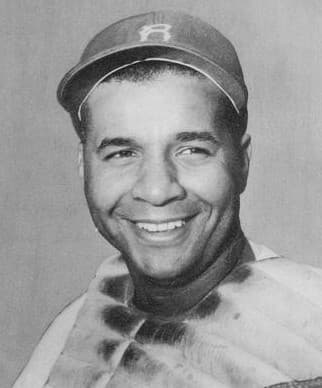
Roy Campanella portrait (1956).
Photo credit: Unknown photographer via Wikimedia Commons (Public domain)
Roy Campanella won three National League MVP awards in a major league career that lasted only ten seasons, and the career ended not because his skills had faded but because an automobile accident left him paralyzed from the shoulders down at 36. He was the best catcher in the National League during the 1950s, a leader behind the plate and in the clubhouse for Brooklyn Dodgers teams that won five pennants and one World Series, and he spent the last 35 years of his life in a wheelchair without ever losing the warmth and optimism that had defined him as a player. The BBWAA elected him to the Hall of Fame in 1969.
Philadelphia
Roy Campanella was born on November 19, 1921, in Philadelphia, Pennsylvania, and grew up in the Nicetown neighborhood on the city's north side. His father was Italian American and his mother was black, and Campanella grew up navigating the racial boundaries of a segregated country from both sides. He began playing semipro baseball at 15 and joined the Washington Elite Giants of the Negro National League in 1937, when he was still a teenager.
Campanella spent nearly a decade in the Negro Leagues, developing into one of the best catchers in black baseball. He played winter ball in Latin America and earned a reputation as a durable, intelligent receiver with right-handed power. Branch Rickey signed him to the Dodgers organization in March 1946, five months after signing Jackie Robinson, and Campanella reached the major leagues in April 1948.
Brooklyn
Campanella became the Dodgers' starting catcher in 1949 and immediately established himself as the anchor of the team. He won his first MVP award in 1951, batting .325 with 33 home runs and 108 RBI. He won his second in 1953, hitting .312 with 41 home runs and 142 RBI, and his third in 1955, batting .318 with 32 home runs and 107 RBI. The 1955 season culminated in the Dodgers' first World Series championship, a seven-game victory over the Yankees that ended decades of frustration for the Brooklyn franchise.
His value extended well beyond his offensive numbers. Campanella was widely regarded as one of the best defensive catchers of his era, handling pitching staffs with a command that made everyone around him better. He called games with an instinctive feel for hitters' weaknesses and threw well enough to discourage baserunners from testing him. His rapport with the Dodgers' pitchers was a foundation of the team's success throughout the early 1950s.
Campanella played on five pennant-winning teams in Brooklyn, in 1949, 1952, 1953, 1955, and 1956. His career totals across ten seasons included a .276 batting average, 242 home runs, and 856 RBI, numbers that would have been considerably larger if the Negro Leagues had not claimed the first decade of his professional career.
The Accident
On January 28, 1958, Campanella was driving home from his liquor store in Harlem when his car hit a patch of ice on a curve in Glen Cove, Long Island. The car skidded and overturned, and the accident fractured the fifth and sixth cervical vertebrae in his neck, leaving him a quadriplegic. He was 36 years old. The Dodgers had announced their move to Los Angeles three months earlier, and Campanella never played a game on the West Coast.
The Dodgers held a tribute game for Campanella at the Los Angeles Memorial Coliseum on May 7, 1959, and 93,103 people attended, the largest crowd in baseball history at that time. The stadium lights were turned off and the crowd lit matches and candles in the darkness, a scene that became one of the most iconic images in the history of the sport.
After Baseball
Campanella spent the rest of his life in a wheelchair but remained connected to baseball. He worked as a coach and instructor for the Dodgers and became an ambassador for the game, speaking publicly about his experiences with a spirit that moved everyone who encountered him. He died on June 26, 1993, in Woodland Hills, California, at 71.