Profile
Pop Lloyd
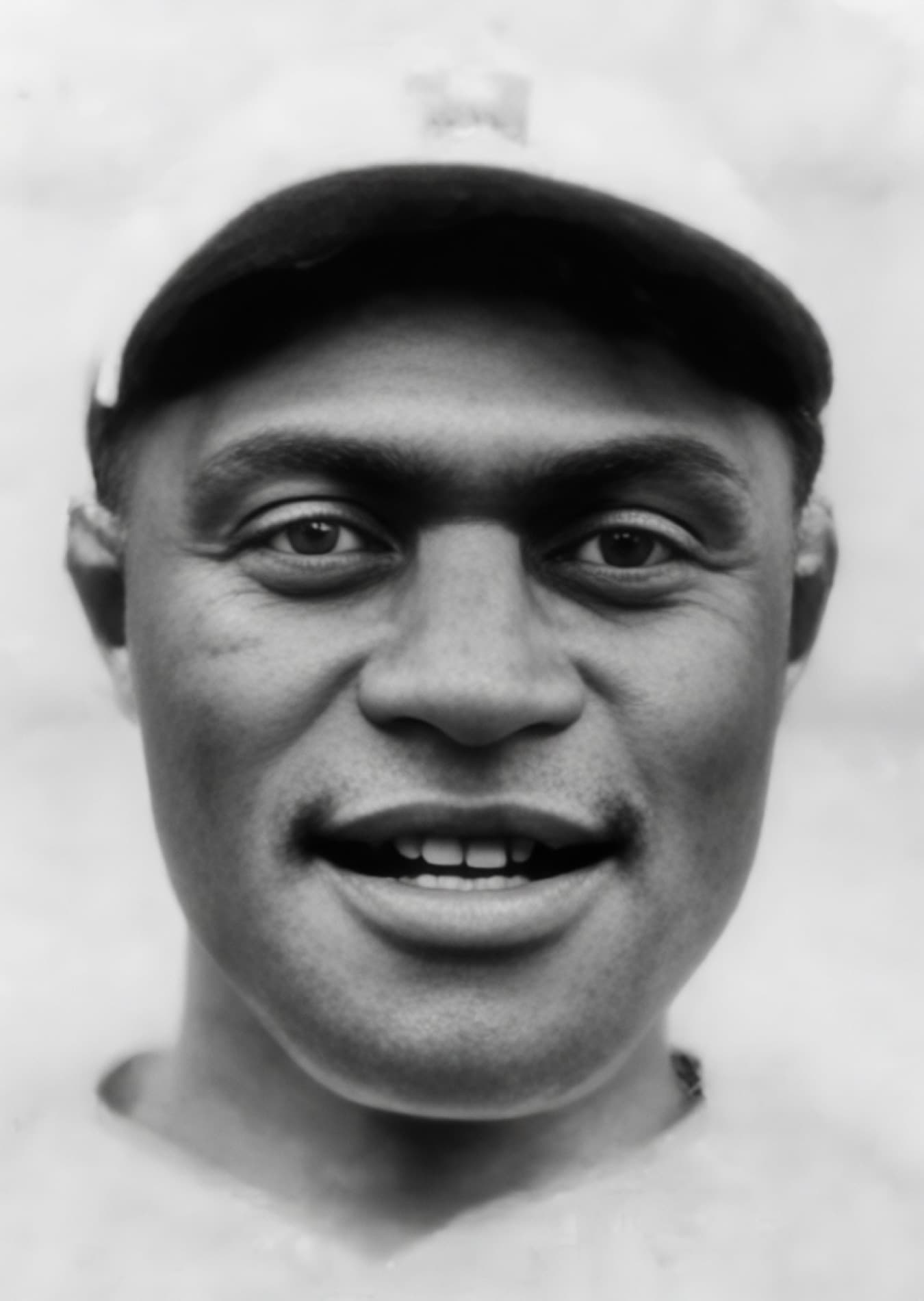
Pop Lloyd portrait.
Photo credit: User-provided image via User-provided image
John Henry Lloyd played shortstop in the Negro Leagues for 27 years and batted over .300 in nearly all of them. People called him "the Black Wagner" because he fielded like Honus Wagner, scooping grounders out of the dirt with hands so large they looked like telephone books, and because he hit like Wagner, placing the ball wherever the defense was not. Wagner heard the comparison and embraced it. "I am honored to have John Lloyd called the Black Wagner," Wagner said. "It is a privilege to have been compared to him." Connie Mack put it more directly. The two best shortstops he ever saw were Wagner and Lloyd, Mack said, and if you put them in a bag and shook it, either one you pulled out would be the right choice. The Special Committee on the Negro Leagues elected Lloyd to the Hall of Fame in 1977.
Palatka
Lloyd was born on April 25, 1884, in Palatka, Florida. His father John died during Lloyd's infancy, and his mother Mary Jane remarried. His maternal grandmother Maria Jenkins brought him up in Jacksonville's Hansontown neighborhood. Lloyd dropped out of elementary school to work and began playing semipro baseball in his late teens. In 1905 he caught for the Acmes of Macon, Georgia, but foul balls kept hitting him in the face, and he moved to the infield. Sol White, who managed the Philadelphia Giants, signed Lloyd in 1907, trained him at shortstop, and by 1909 Lloyd was hitting .439.
Lloyd played for more teams than most men could keep track of, moving wherever the money was best. "Wherever the money was, that's where I was," he said. Between 1906 and 1932 he played for the Cuban X-Giants, the Philadelphia Giants, the Chicago Leland Giants, the New York Lincoln Giants, the Chicago American Giants under Rube Foster, the Brooklyn Royal Giants, the Bacharach Giants, the Columbus Buckeyes, the Hilldale Daisies, and several others. He managed as often as he played and compiled a record of 253-236.
The Shortstop
Lloyd was a scientific hitter who batted left-handed and held the bat on his arm, directing line drives to the gaps with placement rather than power. Ted Page said he "never saw Lloyd hit skyrockets," only line drives. George Scales said, "You could hardly see his feet move" when Lloyd glided across the infield. Cum Posey described him as "the Jekyll and Hyde of baseball, a fierce competitor on the field and as a manager against the opposition, but a gentle considerate man off the field."
Lloyd batted .343 for his career in organized Negro League play, though the figure varies by compiler because record-keeping was inconsistent and incomplete. He hit .371 for the Chicago Leland Giants in 1910, .379 for the Lincoln Giants in 1913, .357 with 11 consecutive hits over five days for the Bacharach Giants in 1924, and .434 for the Lincoln Giants in 1930, when he was 46 years old. In 12 Cuban winter league seasons he batted .329 and won championships with Habana and Almendares.
Lloyd played against major leaguers in barnstorming exhibitions throughout his career. During the Cuban winter season of 1910, Lloyd batted .500 against a touring Detroit Tigers squad that included Ty Cobb and Sam Crawford. In 1912 his Lincoln Giants beat two separate squads of major leaguers by identical 6-0 scores, one led by Larry Doyle and the other by Hal Chase. In 1930, at 46, Lloyd helped open Yankee Stadium to Negro League baseball in a July 5 doubleheader.
Bill Yancey, who played under Lloyd, said he "was the greatest player, the greatest manager, the greatest teacher. He had the ability and knowledge and, above all, patience." Babe Ruth, asked once to name the greatest player regardless of league, reportedly chose John Henry Lloyd. Bill James ranked him the 27th greatest player of all time.
Atlantic City
Lloyd's first wife Lizzie died in September 1931 in Atlantic City, and Lloyd refused all further offers to manage Negro League teams. He took a job as a janitor for the Atlantic City school system and became something else entirely, a father figure to the children of a city that needed one. The kids called him Pop, and the name stuck. Whitey Gruhler of the Atlantic City Press described the scene between class sessions. "The youngsters cluster about him," Gruhler wrote. "They call him 'Pop' and love to listen while he spins baseball yarns of the past. Pop has to pick them up bodily and carry them into their classrooms."
In October 1949, Atlantic City renamed its municipal baseball park Pop Lloyd Field. Lloyd spoke at the dedication. "I gave my best when I was playing ball," he said. "I hope the young men, not only of Atlantic City but of the entire nation, will benefit from what I have tried to give the youth of America."
When a reporter asked Lloyd in 1949 whether he wished he had been born later, in time to play in the integrated major leagues, Lloyd declined the premise. "I do not consider that I was born at the wrong time," he said. "I felt it was the right time, for I had a chance to prove the ability of our race in this sport. We have given the Negro a greater opportunity now."
Lloyd died on March 19, 1964, in Atlantic City, at 79. His wife Nan, whom he married in 1942, spent years advocating for his induction into the Hall of Fame but died roughly two years before the 1977 ceremony. His gravestone in Atlantic City reads that he "served to uphold the dignity of the game and to advance opportunities of African Americans in the Major Leagues."