Profile
Ty Cobb
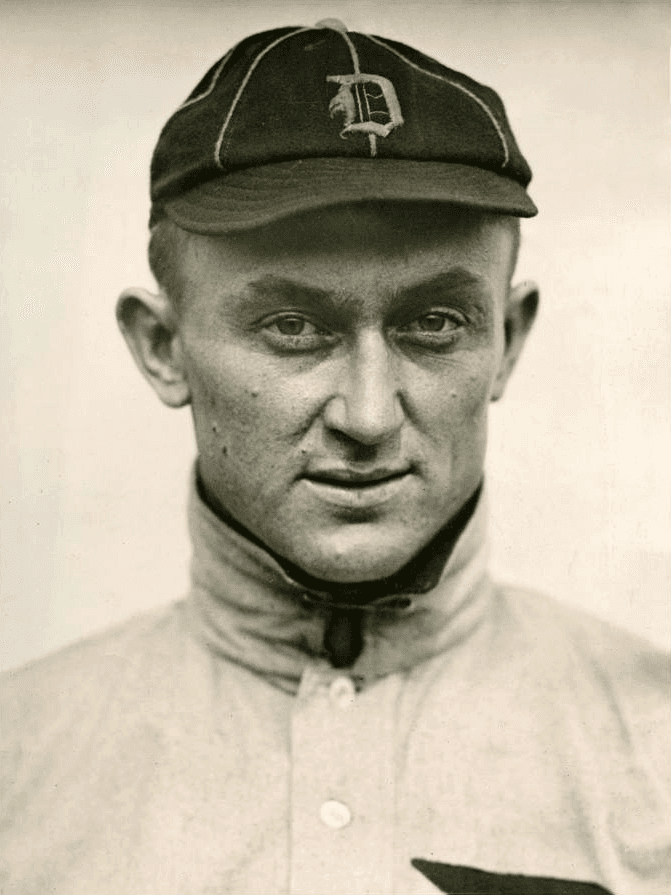
Ty Cobb portrait, 1913.
Photo credit: International Film Service via Wikimedia Commons (Public domain)
Tyrus Raymond Cobb batted .366 across 24 seasons, won 12 batting titles (nine of them consecutive), stole 897 bases, collected 4,189 hits, and played the game with a fury that made him the most feared and most disliked player of his generation. His father, a school teacher, state senator, and the most important person in Cobb's life, was shot and killed by Cobb's mother 22 days before Cobb made his major league debut. Cobb turned the grief into fuel. "I did it for my father," Cobb said. "He never got to see me play, but I knew he was watching me, and I never let him down." Casey Stengel called him "the most sensational player of all the players I have seen in all my life." George Sisler said, "The greatness of Ty Cobb was something that had to be seen, and to see him was to remember him forever." Cobb was the leading vote-getter in the first Hall of Fame class in 1936, outpolling Babe Ruth, Honus Wagner, Christy Mathewson, and Walter Johnson.
The Narrows
Cobb was born on December 18, 1886, in The Narrows, Georgia, a rural community in Banks County. His father William Herschel Cobb was a school teacher, newspaper editor, and state senator. "My father was the greatest man I ever knew," Cobb said. "He was a scholar, state senator, editor, and philosopher. I worshiped him." When Cobb left for professional baseball in 1904, his father told him, "Don't come home a failure."
On August 8, 1905, Cobb's mother Amanda shot and killed William with a pistol he purchased for her. She said she mistook him for a burglar. William suspected her of infidelity and was climbing past a bedroom window. Amanda was arrested, indicted for murder, and acquitted at trial in March 1906. Cobb made his debut with the Detroit Tigers on August 30, 1905, 22 days after his father's death, and doubled off Jack Chesbro in his first at bat.
Detroit
Cobb endured vicious hazing from his own teammates as a rookie. Players sawed his bats, ruined his hats, and isolated him in the clubhouse. "These old-timers turned me into a snarling wildcat," Cobb said. He responded by turning inward and turning hostile, and he channeled it into the most aggressive playing style baseball produced.
Cobb won his first batting title in 1907 at 20 and won eight more in a row, through 1915. He won the Triple Crown in 1909 with a .377 average, 107 RBI, and nine home runs, all of them inside the park. In 1911 Cobb batted .420, the highest average of the twentieth century at the time, and won the Chalmers Award (the precursor to the MVP). He hit above .300 in 23 consecutive seasons and above .400 three times.
Cobb held the bat with his hands separated, brought them together during the swing, and placed the ball where he wanted it. Sam Crawford, his teammate for 13 years, said, "He didn't outhit the opposition and he didn't outrun them. He outthought them!" Cobb ran the bases with a recklessness designed to plant fear. He kicked bases toward the next bag to gain inches before stealing. He stole second, third, and home in succession four times in his career, and he stole home 54 times total. "My system was all offense," Cobb said. "I believed in putting up a mental hazard for the other fellow."
Cobb managed the Tigers from 1921 through 1926, compiling a 479-444 record but never winning a pennant. He played his final two seasons with Connie Mack's Philadelphia Athletics in 1927 and 1928. On July 18, 1927, Cobb became the first member of the 4,000 hit club.
Royston
Cobb invested in Coca-Cola stock beginning in 1907 and in General Motors, and by his death he held an estate worth at least $11.78 million. Cobb donated $100,000 to build a hospital in his parents' names in Royston, Georgia, and established the Cobb Educational Fund with another $100,000 in 1953 to provide scholarships to college-bound students in Georgia. The fund has distributed more than $16 million in scholarships since its founding.
Cobb's reputation for violence and racism, cultivated during his playing career and amplified by posthumous accounts from writer Al Stump, underwent significant reassessment in the twenty-first century. Stump collaborated with Cobb on an autobiography and then published additional accounts after Cobb's death depicting him in the most unflattering terms. Researchers later discovered that Stump forged documents, stole personal items, and fabricated stories. Charles Leerhsen's 2015 biography debunked many of the most notorious claims while acknowledging Cobb was combative, difficult, and shaped by a violent era. In 1952 Cobb told the Associated Press, "Certainly it is O.K. for them to play. I see no reason in the world why we shouldn't compete with colored athletes as long as they conduct themselves with politeness and gentility." He praised Roy Campanella as "among the best catchers of all time" and called Willie Mays "the only player I'd pay money to see."
Cobb died of prostate cancer on July 17, 1961, at Emory University Hospital in Atlanta, at 74. Roughly 150 friends and family attended the funeral in Cornelia, Georgia. Cobb was buried at Rose Hill Cemetery in Royston, beside his parents and sister.