Profile
Rube Foster
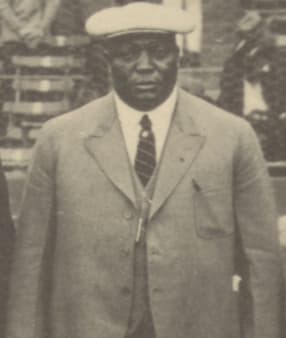
Rube Foster portrait (1924).
Photo credit: Unknown author via Wikimedia Commons (Public domain)
Andrew "Rube" Foster pitched, managed, owned, and organized, and when he was finished, black baseball had a structure that would endure for three decades and produce the players who eventually integrated the major leagues. He founded the Negro National League in 1920, ran it as president while simultaneously owning and managing the Chicago American Giants, and earned the title "Father of Black Baseball" from the people who understood what he had built. The Hall of Fame inducted him in 1981.
Texas
Andrew Foster was born on September 17, 1879, in Calvert, Texas, a small railroad town between Waco and Bryan. His father, Andrew Sr., was a presiding elder in the African Methodist Episcopal Church, and the family was prominent in Calvert's black community. Foster left school after the eighth grade and began pitching for traveling black baseball teams in his late teens, heading first to Fort Worth and then east.
The Pitcher
The nickname came from a game against Rube Waddell, the Philadelphia Athletics' ace and the best left-handed pitcher in the American League. Playing for the Cuban X-Giants in 1903, Foster outpitched Waddell, and the writers and players who saw it started calling him "Rube" as a mark of what he had done. The name followed him for the rest of his life.
Foster pitched for the Cuban X-Giants and then the Philadelphia Giants in the early 1900s, and he was dominant enough that white semipro teams sought him out for exhibition games. He was a large, physically commanding man who threw hard and thought constantly about the mechanics of pitching and the strategy of the game. He studied opposing hitters, took detailed notes, and believed that baseball was a mental exercise as much as a physical one.
Chicago
In 1911, Foster partnered with John Schorling, a white tavern and ballpark owner, to form the Chicago American Giants. They played at Schorling's Park, a converted version of the old White Sox grounds on the South Side, and Foster built the American Giants into the best black baseball team in the country.
His teams played a style that reflected his intelligence and his conviction that speed and strategy could beat raw power. He pioneered the hit-and-run, the bunt-and-run, and defensive shifts long before they became common in white baseball. His teams bunted relentlessly, ran the bases with purpose, and executed plays that opponents knew were coming but could not stop. He managed from the bench with a pipe in his hand, signaling plays with its movement, and his players understood that every inning had a plan behind it.
The League
Foster had spent years watching black baseball struggle with the same problems: no regular schedules, no enforceable contracts, and no protection against white booking agents who took a percentage of every gate. He decided the solution was a formal league, and on February 13, 1920, he gathered the owners of eight midwestern teams at the Paseo YMCA in Kansas City, Missouri, and convinced them to form the Negro National League.
The eight charter members were the Chicago American Giants, the Chicago Giants, the Cuban Stars, the Dayton Marcos, the Detroit Stars, the Indianapolis ABCs, the Kansas City Monarchs, and the St. Louis Giants. Foster served as president and ran the league with an authority that kept weaker franchises alive through their early years, sometimes subsidizing them with his own money. The motto he chose was "We Are the Ship, All Else the Sea."
The Eastern Colored League was founded in 1923 as a rival, and the two leagues agreed to a Negro League World Series beginning in 1924. The structure Foster had built, two leagues with a championship series, mirrored the white major leagues deliberately. He wanted black baseball treated as a legitimate professional enterprise, and for the years he ran it, it was.
Kankakee
In late May 1925, while staying at a boarding house in Indianapolis, Foster was exposed to a gas leak. The incident triggered a mental breakdown that worsened over the following months. He was committed to the Kankakee State Hospital in Illinois and never recovered. He died there on December 9, 1930, at 51. Three thousand people stood in the snow and rain at his funeral, and his coffin was closed, one account reported, "at the usual hour a ballgame ends."
The Negro National League, weakened by the Depression and by the loss of the man who had held it together, collapsed after the 1931 season. A new Negro National League was organized in 1933, and black professional baseball continued until integration made it obsolete. The Hall of Fame inducted Foster in 1981. Every player who walked from the Negro Leagues into the major leagues walked through an institution that Foster had imagined, financed, and built.