Profile
Cool Papa Bell
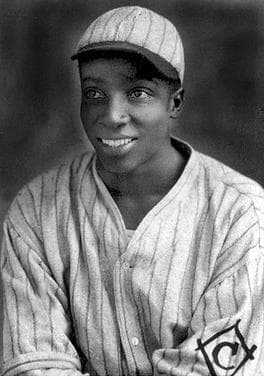
Cool Papa Bell portrait.
Photo credit: Negro Leagues Baseball Museum via Wikipedia (Fair use)
James Thomas Bell played in the Negro Leagues from 1922 to 1946 and was, by the testimony of everyone who saw him, the fastest man who ever played baseball. He hit .325 over more than two decades as a switch-hitting center fielder, won a Triple Crown in the Mexican League at 37, and gave up a batting title at 43 so that a younger player might catch the attention of major league scouts. The Hall of Fame inducted him in 1974.
Mississippi
Bell was born James Thomas Nichols on May 17, 1903, near Starkville, Mississippi. His father Samuel died a month after marrying his mother Mary, and when she later married Jonas Bell, James took his stepfather's surname. He grew up on his grandfather's farm raising cotton and corn, started playing baseball at ten, and at 17 moved to St. Louis to live with his brothers, where he worked at a packing house and played sandlot baseball on the side.
In 1922, after striking out Oscar Charleston in a game that caught the attention of the St. Louis Stars, he signed with the team for $90 a month. He had been a knuckleball pitcher, but his composure on the mound that day earned him a new identity. Manager Big Bill Gatewood watched him face down the best hitter in the Negro Leagues without flinching and called him "Cool," then added "Papa" because it sounded better. The name stuck for the rest of his life.
The Stars and the Crawfords
Bell pitched for the Stars through 1924, when his manager converted him to center field and taught him to bat left-handed so he could start a step closer to first base. The conversion unleashed the speed that defined his career. He hit above .300 in every full season with the Stars and helped them win Negro National League championships in 1928, 1930, and 1931.
When the NNL disbanded after the 1931 season, Bell spent a year with the Detroit Wolves and the Kansas City Monarchs before joining the Pittsburgh Crawfords in 1933, where owner Gus Greenlee assembled five future Hall of Famers on one roster. Bell, Josh Gibson, Charleston, Satchel Paige, and Judy Johnson played together through the mid-1930s, and Bell called the Crawfords "the best team in the history of black baseball." In 1937, Bell, Gibson, and Paige jumped to the Dominican Republic to play for dictator Rafael Trujillo's team, where armed soldiers watched their games and the players understood that losing carried consequences beyond the standings.
Mexico
Bell played four seasons in the Mexican League from 1938 through 1941, and in 1940, at the age of 37, he won the league's first Triple Crown with a .437 batting average, 12 home runs, and 79 RBI for Veracruz. He remembered Mexico for more than the numbers. "Everybody was the same down there," he said. "We could go in any restaurant, stay in hotels." The contrast with Jim Crow did not need explaining.
The Speed
Satchel Paige said Bell was so fast he could turn off the light switch and be in bed before the room got dark. Bell revealed the truth at a reunion in 1981. He and Paige had roomed together in California, and Bell noticed a three-second delay in the wiring between the switch and the light going out. He bet Paige he could flip the switch and be under the covers before darkness fell, won the bet, and Paige told the story for the next forty years.
The real speed needed no embellishment. In a 1931 exhibition game against a team of white major leaguers that included Charlie Gehringer and Paul Waner, Bell bunted for a hit and then stole second, third, and home against pitcher Bill Walker. Gehringer said he had watched Ty Cobb many times as a young man and had never seen him do anything like what Bell did that night. In a 1948 barnstorming game, at roughly 45 years old, Bell scored from first base on a bunt against a team that included Bob Lemon and Jackie Robinson.
Later Years
Bell returned to the Negro Leagues in 1942 with the Chicago American Giants and joined the Homestead Grays the following year, helping them win championships in 1943 and 1944. In 1946, his final season, he was leading the Negro National League with a .393 batting average when he removed himself from the lineup so that Monte Irvin could win the batting title instead. Bell was 43 and knew his major league window had closed. Irvin was young enough to attract a contract, and Bell believed the batting title would help him get noticed. "I was too old," he said, "but Monte was young and had a chance for a future."
After baseball, Bell worked at St. Louis City Hall for more than two decades, first as a custodian and then as a night watchman. He married Clara in 1928, and they were together for 62 years. The Hall of Fame inducted him in 1974, and he made the trip to Cooperstown every summer until his health failed. Clara died on January 20, 1991, and Bell suffered a heart attack five weeks later. He died on March 7, 1991, in St. Louis, at 87. His will specified twelve pallbearers, six black and six white.