Profile
Satchel Paige
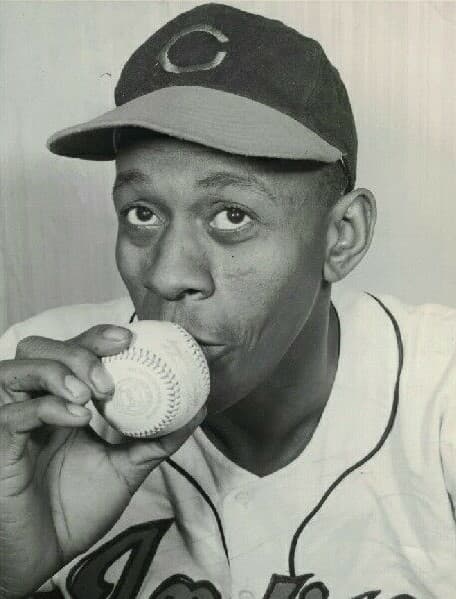
Satchel Paige portrait, 1948.
Photo credit: Acme Newspictures via Wikimedia Commons (Public domain)
Leroy Robert Paige pitched for 40 years, on at least 250 teams by his own count, and nobody who saw him throw ever forgot it. Paige dominated the Negro Leagues with a fastball he called "Long Tom," a hesitation pitch the American League president banned, and a showmanship so theatrical that he would call in his outfielders, have them sit behind the infield, and strike out the side. Dizzy Dean called him "the pitcher with the greatest stuff I ever saw." Joe DiMaggio called him the best pitcher he ever faced. Bill Veeck signed Paige to the Cleveland Indians in 1948 at age 42 as the oldest rookie in major league history, and Paige helped Cleveland win the pennant. In 1965, at 59, he threw three scoreless innings for the Kansas City Athletics, sat in a rocking chair that was moved from the bullpen to the dugout between innings, and set the record as the oldest pitcher in major league history. "Don't look back," Paige said. "Something might be gaining on you." The Hall of Fame inducted him in 1971.
Mobile
Paige was born on July 7, 1906, in Mobile, Alabama, though the year was disputed throughout his life and Paige enjoyed the confusion. "How old would you be if you didn't know how old you are?" he asked. His father John was a gardener and his mother Lula a washerwoman, and Paige was one of 12 children. Paige earned his nickname as a boy by rigging a pole and rope to carry multiple suitcases at the Louisville and Nashville railroad station, and a coworker told him he looked like "a walking satchel tree."
Paige was sentenced to the Alabama Reform School for Juvenile Negro Law-Breakers at 12 for stealing suitcases and truancy. He spent five years at Mount Meigs, where he learned to pitch and developed the high leg kick that became his signature delivery. "You might say I traded five years of freedom to learn how to pitch," Paige said.
The Negro Leagues
Paige pitched for the Chattanooga Black Lookouts, the Birmingham Black Barons, the Pittsburgh Crawfords, the Kansas City Monarchs, and a dozen other teams across 20 years, moving wherever the money was best. With the Crawfords in the early 1930s, Paige pitched alongside catcher Josh Gibson, forming the most celebrated battery in Negro League history. Paige taunted Gibson whenever they faced each other on opposing teams, promising to strike him out and then doing it. After one such encounter, Gibson reportedly hit a home run and yelled at Paige, "If you could cook, I'd marry you."
Paige went roughly 13-3 with more than 140 strikeouts for the Crawfords in 1934. In a 1935 semipro tournament in Wichita, Paige won all four of his starts and struck out 60 batters, a record that stood for decades. In 1937 the dictator Rafael Trujillo paid Paige $30,000 to recruit Negro League stars, including Gibson and Cool Papa Bell, for a Dominican Republic team. Paige played in Mexico in 1938 and destroyed his right shoulder. The injury seemed career-ending. Paige threw junk for a season while his arm healed, and then the fastball came back.
In the Puerto Rican winter league of 1939-40, Paige went 19-3 with a 1.93 ERA and 208 strikeouts in 205 innings, both records that have never been broken. With the Kansas City Monarchs in the 1940s, Paige earned roughly $40,000 a year, nearly matching DiMaggio. Owner J.L. Wilkinson purchased a Douglas DC-3 airplane to ferry Paige between barnstorming appearances.
Paige and Jackie Robinson were teammates on the 1945 Monarchs. Both Paige and Gibson believed they deserved to be the first player to cross the color line. Branch Rickey chose Robinson. Gibson died in January 1947, three months before Robinson's debut. Paige signed with Cleveland 18 months later.
Cleveland
Veeck signed Paige on July 7, 1948, his 42nd birthday by the birth certificate. Paige went 6-1 with a 2.48 ERA, the second best in the American League, and drew record crowds wherever he pitched. On August 20, before 78,382 fans at Cleveland Municipal Stadium, Paige shut out the White Sox on three hits. Paige was the first black pitcher to pitch in a World Series, entering Game 5 against the Boston Braves. Cleveland won the championship in six games. Asked about the Rookie of the Year voting, in which he finished fourth, Paige said, "I wasn't sure what year the gentlemen had in mind."
Paige pitched for the St. Louis Browns from 1951 through 1953, going 12-10 with a 3.07 ERA in 1952 for a team that lost 90 games. Casey Stengel named Paige to the All-Star team in both 1952 and 1953, making him the first black pitcher selected for the American League squad.
Cooperstown
Commissioner Bowie Kuhn announced in February 1971 that Paige would be the first member of a separate "Negro wing" of the Hall of Fame. The backlash was immediate. Jim Murray wrote, "The notion of Jim Crow in Baseball's Heaven is appalling." Robinson said, "It's not worth a hill of beans. If it were me under those conditions, I'd prefer not to be in it." Paige said, "I was just as good as the white boys. I ain't going in the back door to the Hall of Fame." The Hall reversed the decision within months, and Paige's plaque was hung in the main gallery alongside every other inductee. "I am the proudest man on the earth today," Paige said at his induction on August 9, 1971.
Paige's last professional appearance came on June 21, 1966, for the Peninsula Grays of the Carolina League, two weeks before his 60th birthday. The regular catcher was Johnny Bench, though a backup caught Paige's final game. Paige started, pitched two innings, and allowed two runs on five hits.
On June 5, 1982, Paige attended the dedication of a stadium in Kansas City named in his honor. "I hope the next time you come out, I can stand up," he told the crowd. Three days later, on June 8, 1982, Paige suffered a heart attack at his home in Kansas City and was pronounced dead at Truman Medical Center at 75 during a power failure caused by a rainstorm. His wife Lahoma, a trained nurse's aide, attempted CPR. Paramedics were delayed by a fallen tree blocking the road. Paige was buried at Forest Hill Memorial Park Cemetery in Kansas City. His gravestone carries the most famous advice anyone in baseball ever offered. "Don't look back. Something might be gaining on you."