Profile
Josh Gibson
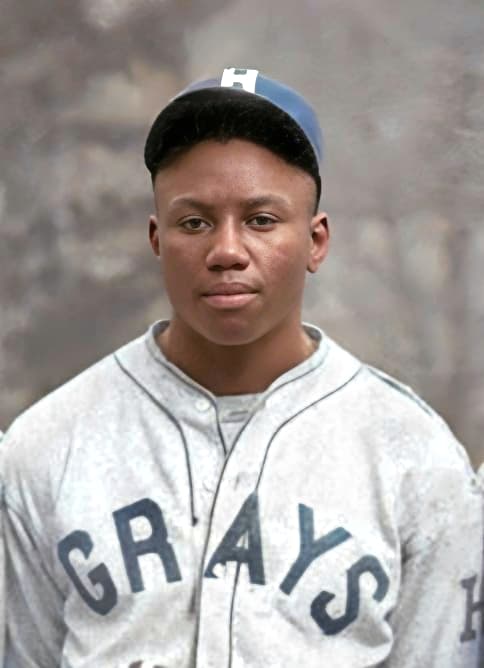
Josh Gibson portrait, circa 1931.
Photo credit: Harrison Studio via Wikimedia Commons (Public domain)
Joshua Gibson hit a baseball harder than anyone Buck O'Neil ever saw except Babe Ruth. O'Neil said the sound of Gibson's bat was like dynamite, and that he heard that sound only three times in his life, from Ruth, from Gibson, and 50 years later from Bo Jackson. Walter Johnson said, "There is a catcher that any big league club would like to buy for $200,000. His name is Gibson. He can do everything. He hits the ball a mile. He catches so easy he might as well be in a rocking chair. Throws like a rifle. Too bad this Gibson is a colored fellow." Roy Campanella called Gibson "not only the greatest catcher but the greatest ballplayer I ever saw." Gibson caught for the Homestead Grays and Pittsburgh Crawfords across 17 Negro League seasons, hit with a power that generated estimates of nearly 800 home runs across all competition, and died at 35, three months before Jackie Robinson played his first game for the Brooklyn Dodgers. The Hall of Fame inducted Gibson in 1972.
Buena Vista
Gibson was born on December 21, 1911, in Buena Vista, Georgia. His father Mark was a sharecropper who moved the family to Pittsburgh in 1923 and found work at the Carnegie-Illinois Steel Company. Gibson attended Allegheny Pre-Vocational School, studied electrical work, and dropped out by 15 to work at an airbrake manufacturing plant. Gibson caught and then played third base for the Gimbels department store team before signing with the semipro Pittsburgh Crawford Colored Giants at 16.
Gibson married Helen Mason on March 7, 1929, at Macedonia Baptist Church in Pittsburgh. Helen died on August 11, 1930, from a kidney rupture during premature labor delivering twins, a son named Josh Jr. and a daughter named Helen. Gibson was 18. The twins were raised by Helen's parents, and Gibson never fully recovered from the loss.
The Crawfords and the Grays
Gibson joined the Homestead Grays in July 1930, reportedly called out of the stands during a game when the regular catcher injured his hand. Gus Greenlee lured Gibson to the Pittsburgh Crawfords in 1932 to catch for Satchel Paige, the first time the two were paired. Teammates on the Crawfords included Paige, Cool Papa Bell, Oscar Charleston, and Judy Johnson, a concentration of talent that many historians consider the greatest on a single team in baseball history.
Gibson won two consecutive Triple Crowns in 1936 and 1937, the only player to accomplish consecutive Triple Crowns. In 1937 Gibson batted .417 with 20 home runs in 39 games and slugged .974. Gibson played in 12 East-West All-Star Games and won nine home run titles. The Grays sold Gibson back from the Crawfords in 1937, and Gibson anchored the catching position alongside first baseman Buck Leonard for the next decade. Together they were called "the Ruth and Gehrig of the Negro Leagues." The Grays won nine consecutive Negro National League pennants during Gibson's tenure and two Negro World Series titles in 1943 and 1944.
Gibson also played winter ball in Cuba, Puerto Rico, Mexico, and the Dominican Republic. In the Mexican League in 1941 Gibson batted .374 with 33 home runs and 124 RBI in 94 games. In Puerto Rico he hit .480, a league record, and served as the first manager of the Santurce Crabbers.
The Power
Gibson's home run distances became legend, and the legends grew with each telling. Multiple witnesses described a blast at Yankee Stadium in the 1930s that reportedly left the stadium entirely, though no published account or film evidence confirms it. Gibson himself dismissed the claim, saying he only reached the center field bullpen. Clark Griffith said Gibson "hit more home runs into Griffith Stadium's distant left field bleachers than the entire American League." Ted Page remembered that "next to hitting, I think he liked eating ice cream more than anything else in the world."
Gibson's documented Negro League statistics show a .373 career batting average, 166 home runs, and a 1.176 OPS across roughly 600 games. His Hall of Fame plaque credits him with "almost 800 homers" across all levels of competition, including barnstorming, exhibitions, and league play.
January
Gibson suffered a seizure on January 1, 1943, and was hospitalized for 10 days. Doctors diagnosed a brain tumor and recommended surgery. Gibson refused. He grew increasingly reliant on alcohol, suffered persistent headaches, and gained weight. Gibson was hospitalized again in Washington in 1944 for mental observation. His production declined but remained elite by any standard. Gibson batted .466 in 1943, the highest single-season average in Negro League history.
Gibson collapsed at his home in Pittsburgh on January 20, 1947, at roughly 1:20 a.m. He briefly regained consciousness and then died. The cause was a stroke, likely related to the brain tumor diagnosed four years earlier. Gibson was 35. Jackie Robinson debuted for the Dodgers on April 15, three months later. Larry Doby said, "One of the things that was disappointing and disheartening to a lot of the black players at the time was that Jack was not the best player. The best was Josh Gibson. I think that's one of the reasons why Josh died so early, he was heartbroken." Gibson's son Josh Jr. disagreed. "When I hear that stuff about how my father died of a broken heart, that pisses me off. That wasn't my father. He was the last guy to brood about something he couldn't do nothing about."
People lined up for more than half a mile to pay respects at the funeral, held at Macedonia Baptist Church, the same church where Gibson married Helen 18 years earlier. Gibson was buried at Allegheny Cemetery in Pittsburgh. His grave went unmarked until a small plaque was placed in 1975.
In 2020, MLB officially recognized the Negro Leagues from 1920 through 1948 as major leagues. In May 2024, Baseball Reference completed the integration of Negro League statistics into the official record. Gibson's .373 career average displaced Ty Cobb's .366 as the highest in major league history. His 1937 slugging percentage of .974 and his 1943 batting average of .466 became official single-season records. The recognition confirmed what every player who faced Gibson already knew.